Paljärvi Tapio, Martikainen Pekka, Pensola Tiina, Leinonen Taina, Herttua Kimmo, Mäkelä Pia
Alcohol and Drugs Unit, National Institute for Health and Welfare, Helsinki, Finland.
Population Research Unit, University of Helsinki, Helsinki, Finland; Max Planck Institute for Demographic Research, Rostock, Germany.
PLoS One. 2015 May 4;10(5):e0126215. doi: 10.1371/journal.pone.0126215. eCollection 2015.
Long-term employment trajectories of young problem drinkers are poorly understood.
We constructed retrospective labour market participation histories at ages 18-34 of 64 342 persons born in 1969-1982. Beginning from the year of each subject's 18th birthday, we extracted information from the records of Statistics Finland on educational attainment, main type of economic activity, months in employment, and months in unemployment for a minimum of seven years (range 7-16 years). We used information on the timing of alcohol-related hospitalizations and deaths in the same period to define problem drinkers with early onset limited course, early onset persistent course, and late onset problem drinking.
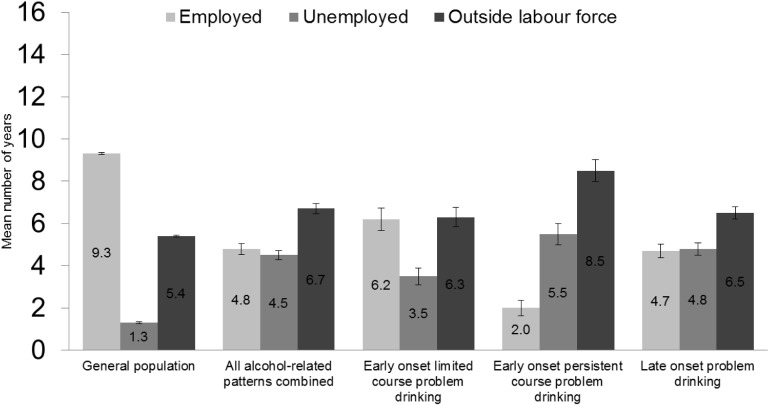
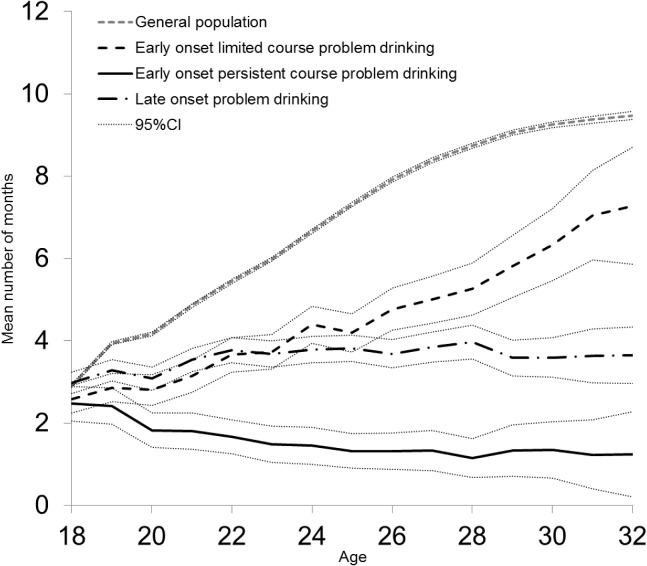
Early onset limited course problem drinkers improved their employment considerably by age, whereas early onset persistent problem drinkers experienced a constant decline in their employment by age. From the age of 18 to 34, early onset persistent problem drinkers were in employment merely 12% of the time, in comparison with 39% among the early onset limited course problem drinkers, and 58% among the general population.
These results indicate that young adults who were retrospectively defined as having early onset persistent course problem drinking were extensively marginalized from the labour market early on during their life course, and that their employment trajectory was significantly worse compared to other problem drinkers.
年轻的问题饮酒者的长期就业轨迹鲜为人知。
我们构建了64342名出生于1969年至1982年的人在18至34岁时的回顾性劳动力市场参与历史。从每个受试者18岁生日那年开始,我们从芬兰统计局的记录中提取了关于教育程度、主要经济活动类型、就业月数和失业月数的信息,时间跨度至少为七年(7至16年)。我们利用同期与酒精相关的住院和死亡时间信息,定义了早发型有限病程、早发型持续病程和晚发型问题饮酒的问题饮酒者。
早发型有限病程的问题饮酒者随着年龄增长就业情况有显著改善,而早发型持续病程的问题饮酒者随着年龄增长就业情况持续下降。从18岁到34岁,早发型持续病程的问题饮酒者就业时间仅占12%,相比之下,早发型有限病程的问题饮酒者为39%,普通人群为58%。
这些结果表明,那些回顾性定义为早发型持续病程问题饮酒的年轻人在其生命历程早期就被劳动力市场广泛边缘化,而且他们的就业轨迹与其他问题饮酒者相比明显更差。