Chaumeil Myriam M, Larson Peder E Z, Woods Sarah M, Cai Larry, Eriksson Pia, Robinson Aaron E, Lupo Janine M, Vigneron Daniel B, Nelson Sarah J, Pieper Russell O, Phillips Joanna J, Ronen Sabrina M
Departments of Radiology and Biomedical Imaging.
Pathology, and Neurological Surgery, Helen Diller Research Center; and Brain Tumor Research Center, University of California San Francisco, San Francisco, California.
Cancer Res. 2014 Aug 15;74(16):4247-57. doi: 10.1158/0008-5472.CAN-14-0680. Epub 2014 May 29.
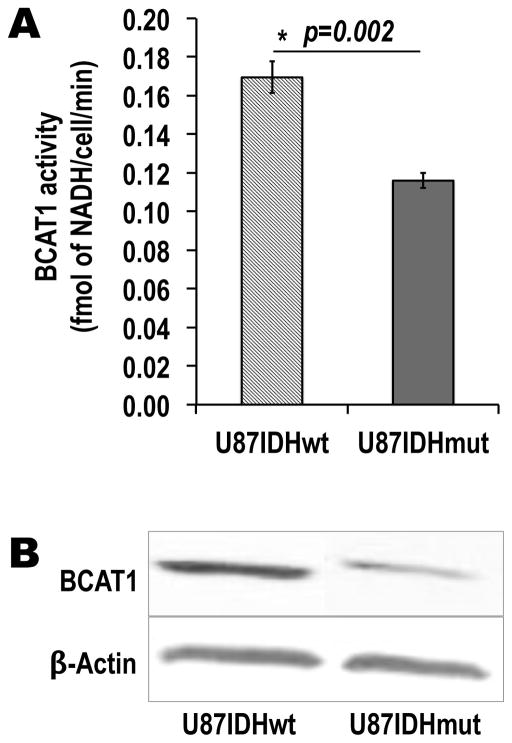
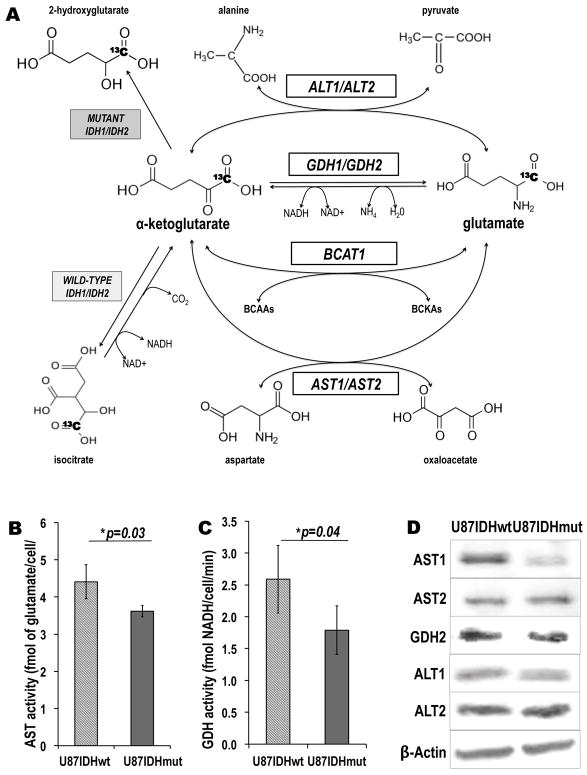
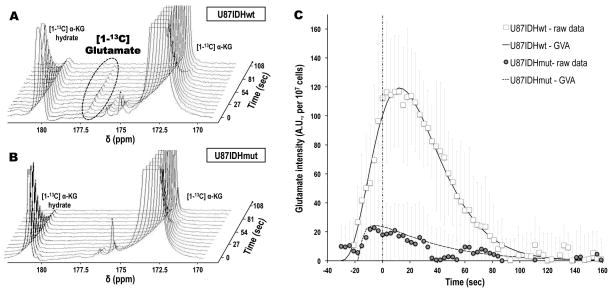
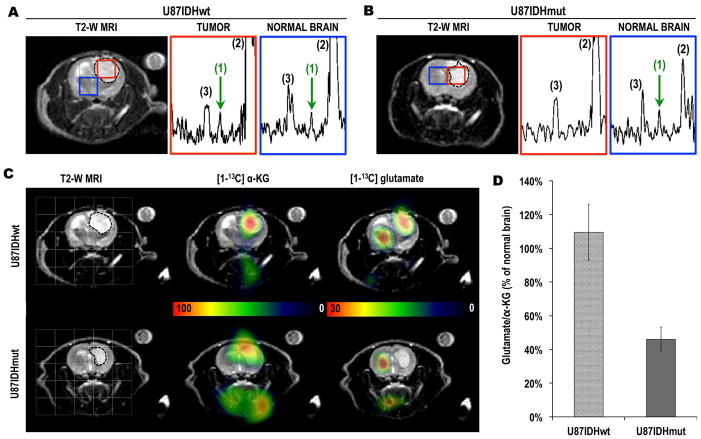
Mutations of the isocitrate dehydrogenase 1 (IDH1) gene are among the most prevalent in low-grade glioma and secondary glioblastoma, represent an early pathogenic event, and are associated with epigenetically driven modulations of metabolism. Of particular interest is the recently uncovered relationship between the IDH1 mutation and decreased activity of the branched-chain amino acid transaminase 1 (BCAT1) enzyme. Noninvasive imaging methods that can assess BCAT1 activity could therefore improve detection of mutant IDH1 tumors and aid in developing and monitoring new targeted therapies. BCAT1 catalyzes the transamination of branched-chain amino acids while converting α-ketoglutarate (α-KG) to glutamate. Our goal was to use (13)C magnetic resonance spectroscopy to probe the conversion of hyperpolarized [1-(13)C] α-KG to hyperpolarized [1-(13)C] glutamate as a readout of BCAT1 activity. We investigated two isogenic glioblastoma lines that differed only in their IDH1 status and performed experiments in live cells and in vivo in rat orthotopic tumors. Following injection of hyperpolarized [1-(13)C] α-KG, hyperpolarized [1-(13)C] glutamate production was detected both in cells and in vivo, and the level of hyperpolarized [1-(13)C] glutamate was significantly lower in mutant IDH1 cells and tumors compared with their IDH1-wild-type counterparts. Importantly however, in our cells the observed drop in hyperpolarized [1-(13)C] glutamate was likely mediated not only by a drop in BCAT1 activity, but also by reductions in aspartate transaminase and glutamate dehydrogenase activities, suggesting additional metabolic reprogramming at least in our model. Hyperpolarized [1-(13)C] glutamate could thus inform on multiple mutant IDH1-associated metabolic events that mediate reduced glutamate production.
异柠檬酸脱氢酶1(IDH1)基因突变是低级别胶质瘤和继发性胶质母细胞瘤中最常见的突变之一,代表了早期致病事件,并且与代谢的表观遗传驱动调节有关。特别值得关注的是,最近发现IDH1突变与支链氨基酸转氨酶1(BCAT1)酶活性降低之间的关系。因此,能够评估BCAT1活性的非侵入性成像方法可以改善突变型IDH1肿瘤的检测,并有助于开发和监测新的靶向治疗。BCAT1催化支链氨基酸的转氨基作用,同时将α-酮戊二酸(α-KG)转化为谷氨酸。我们的目标是使用(13)C磁共振波谱来探测超极化的[1-(13)C]α-KG向超极化的[1-(13)C]谷氨酸的转化,以此作为BCAT1活性的读数。我们研究了两个仅在IDH1状态上不同的同基因胶质母细胞瘤细胞系,并在活细胞和大鼠原位肿瘤体内进行了实验。注射超极化的[1-(13)C]α-KG后,在细胞和体内均检测到超极化的[1-(13)C]谷氨酸的产生,与IDH1野生型对应物相比,突变型IDH1细胞和肿瘤中超极化的[1-(13)C]谷氨酸水平显著降低。然而,重要的是,在我们的细胞中,观察到的超极化的[1-(13)C]谷氨酸的下降可能不仅是由BCAT1活性下降介导的,还可能是由天冬氨酸转氨酶和谷氨酸脱氢酶活性降低介导的,这表明至少在我们的模型中存在额外的代谢重编程。因此,超极化的[1-(13)C]谷氨酸可以反映介导谷氨酸产生减少的多个与突变型IDH1相关的代谢事件。