Ndiath Mamadou Ousmane, Mazenot Catherine, Sokhna Cheikh, Trape Jean-François
G4-Group, Institut Pasteur International Network, Entomology Unit, Institut Pasteur of Bangui, Bangui, Central African Republic.
Laboratoire de Paludologie et de Zoologie Médicale, Institut de Recherche pour le Développement, Campus International UCAD- IRD, Hann, Dakar, Sénégal.
PLoS One. 2014 Jun 3;9(6):e97700. doi: 10.1371/journal.pone.0097700. eCollection 2014.
Insecticide treated bed nets have been recommended and proven efficient as a measure to protect African populations from malaria mosquito vector Anopheles spp. This study evaluates the consequences of bed nets use on vectors resistance to insecticides, their feeding behavior and malaria transmission in Dielmo village, Senegal, were LLINs were offered to all villagers in July 2008.
Adult mosquitoes were collected monthly from January 2006 to December 2011 by human landing catches (HLC) and by pyrethroid spray catches (PCS). A randomly selected sub-sample of 15-20% of An. gambiae s.l. collected each month was used to investigate the molecular forms of the An. gambiae complex, kdr mutations, and Plasmodium falciparum circumsporozoite (CSP) rate. Malaria prevalence and gametocytaemia in Dielmo villagers were measured quarterly.
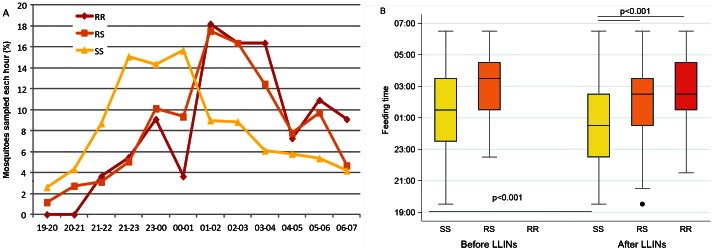
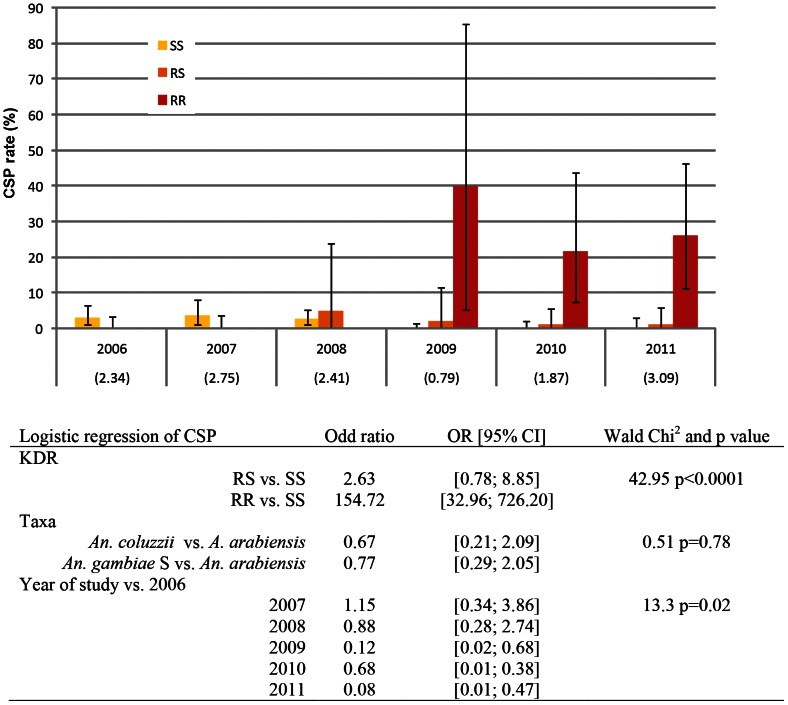
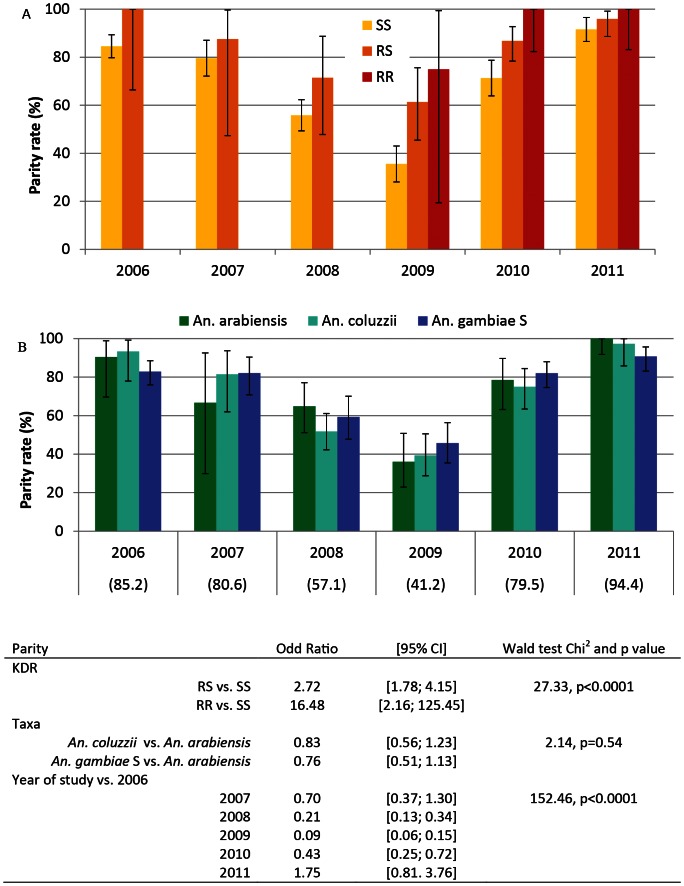
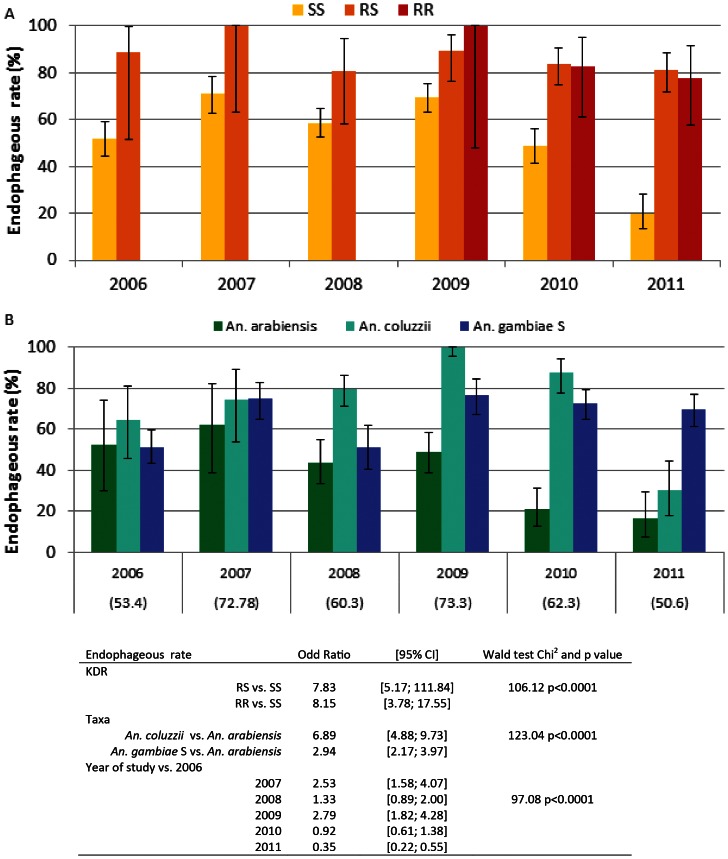
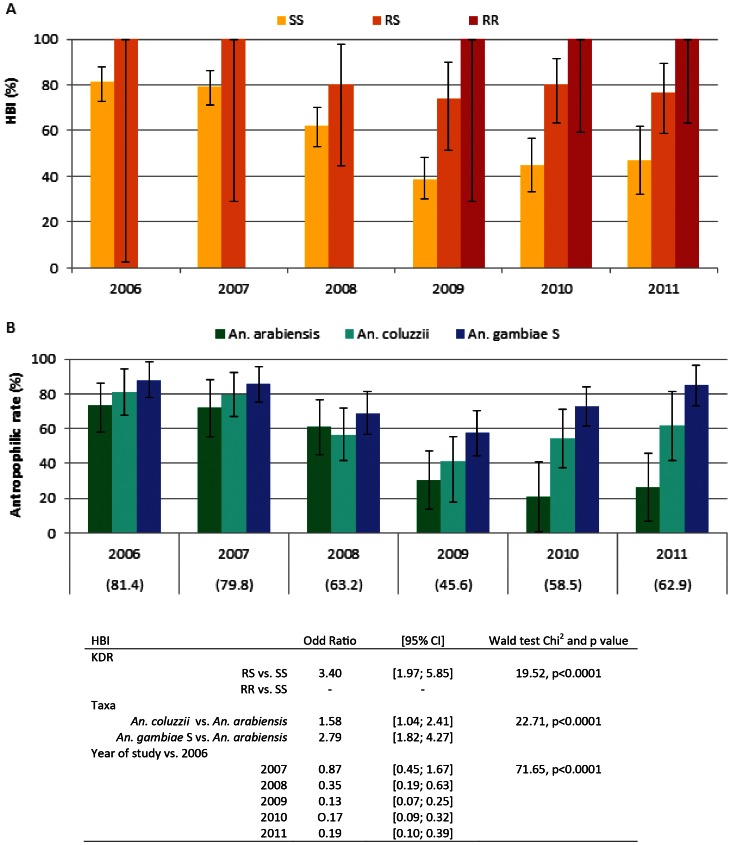
Insecticide susceptible mosquitoes (wild kdr genotype) presented a reduced lifespan after LLINs implementation but they rapidly adapted their feeding behavior, becoming more exophageous and zoophilic, and biting earlier during the night. In the meantime, insecticide-resistant specimens (kdr L1014F genotype) increased in frequency in the population, with an unchanged lifespan and feeding behaviour. P. falciparum prevalence and gametocyte rate in villagers decreased dramatically after LLINs deployment. Malaria infection rate tended to zero in susceptible mosquitoes whereas the infection rate increased markedly in the kdr homozygote mosquitoes.
Dramatic changes in vector populations and their behavior occurred after the deployment of LLINs due to the extraordinary adaptative skills of An. gambiae s. l. mosquitoes. However, despite the increasing proportion of insecticide resistant mosquitoes and their almost exclusive responsibility in malaria transmission, the P. falciparum gametocyte reservoir continued to decrease three years after the deployment of LLINs.
经杀虫剂处理的蚊帐已被推荐并证明是保护非洲人群免受疟疾媒介按蚊叮咬的有效措施。本研究评估了在塞内加尔的迪耶尔莫村使用蚊帐对媒介昆虫抗杀虫剂能力、其摄食行为以及疟疾传播的影响,2008年7月向所有村民提供了长效驱虫蚊帐(LLINs)。
从2006年1月至2011年12月,每月通过人饵诱捕法(HLC)和拟除虫菊酯喷雾捕蚊法(PCS)收集成年蚊子。每月随机抽取15%-20%的冈比亚按蚊复合体样本,用于研究冈比亚按蚊复合体的分子形态、kdr突变以及恶性疟原虫环子孢子蛋白(CSP)率。每季度测量迪耶尔莫村村民的疟疾患病率和配子血症。
使用长效驱虫蚊帐后,对杀虫剂敏感的蚊子(野生kdr基因型)寿命缩短,但它们迅速改变了摄食行为,变得更倾向于室外摄食和嗜动物性,并且在夜间更早叮咬。与此同时,抗杀虫剂的样本(kdr L1014F基因型)在种群中的频率增加,其寿命和摄食行为没有变化。使用长效驱虫蚊帐后,村民中恶性疟原虫的患病率和配子体率显著下降。敏感蚊子中的疟疾感染率趋于零,而kdr纯合子蚊子中的感染率显著增加。
由于冈比亚按蚊复合体具有非凡的适应能力,使用长效驱虫蚊帐后媒介种群及其行为发生了巨大变化。然而,尽管抗杀虫剂蚊子的比例不断增加,且它们几乎是疟疾传播的唯一责任主体,但在使用长效驱虫蚊帐三年后,恶性疟原虫配子体库仍在持续减少。