
肯尼亚南部沿海地区经杀虫剂处理过的蚊帐对疟疾传播指数的影响。
Impact of insecticide-treated bed nets on malaria transmission indices on the south coast of Kenya.
机构信息
Department of Environmental Studies, Emory University, Atlanta, Georgia, USA.
出版信息
Malar J. 2011 Dec 13;10:356. doi: 10.1186/1475-2875-10-356.
BACKGROUND
Besides significantly reducing malaria vector densities, prolonged usage of bed nets has been linked to decline of Anopheles gambiae s.s. relative to Anopheles arabiensis, changes in host feeding preference of malaria vectors, and behavioural shifts to exophagy (outdoor biting) for the two important malaria vectors in Africa, An. gambiae s.l. and Anopheles funestus. In southern coastal Kenya, bed net use was negligible in 1997-1998 when Anopheles funestus and An. gambiae s.s. were the primary malaria vectors, with An. arabiensis and Anopheles merus playing a secondary role. Since 2001, bed net use has increased progressively and reached high levels by 2009-2010 with corresponding decline in malaria transmission.
METHODS
To evaluate the impact of the substantial increase in household bed net use within this area on vector density, vector composition, and human-vector contact, indoor and outdoor resting mosquitoes were collected in the same region during 2009-2010 using pyrethrum spray catches and clay pots for indoor and outdoor collections respectively. Information on bed net use per sleeping spaces and factors influencing mosquito density were determined in the same houses using Poisson regression analysis. Species distribution was determined, and number of mosquitoes per house, human-biting rates (HBR), and entomological inoculation rate (EIR) were compared to those reported for the same area during 1997-1998, when bed net coverage had been minimal.
RESULTS
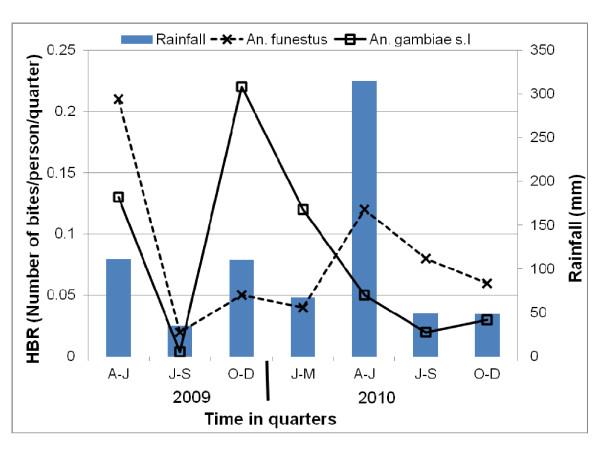
Compared to 1997-1998, a significant decline in the relative proportion of An. gambiae s.s. among collected mosquitoes was noted, coupled with a proportionate increase of An. arabiensis. Following > 5 years of 60-86% coverage with bed nets, the density, human biting rate and EIR of indoor resting mosquitoes were reduced by more than 92% for An. funestus and by 75% for An. gambiae s.l. In addition, the host feeding choice of both vectors shifted more toward non-human vertebrates. Besides bed net use, malaria vector abundance was also influenced by type of house construction and according to whether one sleeps on a bed or a mat (both of these are associated with household wealth). Mosquito density was positively associated with presence of domestic animals.
CONCLUSIONS
These entomological indices indicate a much reduced human biting rate and a diminishing role of An. gambiae s.s. in malaria transmission following high bed net coverage. While increasing bed net coverage beyond the current levels may not significantly reduce the transmission potential of An. arabiensis, it is anticipated that increasing or at least sustaining high bed net coverage will result in a diminished role for An. funestus in malaria transmission.
背景
除了显著降低疟疾媒介密度外,长期使用蚊帐还与冈比亚按蚊 s.s.相对于阿拉伯按蚊的下降有关,这两种重要的疟疾媒介的宿主摄食偏好发生变化,以及行为向户外(户外叮咬)转移。在非洲,冈比亚按蚊 s.l.和疟蚊。在肯尼亚南部沿海地区,1997-1998 年,当疟蚊和冈比亚按蚊 s.s.是主要的疟疾媒介时,蚊帐的使用微不足道,而阿拉伯按蚊和疟蚊。merus 发挥次要作用。自 2001 年以来,蚊帐的使用逐渐增加,并在 2009-2010 年达到高水平,同时疟疾传播相应下降。
方法
为了评估该地区家庭蚊帐使用量大幅增加对媒介密度、媒介组成和人类与媒介接触的影响,在 2009-2010 年期间,使用拟除虫菊酯喷雾捕获法和粘土罐分别在同一地区室内和室外收集蚊子。使用泊松回归分析在同一房屋中确定了每间卧室的蚊帐使用情况和影响蚊子密度的因素。确定了物种分布,并比较了 2009-2010 年与 1997-1998 年报告的每栋房屋的蚊子数量、人叮咬率(HBR)和昆虫接种率(EIR),当时蚊帐覆盖率最低。
结果
与 1997-1998 年相比,收集到的蚊子中冈比亚按蚊 s.s.的相对比例明显下降,同时阿拉伯按蚊的比例相应增加。在 60-86%的蚊帐覆盖率超过 5 年后,室内休息蚊子的密度、人叮咬率和 EIR 分别下降了 92%以上疟蚊和 75%的冈比亚按蚊 s.l. 此外,两种媒介的宿主摄食选择都更多地转向非人类脊椎动物。除了使用蚊帐外,疟疾媒介的丰度还受到房屋建筑类型的影响,以及是否睡在床上或垫子上(这两者都与家庭财富有关)。蚊子密度与家养动物的存在呈正相关。
结论
这些昆虫学指标表明,在高蚊帐覆盖率下,人类叮咬率大幅降低,冈比亚按蚊 s.s.在疟疾传播中的作用减弱。虽然增加蚊帐覆盖率超过目前水平可能不会显著降低阿拉伯按蚊的传播潜力,但预计增加或至少维持高蚊帐覆盖率将导致疟蚊在疟疾传播中的作用减弱。


 Zotero 插件