Hauser Andrea, Santos-Hoevener Claudia, Meixenberger Karolin, Zimmermann Ruth, Somogyi Sybille, Fiedler Stefan, Hofmann Alexandra, Bartmeyer Barbara, Jansen Klaus, Hamouda Osamah, Bannert Norbert, Kuecherer Claudia
Division of HIV and Other Retroviruses, Robert Koch Institute, Berlin, Germany.
Division of HIV/AIDS, STI and Blood-borne Infections, Robert Koch Institute, Berlin, Germany.
PLoS One. 2014 Jun 3;9(6):e98038. doi: 10.1371/journal.pone.0098038. eCollection 2014.
The variety and limitations of current laboratory methods for estimating HIV-incidence has driven attempts to improve and standardize the performance of serological 'Tests for Recent HIV-Infections' (TRI). Primary and follow-up HIV-1 positive plasma samples from individuals with well-defined dates of infection collected as part of the German Seroconverter Cohort provided specimens highly suitable for use in comparing the performance of three TRIs: the AWARE™ BED™ EIA HIV-1 Incidence test (BED-CEIA), Genetic systems HIV-1/HIV-2 Plus O EIA antibody avidity-based assay (BioRad Avidity) and Sedia™ HIV-1 LAg Avidity EIA (LAg Avidity).
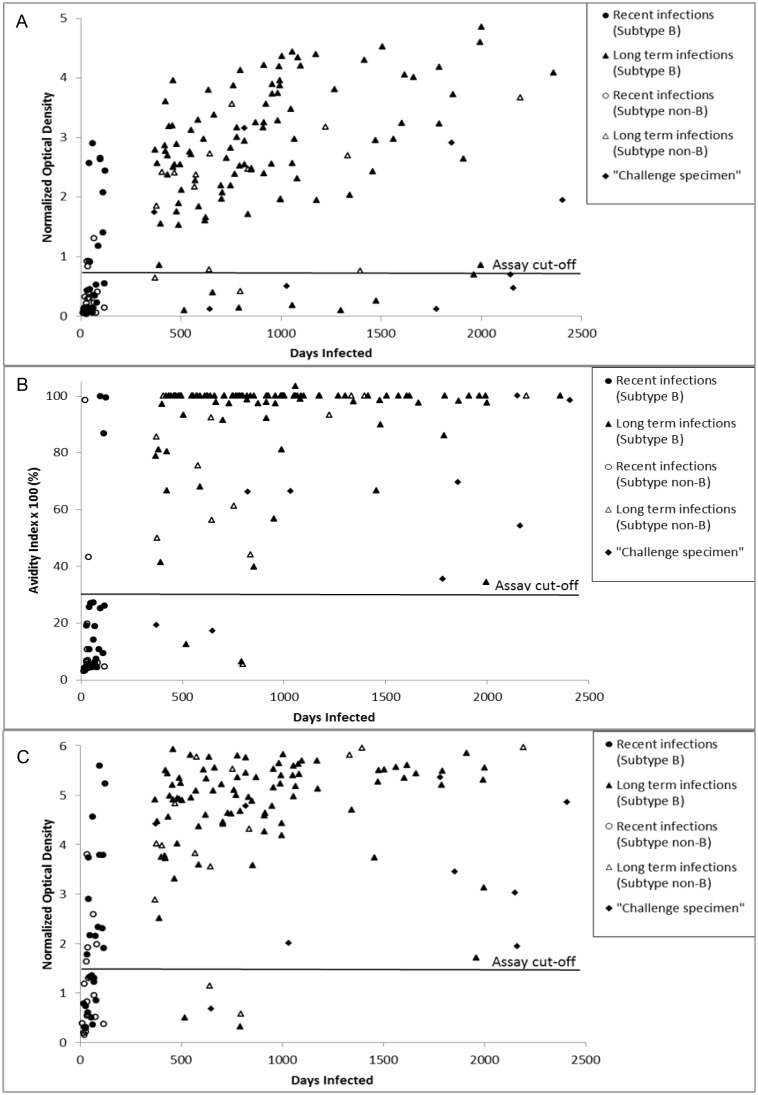
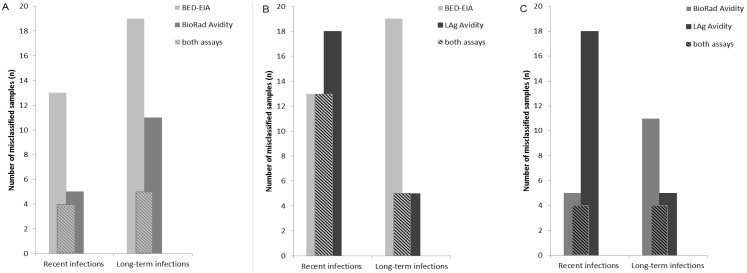
The evaluation panel included 180 specimens: 44 from antiretroviral (ARV)-naïve individuals with recently acquired HIV-infection (≤ 130 days; 25 B and 19 non-B subtypes) and 136 from long-term (>12 months) infected individuals [101 ARV-naïve subtype B, 16 non-B subtypes, 14 ARV-treated individuals, 5 slow progressors (SLP)].
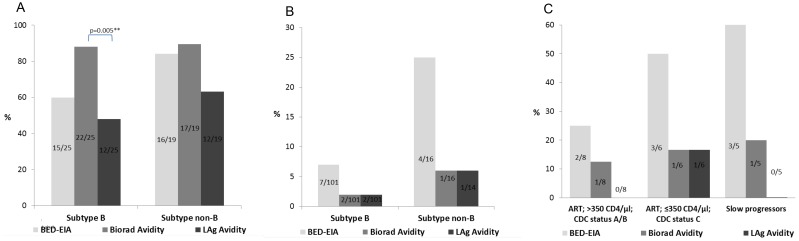
For long-term infected, ARV-naïve individuals the false recent rates (FRR) of both the BioRad and LAg Avidity assays were 2% (2/101 for subtype B) and 6% (1/16 for subtype 'non-B'), while the FRR of the BED-CEIA was 7% (7/101 for subtype B) and 25% (4/16 for subtype 'non-B') (all p>0.05). Misclassification of ARV-treated individuals and SLP was rare by LAg (1/14, 0/5) and BioRad Avidity assays (2/14, 1/5) but more frequent by BED-CEIA (5/14, 3/5). Among recently-infected individuals (subtype B), 60% (15/25) were correctly classified by BED-CEIA, 88% (22/25) by BioRad Avidity and significantly fewer by LAg (48%, 12/25) compared to BioRad Avidity (p = 0.005) with a higher true-recency rate among non-B infections for all assays.
This study using well-characterized specimens demonstrated lower FRRs for both avidity methods than with the BED-CEIA. For recently infected individuals the BioRad Avidity assay was shown to give the most accurate results.
当前用于估计HIV发病率的实验室方法种类繁多且存在局限性,这促使人们尝试改进和规范血清学“近期HIV感染检测”(TRI)的性能。作为德国血清转化队列研究的一部分,收集了感染日期明确的个体的初次和随访HIV-1阳性血浆样本,这些样本非常适合用于比较三种TRI的性能:AWARE™ BED™ EIA HIV-1发病率检测(BED-CEIA)、遗传系统HIV-1/HIV-2 Plus O EIA基于抗体亲和力的检测(BioRad亲和力检测)和Sedia™ HIV-1 LAg亲和力EIA(LAg亲和力检测)。
评估小组包括180个样本:44个来自未接受抗逆转录病毒治疗(ARV)且近期感染HIV(≤130天)的个体(25个B亚型和19个非B亚型),以及136个来自长期(>12个月)感染个体[101个未接受ARV治疗的B亚型、16个非B亚型、14个接受ARV治疗的个体、5个疾病进展缓慢者(SLP)]。
对于长期感染、未接受ARV治疗的个体,BioRad检测和LAg亲和力检测的假近期感染率(FRR)均为2%(B亚型中为2/101)和6%(非B亚型中为1/16),而BED-CEIA的FRR为7%(B亚型中为7/101)和25%(非B亚型中为4/16)(所有p>0.05)。LAg检测(1/14,0/5)和BioRad亲和力检测(2/14,1/5)对接受ARV治疗的个体和SLP的错误分类很少,但BED-CEIA更频繁(5/14,3/5)。在近期感染个体(B亚型)中,BED-CEIA正确分类的比例为60%(15/25),BioRad亲和力检测为88%(22/25),LAg检测明显少于BioRad亲和力检测(48%,12/25)(p = 0.005),所有检测在非B感染中的真近期感染率更高。
本研究使用特征明确的样本表明,两种亲和力方法的FRR均低于BED-CEIA。对于近期感染的个体,BioRad亲和力检测显示出最准确的结果。