Meadows Corey W, Ou Ryan, Klinman Judith P
Department of Chemistry, ‡Department of Molecular and Cell Biology, and the §California Institute for Quantitative Biosciences, University of California, Berkeley , Berkeley, California 94720, United States.
J Phys Chem B. 2014 Jun 12;118(23):6049-61. doi: 10.1021/jp500825x. Epub 2014 Jun 3.
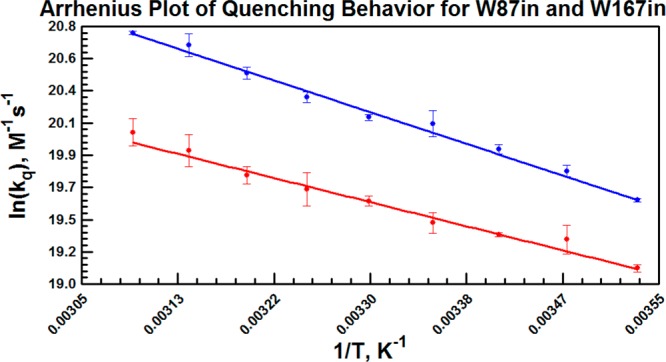
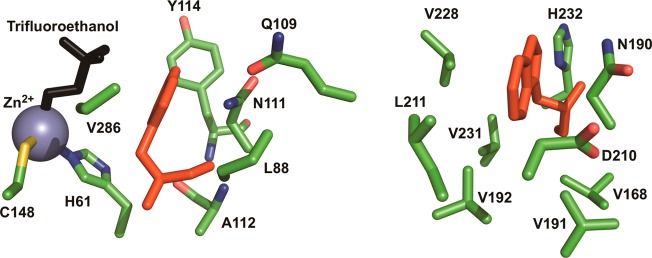
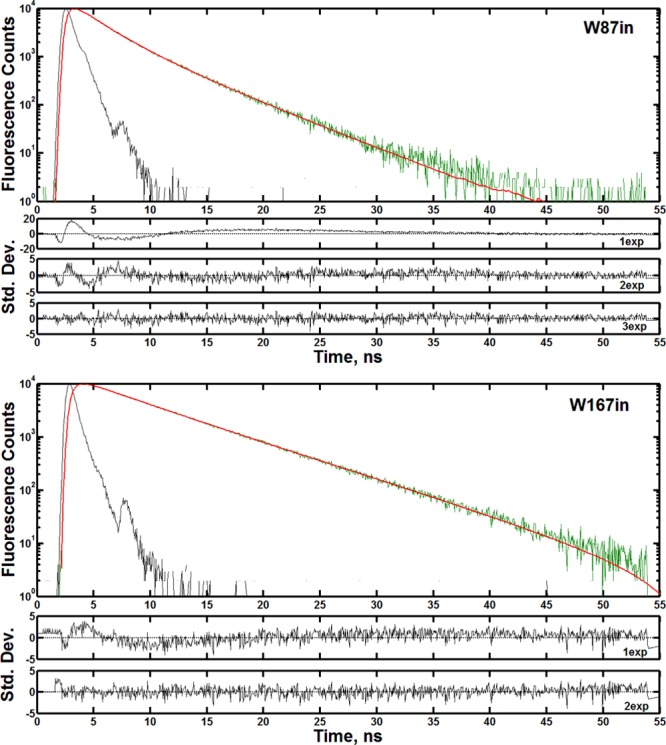
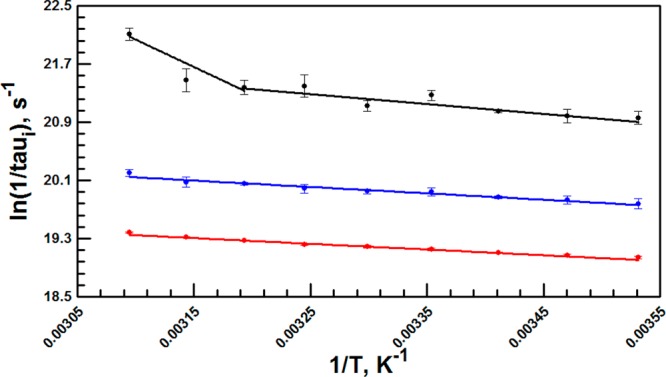
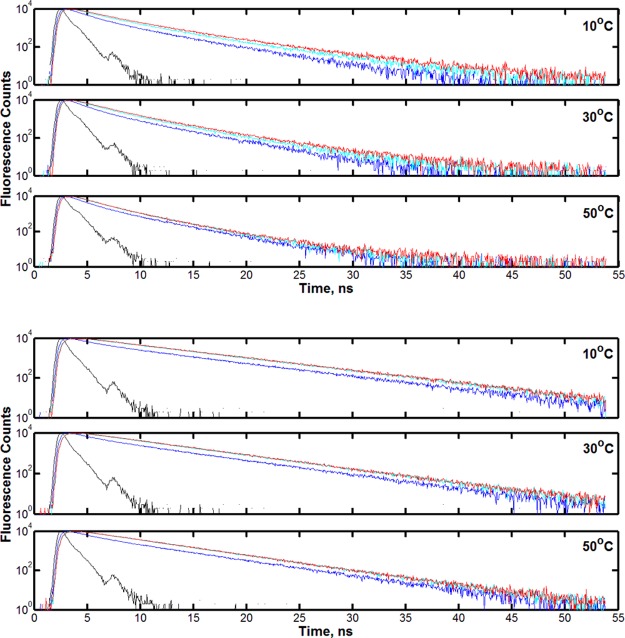
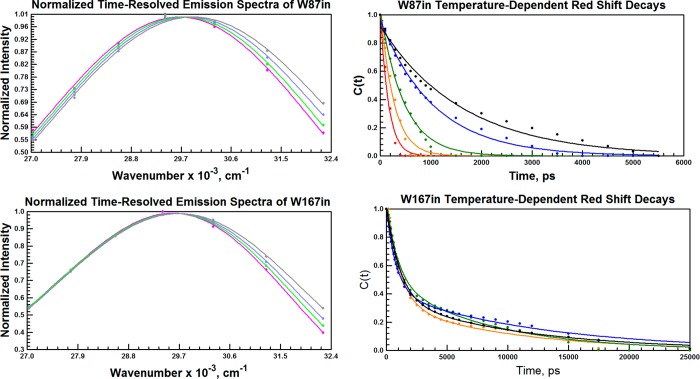
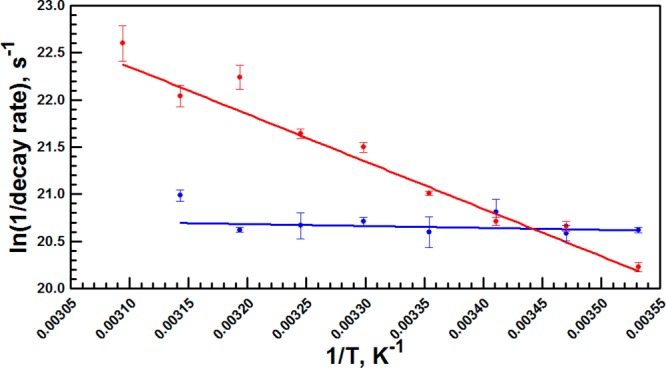
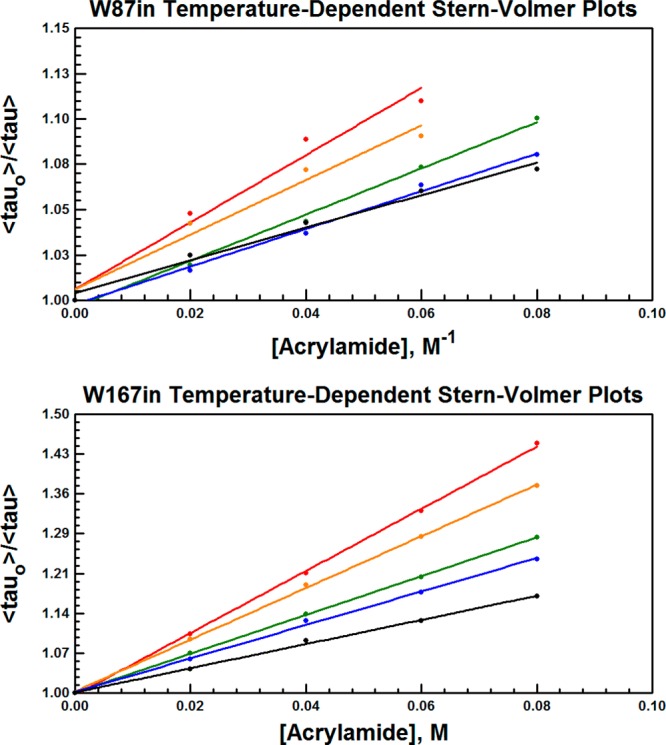
Two single-tryptophan variants were generated in a thermophilic alcohol dehydrogenase with the goal of correlating temperature-dependent changes in local fluorescence with the previously demonstrated catalytic break at ca. 30 °C (Kohen et al., Nature 1999, 399, 496). One tryptophan variant, W87in, resides at the active site within van der Waals contact of bound alcohol substrate; the other variant, W167in, is a remote-site surface reporter located >25 Å from the active site. Picosecond-resolved fluorescence measurements were used to analyze fluorescence lifetimes, time-dependent Stokes shifts, and the extent of collisional quenching at Trp87 and Trp167 as a function of temperature. A subnanosecond fluorescence decay rate constant has been detected for W87in that is ascribed to the proximity of the active site Zn(2+) and shows a break in behavior at 30 °C. For the remainder of the reported lifetime measurements, there is no detectable break between 10 and 50 °C, in contrast with previously reported hydrogen/deuterium exchange experiments that revealed a temperature-dependent break analogous to catalysis (Liang et al., Proc. Natl. Acad. Sci. U.S.A. 2004, 101, 9556). We conclude that the motions that lead to the rigidification of ht-ADH below 30 °C are likely to be dominated by global processes slower than the picosecond to nanosecond motions measured herein. In the case of collisional quenching of fluorescence by acrylamide, W87in and W167in behave in a similar manner that resembles free tryptophan in water. Stokes shift measurements, by contrast, show distinctive behaviors in which the active-site tryptophan relaxation is highly temperature-dependent, whereas the solvent-exposed tryptophan's dynamics are temperature-independent. These data are concluded to reflect a significantly constrained environment surrounding the active site Trp87 that both increases the magnitude of the Stokes shift and its temperature-dependence. The results are discussed in the context of spatially distinct differences in enthalpic barriers for protein conformational sampling that may be related to catalysis.
在一种嗜热醇脱氢酶中产生了两个单色氨酸变体,目的是将局部荧光中与温度相关的变化与之前证明的约30°C时的催化断裂相关联(科恩等人,《自然》,1999年,399卷,496页)。一个色氨酸变体W87in位于与结合的醇底物范德华接触的活性位点内;另一个变体W167in是一个距活性位点大于25 Å的远程表面报告基团。皮秒分辨荧光测量用于分析色氨酸87和色氨酸167处的荧光寿命、时间相关的斯托克斯位移以及碰撞猝灭程度随温度的变化。已检测到W87in的亚纳秒荧光衰减速率常数,这归因于活性位点Zn(2+)的接近,并在30°C时表现出行为变化。对于其余报道的寿命测量,在10至50°C之间没有可检测到的变化,这与之前报道的氢/氘交换实验形成对比,该实验揭示了与催化类似的温度依赖性变化(梁等人,《美国国家科学院院刊》,2004年,101卷,9556页)。我们得出结论,导致ht - ADH在30°C以下刚性化的运动可能由比本文测量的皮秒到纳秒运动更慢的全局过程主导。在丙烯酰胺对荧光的碰撞猝灭情况下,W87in和W167in的行为方式与水中的游离色氨酸相似。相比之下,斯托克斯位移测量显示出独特的行为,其中活性位点色氨酸的弛豫高度依赖于温度,而溶剂暴露的色氨酸的动力学与温度无关。这些数据被认为反映了活性位点色氨酸87周围显著受限的环境,这既增加了斯托克斯位移的幅度及其温度依赖性。在可能与催化相关的蛋白质构象采样的焓垒空间差异的背景下讨论了这些结果。