Orme Robert M L'E, Perkins Gavin D, McAuley Daniel F, Liu Kathleen D, Mason Alexina J, Morelli Andrea, Singer Mervyn, Ashby Deborah, Gordon Anthony C
Section of Anaesthetics, Pain Medicine and Intensive Care, Imperial College London, Charing Cross Hospital, Fulham Palace Road, London W6 8RF, UK.
Trials. 2014 Jun 2;15:199. doi: 10.1186/1745-6215-15-199.
Organ dysfunction consequent to infection ('severe sepsis') is the leading cause of admission to an intensive care unit (ICU). In both animal models and early clinical studies the calcium channel sensitizer levosimendan has been demonstrated to have potentially beneficial effects on organ function. The aims of the Levosimendan for the Prevention of Acute oRgan Dysfunction in Sepsis (LeoPARDS) trial are to identify whether a 24-hour infusion of levosimendan will improve organ dysfunction in adults who have septic shock and to establish the safety profile of levosimendan in this group of patients.
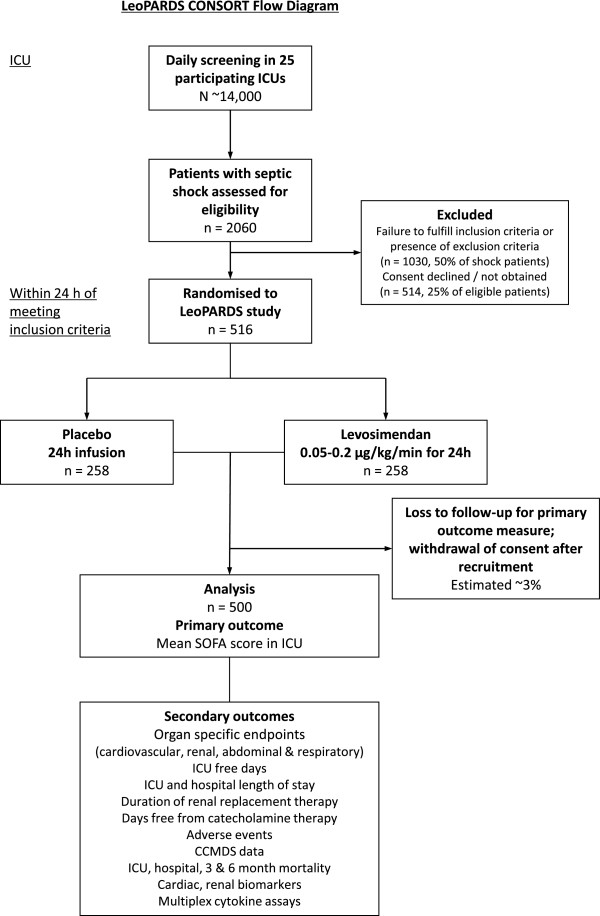
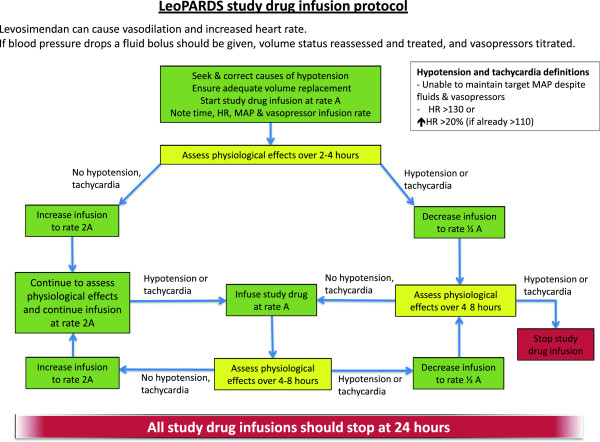
METHODS/DESIGN: This is a multicenter, randomized, double-blind, parallel group, placebo-controlled trial. Adults fulfilling the criteria for systemic inflammatory response syndrome due to infection, and requiring vasopressor therapy, will be eligible for inclusion in the trial. Within 24 hours of meeting these inclusion criteria, patients will be randomized in a 1:1 ratio stratified by the ICU to receive either levosimendan (0.05 to 0.2 μg.kg⁻¹.min⁻¹ or placebo for 24 hours in addition to standard care. The primary outcome measure is the mean Sequential Organ Failure Assessment (SOFA) score while in the ICU. Secondary outcomes include: central venous oxygen saturations and cardiac output; incidence and severity of renal failure using the Acute Kidney Injury Network criteria; duration of renal replacement therapy; serum bilirubin; time to liberation from mechanical ventilation; 28-day, hospital, 3 and 6 month survival; ICU and hospital length-of-stay; and days free from catecholamine therapy. Blood and urine samples will be collected on the day of inclusion, at 24 hours, and on days 4 and 6 post-inclusion for investigation of the mechanisms by which levosimendan might improve organ function. Eighty patients will have additional blood samples taken to measure levels of levosimendan and its active metabolites OR-1896 and OR-1855. A total of 516 patients will be recruited from approximately 25 ICUs in the United Kingdom.
This trial will test the efficacy of levosimendan to reduce acute organ dysfunction in adult patients who have septic shock and evaluate its biological mechanisms of action.
Current controlled trials ISRCTN12776039 (19 September 2013).
感染所致器官功能障碍(“严重脓毒症”)是入住重症监护病房(ICU)的主要原因。在动物模型和早期临床研究中,钙通道敏化剂左西孟旦已被证明对器官功能可能具有有益作用。左西孟旦预防脓毒症急性器官功能障碍(LeoPARDS)试验的目的是确定24小时输注左西孟旦是否会改善感染性休克成人患者的器官功能障碍,并确定左西孟旦在该组患者中的安全性。
方法/设计:这是一项多中心、随机、双盲、平行组、安慰剂对照试验。符合因感染导致全身炎症反应综合征标准且需要血管升压药治疗的成人将有资格纳入试验。在满足这些纳入标准的24小时内,患者将按1:1比例分层随机分组,由ICU分配接受左西孟旦(0.05至0.2μg·kg⁻¹·min⁻¹)或安慰剂治疗24小时,同时给予标准治疗。主要结局指标是在ICU期间的平均序贯器官衰竭评估(SOFA)评分。次要结局包括:中心静脉血氧饱和度和心输出量;使用急性肾损伤网络标准评估的肾衰竭发生率和严重程度;肾脏替代治疗持续时间;血清胆红素;机械通气脱机时间;28天、住院、3个月和6个月生存率;ICU和住院时间;以及无儿茶酚胺治疗天数。在纳入当天、24小时以及纳入后第4天和第6天采集血液和尿液样本,以研究左西孟旦改善器官功能的机制。80名患者将额外采集血液样本以测量左西孟旦及其活性代谢产物OR-1896和OR-1855的水平。将从英国约25个ICU招募总共516名患者。
该试验将测试左西孟旦在感染性休克成人患者中减少急性器官功能障碍的疗效,并评估其生物学作用机制。
当前受控试验ISRCTN12776039(2013年9月19日)。