Hoffmann Jan-Erik, Fermin Yessica, Stricker Ruth Lo, Ickstadt Katja, Zamir Eli
Department of Systemic Cell Biology, Max Planck Institute of Molecular Physiology, Dortmund, Germany Bioanalytics Department, Leibniz Institute for Analytical Sciences, Dortmund, Germany.
Faculty of Statistics, TU Dortmund University, Dortmund, Germany.
Elife. 2014 Jun 3;3:e02257. doi: 10.7554/eLife.02257.
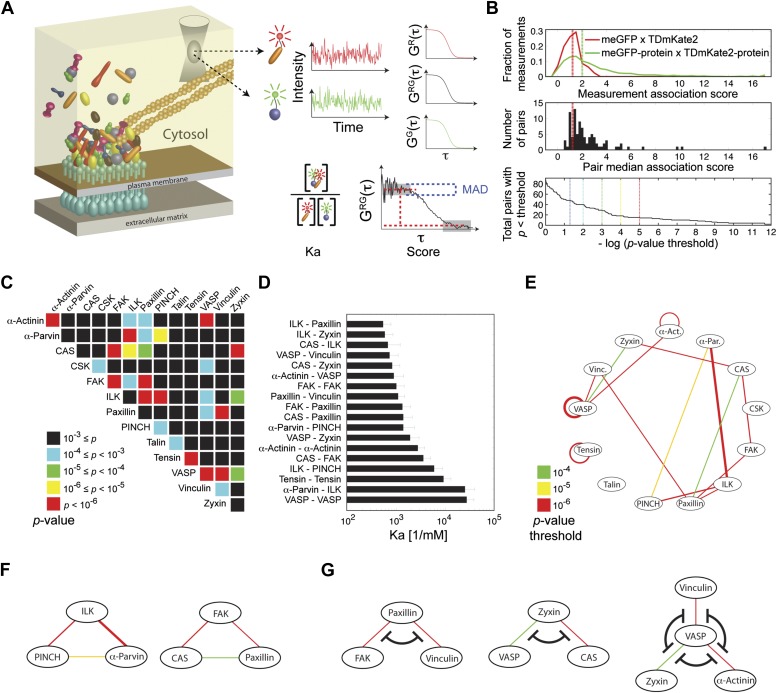
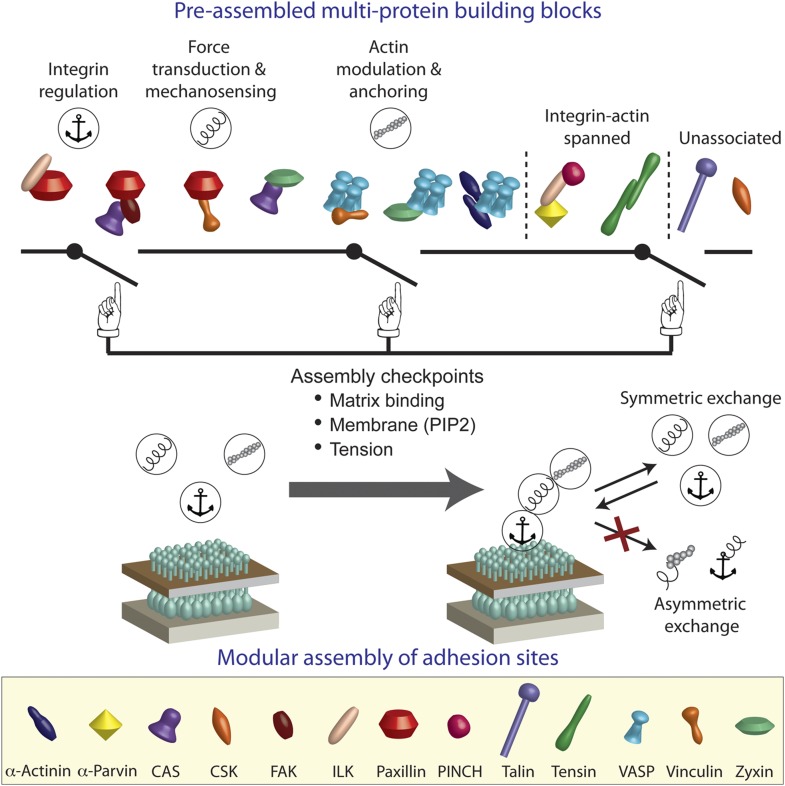
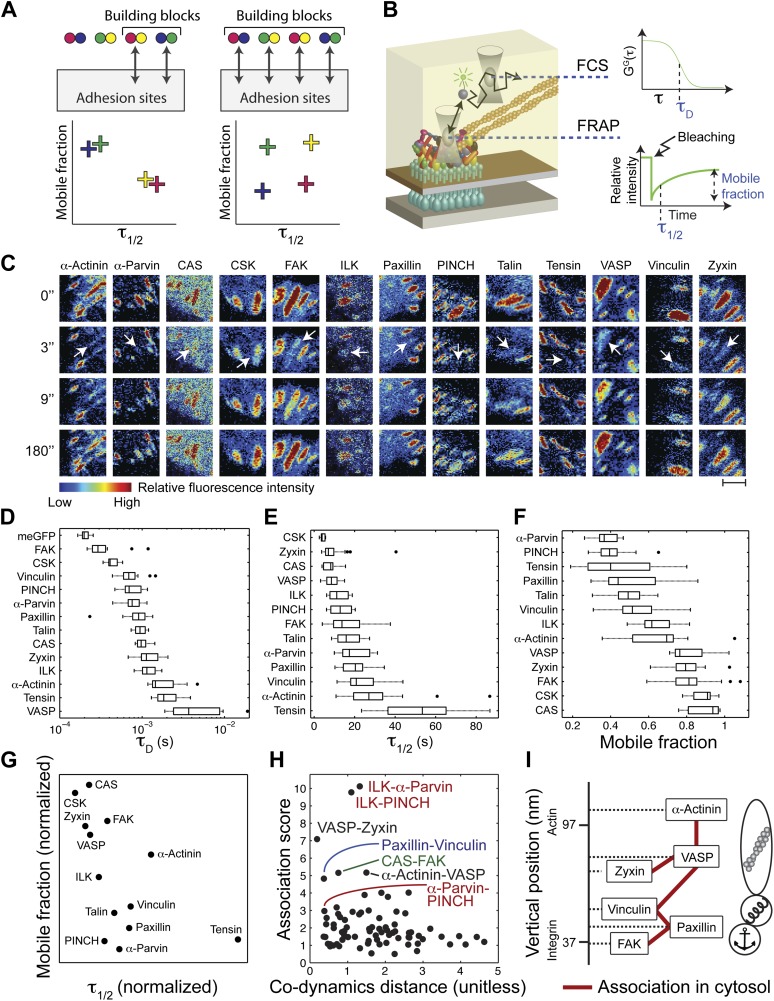
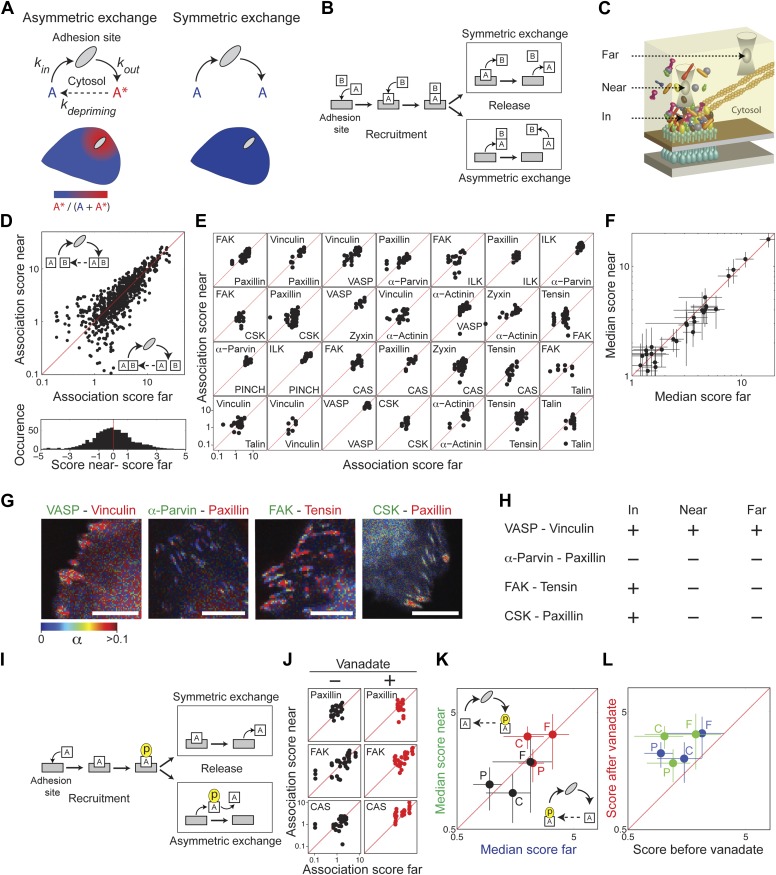
How can the integrin adhesome get self-assembled locally, rapidly, and correctly as diverse cell-matrix adhesion sites? Here, we investigate this question by exploring the cytosolic state of integrin-adhesome components and their dynamic exchange between adhesion sites and cytosol. Using fluorescence cross-correlation spectroscopy (FCCS) and fluorescence recovery after photobleaching (FRAP) we found that the integrin adhesome is extensively pre-assembled already in the cytosol as multi-protein building blocks for adhesion sites. Stationary focal adhesions release symmetrically the same types of protein complexes that they recruit, thereby keeping the cytosolic pool of building blocks spatiotemporally uniform. We conclude a model in which multi-protein building blocks enable rapid and modular self-assembly of adhesion sites and symmetric exchange of these building blocks preserves their specifications and thus the assembly logic of the system.DOI: http://dx.doi.org/10.7554/eLife.02257.001.
整合素黏附体如何作为多样的细胞-基质黏附位点在局部快速且正确地进行自我组装?在此,我们通过探究整合素黏附体组分的胞质状态以及它们在黏附位点与胞质之间的动态交换来研究这个问题。利用荧光互相关光谱技术(FCCS)和光漂白后荧光恢复技术(FRAP),我们发现整合素黏附体在胞质中已广泛地预先组装成用于黏附位点的多蛋白构建模块。静止的黏着斑对称地释放它们所招募的相同类型的蛋白质复合物,从而使构建模块的胞质库在时空上保持均匀。我们总结出一个模型,其中多蛋白构建模块能够实现黏附位点的快速且模块化的自我组装,并且这些构建模块的对称交换保留了它们的规格,进而保留了系统的组装逻辑。DOI: http://dx.doi.org/10.7554/eLife.02257.001 。