Charrier Lorena, Argentero Pier Angelo, Farina Enzo C, Serra Roberto, Mana Francesco, Zotti Carla M
Department of Public Health and Paediatrics, University of Torino, Via Santena 5 bis, Torino, Italy.
BMC Public Health. 2014 Jun 5;14:558. doi: 10.1186/1471-2458-14-558.
A prevalence survey of healthcare-associated infections (HAIs) was previously performed in the Piemonte region in 2000. In the decade following the survey, many studies were performed at both the regional and hospital levels, and training courses were developed to address issues highlighted by the survey. In 2010, a second regional prevalence study was performed. The aim of this paper is to present the results of the second prevalence study and discuss them within the context of the HAI prevention and control programmes that have been implemented in the decade since the original survey was conducted.
The study involved all public hospitals in the Piemonte region. Uni- and multivariate analyses were performed to assess the main risk factors associated with HAIs, including both overall and site-specific infections.
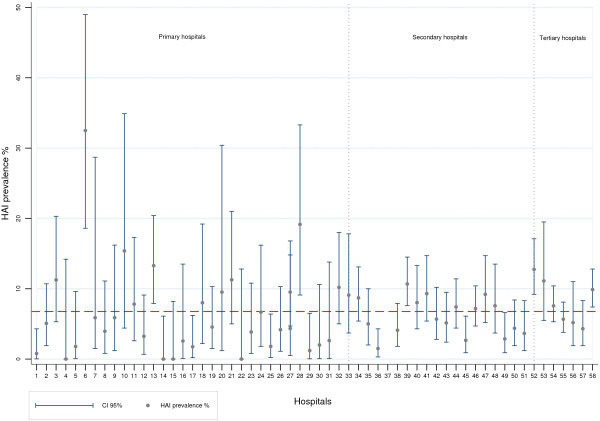
A total of 7841 patients were enrolled: 6.8% were affected by at least one HAI. The highest prevalence of HAIs was found in intensive care units (18.0%, 95% CI 14.0-22.6), while UTIs presented the highest relative frequency (26.7%), followed by respiratory tract infections (21.9%). The age of the patient, hospital size and urinary and central venous catheter status were significantly associated with HAIs.
The study results showed an increase in HAI prevalence, despite prevention and control efforts, as well as training implemented after the first regional survey. Nevertheless, these data are consistent with the current literature. Furthermore, despite its limits, the prevalence approach remains an important means for involving healthcare workers, emphasising HAIs and revealing critical problems that need be addressed.
2000年曾在皮埃蒙特地区开展过一次医疗保健相关感染(HAIs)患病率调查。在该调查后的十年里,地区和医院层面都开展了许多研究,并开设了培训课程以解决调查中凸显的问题。2010年,开展了第二次地区患病率研究。本文旨在呈现第二次患病率研究的结果,并在自首次调查开展后的十年里已实施的HAIs预防与控制项目背景下对其进行讨论。
该研究涵盖了皮埃蒙特地区的所有公立医院。进行了单因素和多因素分析,以评估与HAIs相关的主要危险因素,包括总体感染和特定部位感染。
共纳入7841例患者:6.8%的患者至少感染一种HAIs。HAIs患病率最高的是重症监护病房(18.0%,95%可信区间14.0 - 22.6),而尿路感染的相对发生率最高(26.7%),其次是呼吸道感染(21.9%)。患者年龄、医院规模以及导尿管和中心静脉导管使用情况与HAIs显著相关。
研究结果显示,尽管在首次地区调查后进行了预防控制努力和培训,但HAIs患病率仍有所上升。然而,这些数据与当前文献一致。此外,尽管存在局限性,但患病率调查方法仍是让医护人员参与其中、强调HAIs并揭示需要解决的关键问题的重要手段。