Genetics of Taste Lab, Department of Health Sciences, Denver Museum of Nature and Science Denver, CO, USA.
Department of Mathematical and Statistical Sciences, University of Colorado Denver Denver, CO, USA.
Front Integr Neurosci. 2014 May 27;8:33. doi: 10.3389/fnint.2014.00033. eCollection 2014.
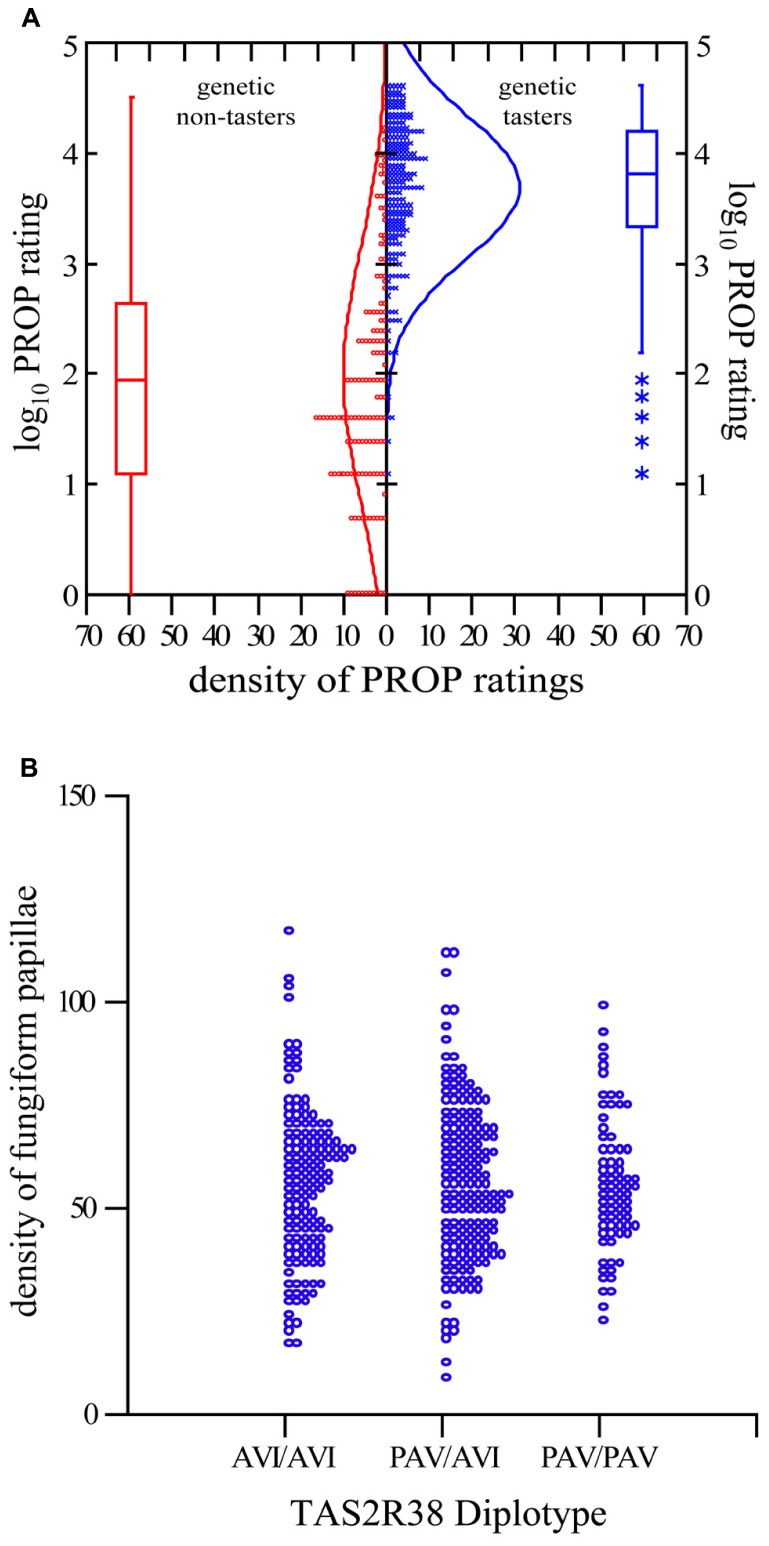
Understanding the influence of taste perception on food choice has captured the interest of academics, industry, and the general public, the latter as evidenced by the extent of popular media coverage and use of the term supertaster. Supertasters are highly sensitive to the bitter tastant propylthiouracil (PROP) and its chemical relative phenylthiocarbamide. The well-researched differences in taste sensitivity to these bitter chemicals are partially controlled by variation in the TAS2R38 gene; however, this variation alone does not explain the supertaster phenomenon. It has been suggested that density of papillae, which house taste buds, may explain supertasting. To address the unresolved role of papillae, we used crowdsourcing in the museum-based Genetics of Taste Lab. This community lab is uniquely situated to attract both a large population of human subjects and host a team of citizen scientists to research population-based questions about human genetics, taste, and health. Using this model, we find that PROP bitterness is not in any way predicted by papillae density. This result holds within the whole sample, when divided into major diplotypes, and when correcting for age, sex, and genotype. Furthermore, it holds when dividing participants into oft-used taster status groups. These data argue against the use of papillae density in predicting taste sensitivity and caution against imprecise use of the term supertaster. Furthermore, it supports a growing volume of evidence that sets the stage for hypergeusia, a reconceptualization of heightened oral sensitivity that is not based solely on PROP or papillae density. Finally, our model demonstrates how community-based research can serve as a unique venue for both study participation and citizen science that makes scientific research accessible and relevant to people's everyday lives.
味觉感知对食物选择的影响引起了学术界、工业界和公众的兴趣,后者的证据是大众媒体对这一术语的广泛报道和使用。超级味觉者对苦味物质丙硫氧嘧啶(PROP)及其化学类似物苯硫脲非常敏感。对这些苦味化学物质的味觉敏感性差异的深入研究部分受到 TAS2R38 基因变异的控制;然而,这种变异本身并不能解释超级味觉现象。有人认为,味蕾所在的乳突密度可能解释了超级味觉现象。为了解决乳突尚未解决的作用,我们在基于博物馆的味觉遗传学社区实验室中使用众包。这个社区实验室具有独特的优势,可以吸引大量的人类受试者,并拥有一组公民科学家来研究关于人类遗传学、味觉和健康的基于人群的问题。使用这种模型,我们发现 PROP 的苦味与乳突密度没有任何关系。在整个样本中,当分为主要的二倍型时,以及当校正年龄、性别和基因型时,这一结果都是成立的。此外,当将参与者分为常用的味觉者群体时,这一结果仍然成立。这些数据反对使用乳突密度来预测味觉敏感性,并警告不要不精确地使用超级味觉者这一术语。此外,它支持越来越多的证据,为味觉过度敏感(hypergeusia)奠定了基础,这是一种对口腔敏感性提高的重新概念化,不仅仅基于 PROP 或乳突密度。最后,我们的模型展示了基于社区的研究如何成为参与研究和公民科学的独特场所,使科学研究能够为人们的日常生活所接受和相关。