Center for Research in Cognition and Neurosciences, Université Libre de Bruxelles Brussels, Belgium.
Ureca, Université de Lille 3 Lille, France ; IPSY, Université Catholique de Louvain Louvain-la-Neuve, Belgium.
Front Psychol. 2014 May 20;5:422. doi: 10.3389/fpsyg.2014.00422. eCollection 2014.
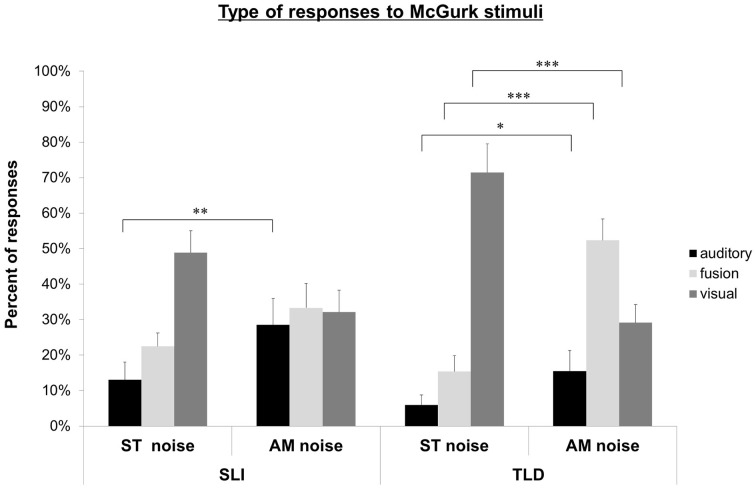
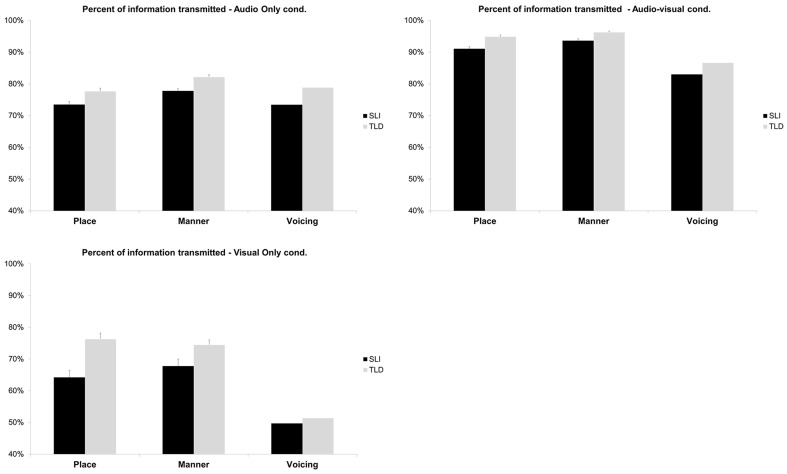
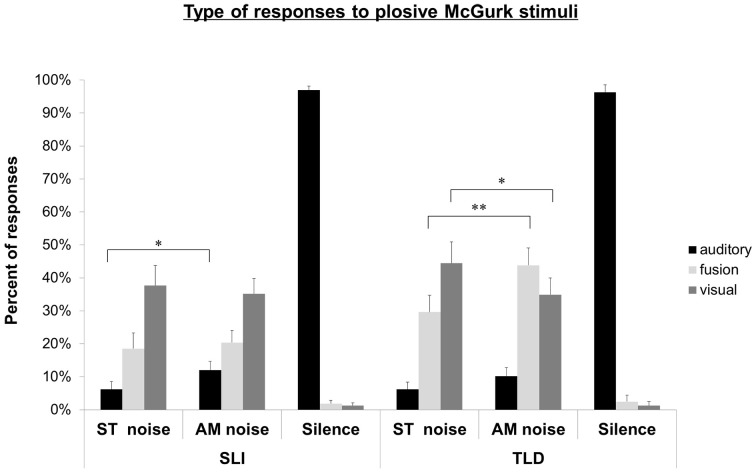
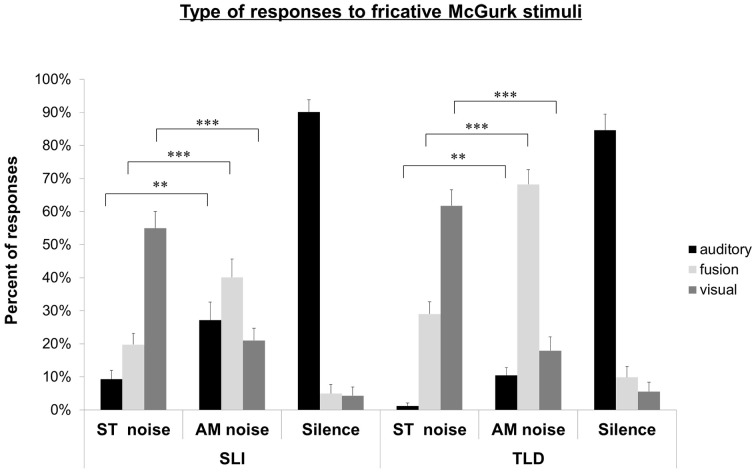
Audiovisual speech perception of children with specific language impairment (SLI) and children with typical language development (TLD) was compared in two experiments using /aCa/ syllables presented in the context of a masking release paradigm. Children had to repeat syllables presented in auditory alone, visual alone (speechreading), audiovisual congruent and incongruent (McGurk) conditions. Stimuli were masked by either stationary (ST) or amplitude modulated (AM) noise. Although children with SLI were less accurate in auditory and audiovisual speech perception, they showed similar auditory masking release effect than children with TLD. Children with SLI also had less correct responses in speechreading than children with TLD, indicating impairment in phonemic processing of visual speech information. In response to McGurk stimuli, children with TLD showed more fusions in AM noise than in ST noise, a consequence of the auditory masking release effect and of the influence of visual information. Children with SLI did not show this effect systematically, suggesting they were less influenced by visual speech. However, when the visual cues were easily identified, the profile of responses to McGurk stimuli was similar in both groups, suggesting that children with SLI do not suffer from an impairment of audiovisual integration. An analysis of percent of information transmitted revealed a deficit in the children with SLI, particularly for the place of articulation feature. Taken together, the data support the hypothesis of an intact peripheral processing of auditory speech information, coupled with a supra modal deficit of phonemic categorization in children with SLI. Clinical implications are discussed.
在两项实验中,比较了特定语言障碍(SLI)儿童和典型语言发展(TLD)儿童的视听言语感知,使用在掩蔽释放范式中呈现的/aCa/音节。儿童必须重复仅在听觉、仅在视觉(口语阅读)、视听一致和不一致(麦格克)条件下呈现的音节。刺激由固定(ST)或幅度调制(AM)噪声掩蔽。尽管 SLI 儿童在听觉和视听言语感知方面的准确性较低,但他们表现出与 TLD 儿童相似的听觉掩蔽释放效应。与 TLD 儿童相比,SLI 儿童在口语阅读中也有较少的正确反应,表明他们在视觉言语信息的音位处理方面存在障碍。对于麦格克刺激,TLD 儿童在 AM 噪声中比在 ST 噪声中表现出更多的融合,这是听觉掩蔽释放效应和视觉信息影响的结果。SLI 儿童没有系统地表现出这种效应,这表明他们较少受到视觉言语的影响。然而,当视觉线索容易识别时,两组对麦格克刺激的反应模式相似,这表明 SLI 儿童不受视听整合障碍的影响。对传递百分比的分析显示 SLI 儿童存在缺陷,特别是在发音特征方面。综上所述,这些数据支持了 SLI 儿童听觉言语信息的外周处理完整,加上音位分类的超模态缺陷的假设。讨论了临床意义。