Department of Rehabilitation Sciences and Physiotherapy, Faculty of Medicine and Health Sciences, University of Antwerp, Antwerp, Belgium; Translational Neurosciences, Faculty of Medicine and Health Sciences, University of Antwerp, Antwerp, Belgium; KU Leuven, Department of Rehabilitation Sciences, Leuven, Belgium.
KU Leuven, Department of Rehabilitation Sciences, Leuven, Belgium.
PLoS One. 2014 Jun 6;9(6):e98735. doi: 10.1371/journal.pone.0098735. eCollection 2014.
to determine the concurrent validity of a physical activity diary for measuring physical activity level and total energy expenditure in hospitalized stroke patients.
Sixteen stroke patients kept coded activity diaries and wore SenseWear Pro2 multi-sensor activity monitors during daytime hours for one day. A researcher observed the patients and completed a diary. Data from the patients' diaries were compared with observed and measured data to determine total activity (METs*minutes), activity level and total energy expenditure.
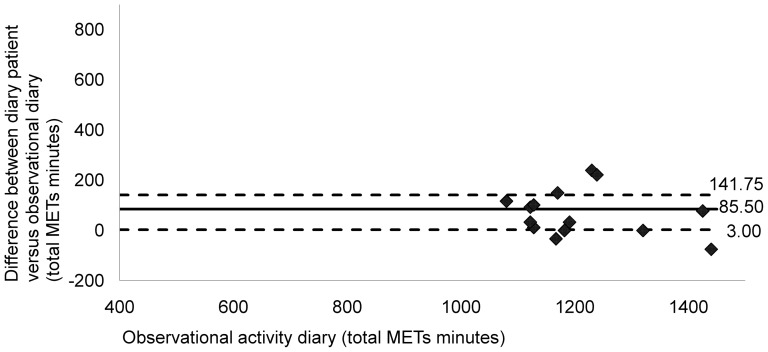
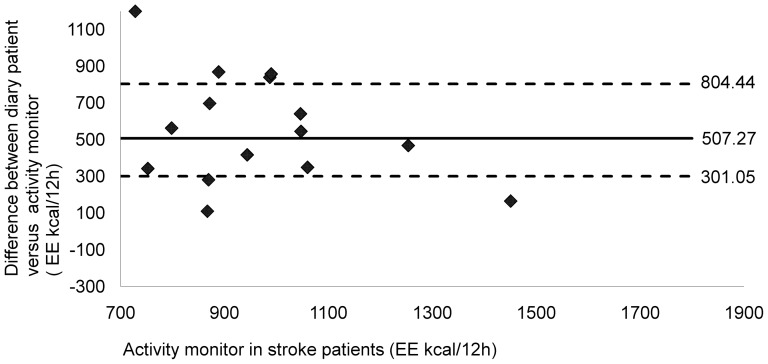
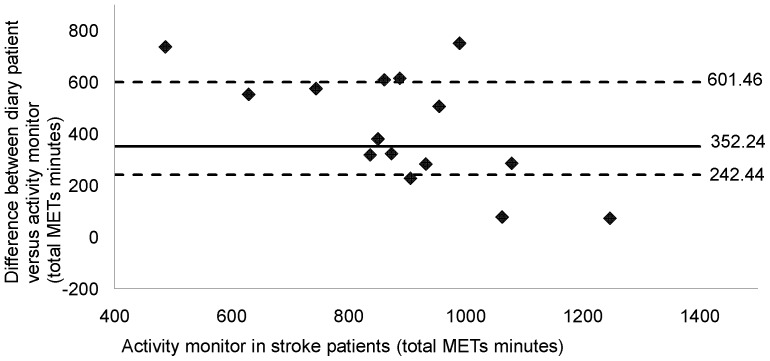
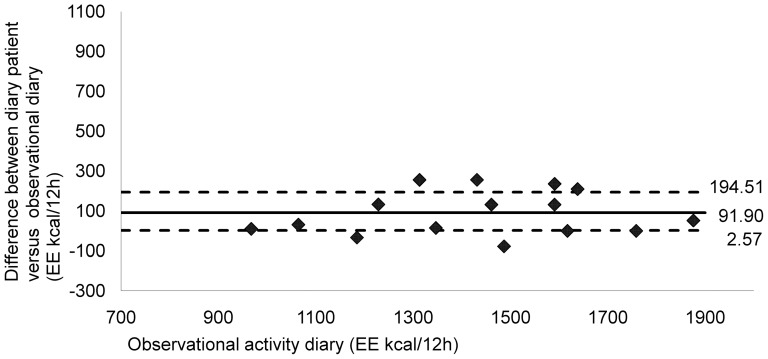
Spearman correlations between the patients' and researchers' diaries revealed a high correlation for total METsminutes (rs = 0.75, p<0.01) for sedentary (rs = 0.74,p<0.01) and moderate activities (rs = 0.71,p<0.01) and a very high correlation (rs = 0.92, p<0.01) for the total energy expenditure. Comparisons between the patients' diaries and activity monitor data revealed a low correlation (rs 0.29) for total METsminutes and energy expenditure.
Coded self-monitoring activity diaries appear feasible as a low-tech alternative to labor-intensive observational diaries for determining sedentary, moderate, and total physical activity and for quantifying energy expenditure in hospitalized stroke patients. Given the poor correlation with objective measurements of physical activity, however, further research is needed to validate its use against a gold-standard measure of physical activity intensity and energy expenditure.
确定活动日记在测量住院脑卒中患者活动水平和总能量消耗方面的同时效度。
16 例脑卒中患者在白天佩戴 SenseWear Pro2 多传感器活动监测器的同时记录编码活动日记,并且有一名研究人员对患者进行观察并完成日记记录。将患者日记中的数据与观察到的和测量到的数据进行比较,以确定总活动量(METs*分钟)、活动水平和总能量消耗。
患者日记和研究人员日记之间的 Spearman 相关分析显示,总 METs分钟(rs=0.75,p<0.01)、久坐(rs=0.74,p<0.01)和中度活动(rs=0.71,p<0.01)的相关性很高,总能量消耗的相关性极高(rs=0.92,p<0.01)。患者日记与活动监测器数据之间的比较显示,总 METs分钟和能量消耗的相关性较低(rs=0.29)。
编码自我监测活动日记似乎是一种可行的低技术替代方法,可以替代劳动密集型观察日记,用于确定住院脑卒中患者的久坐、中度和总体力活动,并量化能量消耗。然而,鉴于与体力活动强度和能量消耗的客观测量值的相关性较差,需要进一步研究以验证其对体力活动强度和能量消耗的黄金标准测量值的使用。