Chisholm Vivienne, Gonzalez Andrea, Atkinson Leslie
Division of Psychology & Sociology, Queen Margaret University, Edinburgh, Musselburgh, Scotland, United Kingdom.
Department of Psychiatry & Behavioural Neurosciences, McMaster University, Hamilton, Ontario, Canada.
PLoS One. 2014 Jun 6;9(6):e97672. doi: 10.1371/journal.pone.0097672. eCollection 2014.
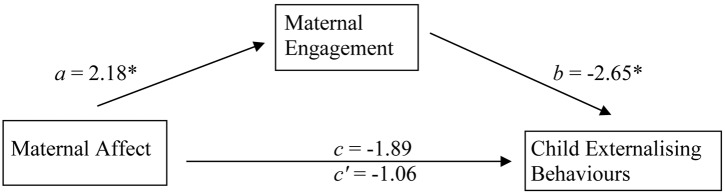
Mother-child interactions around a shared activity have been shown to play a key role in the development of young children's capacity to interact cooperatively with others. This evidence is particularly germane to type 1 diabetes (T1D) management in younger children where cooperation with parental treatment efforts is crucial for treatment success and where maternal distress and child behavioural problems are risk factors for treatment management, biomedical and psychological outcomes. In 49 4-to-8 year old children with T1D, we investigated whether the association between maternal affect and child problematic behaviour is mediated by mother-child interactions in the context of a T1D-relevant collaborative problem-solving activity. Mothers completed standardised measures of maternal and child psychological adjustment and interacted with their children in the problem-solving activity, analysed for quality of interpersonal engagement based on evaluations of maternal (sensitivity and cognitive stimulation) and dyadic (joint attention and warmth) behaviours. Mediation analyses confirmed the hypothesis that interpersonal engagement mediates the relation between maternal affective state and child behavioural problems. Specifically, more negative maternal affect is associated with lower levels of interpersonal engagement; these less engaged interactions in turn are associated with more behavioural problems in children. These findings are consistent with research involving typically developing children. The implications of our findings are twofold. First, in the context of psychological adjustment to T1D, maternal affect and mother-child interactions are 2 potential targets for interventions which promote cooperative interactions. Second, understanding and caring for children at biological risk requires attention to developmental psychology theory and method; in particular, research addressing parent-child cooperation carries both conceptual and clinical relevance.
围绕一项共同活动的母婴互动已被证明在幼儿与他人合作互动能力的发展中起着关键作用。这一证据对于年幼儿童的1型糖尿病(T1D)管理尤为相关,在这种情况下,与父母治疗努力的合作对于治疗成功至关重要,而且母亲的痛苦和儿童行为问题是治疗管理、生物医学和心理结果的风险因素。在49名4至8岁的T1D儿童中,我们调查了在与T1D相关的协作性问题解决活动背景下,母亲的情感与儿童问题行为之间的关联是否由母婴互动介导。母亲们完成了母婴心理调适的标准化测量,并在问题解决活动中与孩子互动,根据对母亲(敏感性和认知刺激)和二元(共同注意力和温暖)行为的评估分析人际互动质量。中介分析证实了人际互动介导母亲情感状态与儿童行为问题之间关系的假设。具体而言,母亲更多的负面情感与较低水平的人际互动相关;这些互动较少的情况反过来又与儿童更多的行为问题相关。这些发现与涉及正常发育儿童的研究一致。我们研究结果的影响是双重的。首先,在对T1D进行心理调适的背景下,母亲的情感和母婴互动是促进合作互动的干预措施的两个潜在目标。其次,理解和照顾处于生物风险中的儿童需要关注发展心理学理论和方法;特别是,涉及亲子合作的研究具有概念和临床相关性。