INSERM U1018, Paris 94270, Le Kremlin Bicêtre France.
BMC Pediatr. 2014 Jun 6;14:143. doi: 10.1186/1471-2431-14-143.
Acute viral respiratory exacerbation is one of the most common conditions encountered in a paediatric emergency department (PED) during winter months. We aimed at defining clinical predictors of chest radiography prescription and radiographic abnormalities, among infants with bronchiolitis in a paediatric emergency department.
We conducted a prospective cohort study of children less than 2 years of age with clinical bronchiolitis, who presented for evaluation at the paediatric emergency department of an urban general hospital in France. Detailed information regarding historical features, examination findings, and management were collected. Clinical predictors of interest were explored in multivariate logistic regression models.
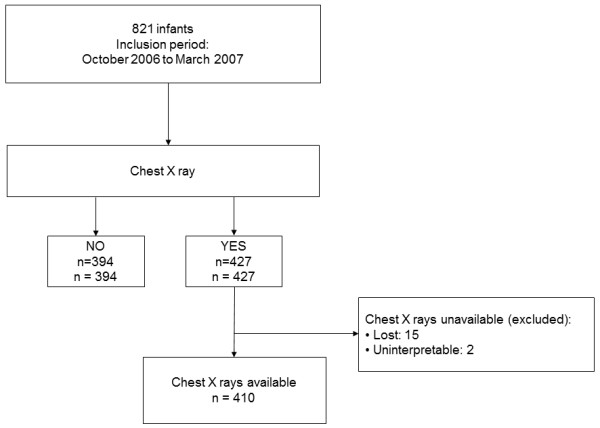
Among 410 chest radiographs blindly interpreted by two experts, 40 (9.7%) were considered as abnormal. Clinical predictors of chest radiography achievement were age (under three months), feeding difficulties, fever over 38°C, hypoxia under than 95% of oxygen saturation, respiratory distress, crackles, and bronchitis rales. Clinical predictors of radiographic abnormalities were fever and close to significance hypoxia and conjunctivitis.
Our study provides arguments for reducing chest radiographs in infants with bronchiolitis. For infants with clinical factors such as age less than three months, feeding difficulties, respiratory distress without hypoxia, isolated crackles or bronchitis rales, careful clinical follow-up should be provided instead of chest radiography.
急性病毒性呼吸道加重是儿科急诊部门(PED)在冬季最常见的病症之一。我们旨在确定小儿急诊部毛细支气管炎婴儿中胸部 X 光检查处方和放射异常的临床预测因素。
我们对法国一家城市综合医院儿科急诊部就诊的 2 岁以下有临床毛细支气管炎的儿童进行了前瞻性队列研究。收集了详细的病史特征、检查结果和治疗信息。使用多变量逻辑回归模型探讨了感兴趣的临床预测因素。
在由两位专家进行的 410 张胸部 X 光片盲法解读中,40 张(9.7%)被认为异常。进行胸部 X 光检查的临床预测因素是年龄(小于三个月)、喂养困难、体温超过 38°C、血氧饱和度低于 95%的缺氧、呼吸窘迫、哮鸣音和支气管炎啰音。放射异常的临床预测因素是发热和接近意义的缺氧和结膜炎。
我们的研究为减少毛细支气管炎婴儿的胸部 X 光检查提供了依据。对于年龄小于三个月、喂养困难、无缺氧的呼吸窘迫、孤立性哮鸣音或支气管炎啰音的婴儿,应提供仔细的临床随访,而不是胸部 X 光检查。