Research Service, Denver VA Medical Center, Denver, CO, USA; Department of Psychiatry, University of Colorado Anschutz Medical Campus, Aurora, CO, USA; Neuroscience Program, University of Colorado Anschutz Medical Campus, Aurora, CO, USA.
Department of Psychiatry, University of Colorado Anschutz Medical Campus, Aurora, CO, USA.
Trends Pharmacol Sci. 2014 Aug;35(8):397-403. doi: 10.1016/j.tips.2014.05.001. Epub 2014 Jun 3.
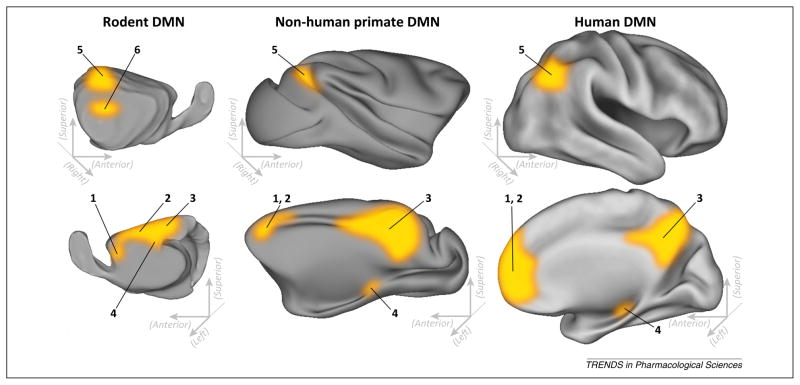
Developing translational biomarkers is a priority for psychiatry research. Task-independent functional brain imaging is a relatively novel technique that allows examination of the brain's intrinsic networks, defined as functionally and (often) structurally connected populations of neurons whose properties reflect fundamental neurobiological organizational principles of the central nervous system. The ability to study the activity and organization of these networks has opened a promising new avenue for translational investigation, because they can be analogously examined across species and disease states. Interestingly, imaging studies have revealed shared spatial and functional characteristics of the intrinsic network architecture of the brain across species, including mice, rats, non-human primates, and humans. Using schizophrenia as an example, we show how intrinsic networks may show similar abnormalities in human diseases and animal models of these diseases, supporting their use as biomarkers in drug development.
开发转化生物标志物是精神病学研究的重点。任务独立性的功能脑成像技术是一种相对较新的技术,可用于检查大脑的内在网络,内在网络被定义为具有功能和(通常)结构连接的神经元群体,其特性反映了中枢神经系统的基本神经生物学组织原则。研究这些网络的活动和组织的能力为转化研究开辟了一条有前途的新途径,因为它们可以在物种和疾病状态之间进行类似的检查。有趣的是,成像研究揭示了包括小鼠、大鼠、非人灵长类动物和人类在内的不同物种大脑内在网络结构的共享空间和功能特征。我们以精神分裂症为例,展示了内在网络在人类疾病和这些疾病的动物模型中可能表现出相似的异常,支持它们作为药物开发中的生物标志物。