Mueller Cornelia, Blum Claudine A, Trummler Michael, Stolz Daiana, Bingisser Roland, Mueller Christian, Tamm Michael, Mueller Beat, Schuetz Philipp, Christ-Crain Mirjam
Department of Endocrinology, Diabetology and Metabolism, UniversityHospital, Basel, Switzerland.
Bioanalytica AG, Luzern, Switzerland.
PLoS One. 2014 Jun 9;9(6):e99518. doi: 10.1371/journal.pone.0099518. eCollection 2014.
Rapid and accurate risk stratification in patients with community-acquired pneumonia (CAP) is an unmet clinical need. Cortisol to dehydroepiandrosterone (DHEA) ratio was put forward as a prognostic marker in sepsis. We herein validated the prognostic value of the adrenal hormones DHEA, DHEA-Sulfate (DHEAS), cortisol/DHEA-, cortisol/DHEAS- and DHEA/DHEAS-ratios in patients with CAP.
We assessed severity of illness using the pneumonia severity index (PSI) and measured adrenal hormone concentrations in 179 serum samples of prospectively recruited patients hospitalized with CAP. We calculated spearman rank correlation, logistic regression analysis and Kaplan Meier curves to study associations of adrenal hormones and outcomes.
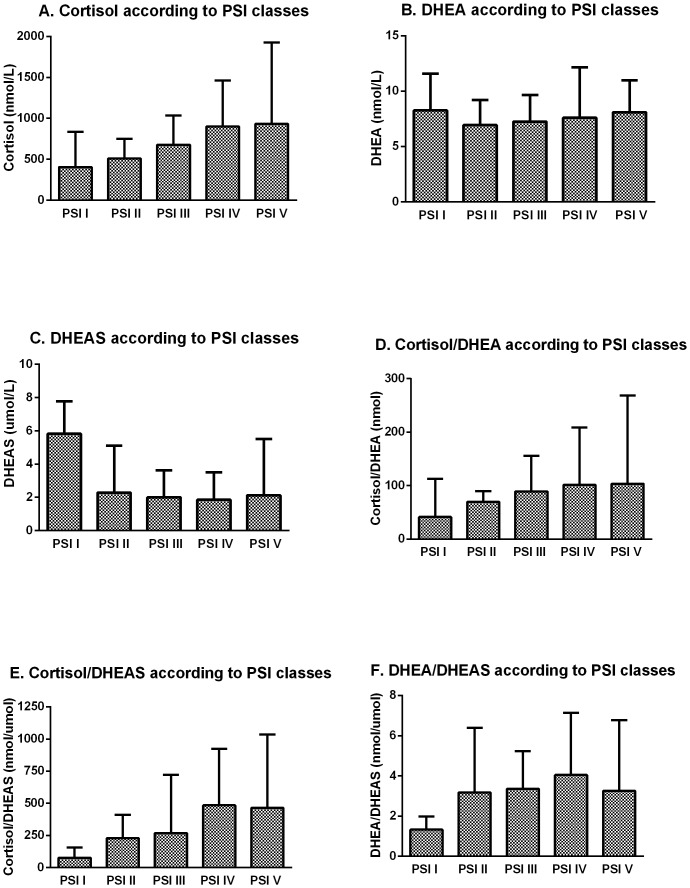
There was a significant correlation between PSI score and total cortisol (r = 0.24, p = 0.001), DHEAS (r = -0.23, p = 0.002), cortisol/DHEA (r = 0.23, p = 0.003), cortisol/DHEAS (r = 0.32, p = <0.0001) and DHEA/DHEAS (r = 0.20, p = 0.009). In age and gender adjusted logistic regression analysis, cortisol (OR:2.8, 95% CI: 1.48-5.28) and DHEA (OR: 2.62,95% CI: 1.28-5.34), but not DHEAS and the different ratios were associated with all-cause mortality. The discriminatory accuracy of cortisol and DHEA in ROC analysis (area under the curve) was 0.74 and 0.61. In Kaplan Meier analysis, patients in the highest deciles of cortisol and DHEA (p = 0.005 and p = 0.015), and to a lesser extent of cortisol/DHEAS ratio (p = 0.081) had a higher risk of death.
Cortisol, DHEAS and their ratios correlate with CAP severity, and cortisol and DHEA predict mortality. Adrenal function in severe pneumonia may be an important factor for CAP outcomes.
社区获得性肺炎(CAP)患者快速准确的风险分层是一项尚未满足的临床需求。皮质醇与脱氢表雄酮(DHEA)的比值被提出作为脓毒症的预后标志物。我们在此验证了肾上腺激素脱氢表雄酮(DHEA)、硫酸脱氢表雄酮(DHEAS)、皮质醇/DHEA比值、皮质醇/DHEAS比值和DHEA/DHEAS比值在CAP患者中的预后价值。
我们使用肺炎严重程度指数(PSI)评估疾病严重程度,并测定了179例因CAP住院的前瞻性招募患者的血清样本中的肾上腺激素浓度。我们计算了斯皮尔曼等级相关性、逻辑回归分析和Kaplan Meier曲线,以研究肾上腺激素与预后的关联。
PSI评分与总皮质醇(r = 0.24,p = 0.001)、DHEAS(r = -0.23,p = 0.002)、皮质醇/DHEA(r = 0.23,p = 0.003)、皮质醇/DHEAS(r = 0.32,p = <0.0001)和DHEA/DHEAS(r = 0.20,p = 0.009)之间存在显著相关性。在年龄和性别调整的逻辑回归分析中,皮质醇(OR:2.8,95%CI:1.48 - 5.28)和DHEA(OR:2.62,95%CI:1.28 - 5.34),但不是DHEAS和不同比值与全因死亡率相关。在ROC分析(曲线下面积)中,皮质醇和DHEA的鉴别准确性分别为0.74和0.61。在Kaplan Meier分析中,皮质醇和DHEA处于最高十分位数的患者(p = 0.005和p = 0.015),以及皮质醇/DHEAS比值在较小程度上处于最高十分位数的患者(p = 0.081)死亡风险更高。
皮质醇、DHEAS及其比值与CAP严重程度相关,皮质醇和DHEA可预测死亡率。重症肺炎中的肾上腺功能可能是影响CAP预后的重要因素。