• 文献检索
  • 文档翻译
  • 深度研究
  • 学术资讯
  • Suppr Zotero 插件Zotero 插件
  • 邀请有礼
  • 套餐&价格
  • 历史记录
应用&插件
Suppr Zotero 插件Zotero 插件浏览器插件Mac 客户端Windows 客户端微信小程序
定价
高级版会员购买积分包购买API积分包
服务
文献检索文档翻译深度研究API 文档MCP 服务
关于我们
关于 Suppr公司介绍联系我们用户协议隐私条款
关注我们

Suppr 超能文献

核心技术专利:CN118964589B侵权必究
粤ICP备2023148730 号-1Suppr @ 2026

文献检索

告别复杂PubMed语法,用中文像聊天一样搜索,搜遍4000万医学文献。AI智能推荐,让科研检索更轻松。

立即免费搜索

文件翻译

保留排版,准确专业,支持PDF/Word/PPT等文件格式,支持 12+语言互译。

免费翻译文档

深度研究

AI帮你快速写综述,25分钟生成高质量综述,智能提取关键信息,辅助科研写作。

立即免费体验

动脉瘤性蛛网膜下腔出血再出血的危险因素:一项荟萃分析。

Risk factors for rebleeding of aneurysmal subarachnoid hemorrhage: a meta-analysis.

作者信息

Tang Chao, Zhang Tian-Song, Zhou Liang-Fu

机构信息

Department of Neurosurgery, Huashan Hospital, Fudan University, Shanghai, China.

Department of TCM, Shanghai Jing-an District Central hospital, Shanghai, China.

出版信息

PLoS One. 2014 Jun 9;9(6):e99536. doi: 10.1371/journal.pone.0099536. eCollection 2014.

DOI:10.1371/journal.pone.0099536
PMID:24911172
原文链接:https://pmc.ncbi.nlm.nih.gov/articles/PMC4049799/
Abstract

BACKGROUND

Rebleeding is a serious complication of aneurysmal subarachnoid hemorrhaging. To date, there are conflicting data regarding the factors contributing to rebleeding and their significance.

METHODS

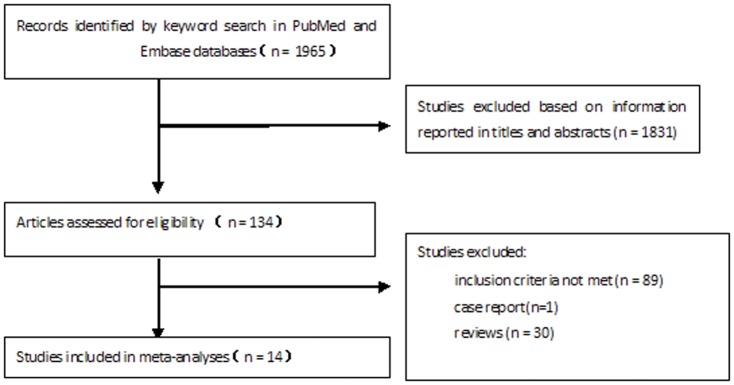
A systematic review of PubMed and Embase databases was conducted for studies pertaining to aneurysmal subarachnoid hemorrhage (aSAH) and rebleeding in order to assess the associated risk factors. Odds ratios (ORs) and corresponding 95% confidence intervals (CIs) were estimated from fourteen studies comprised of a total of 5693 patients that met the inclusion criteria.

RESULTS

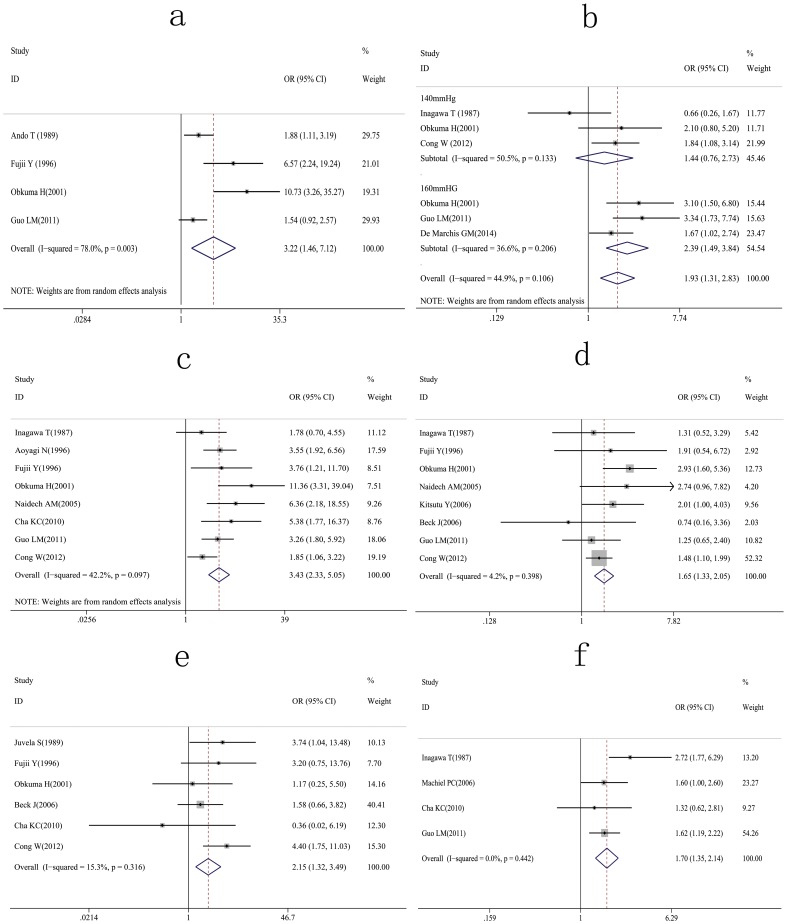
Higher rebleeding rates were observed < 6 h after the initial aSAH (OR  = 3.22, 95% CI  = 1.46-7.12), and were associated with high systolic blood pressure (OR  = 1.93, 95% CI  = 1.31-2.83), poor Hunt-Hess grade (III-IV) (OR  = 3.43, 95% CI  = 2.33-5.05), intracerebral or intraventricular hematomas (OR  = 1.65, 95% CI  = 1.33-2.05), posterior circulation aneurysms (OR  = 2.15, 95% CI  = 1.32-3.49), and aneurysms >10 mm in size (OR  = 1.70, 95% CI  = 1.35-2.14).

CONCLUSIONS

Aneurysmal rebleeding occurs more frequently within the first 6 hours after the initial aSAH. Risk factors associated with rebleeding include high systolic pressure, the presence of an intracerebral or intraventricular hematoma, poor Hunt-Hess grade (III-IV), aneurysms in the posterior circulation, and an aneurysm >10 mm in size.

摘要

背景

再出血是动脉瘤性蛛网膜下腔出血的一种严重并发症。迄今为止,关于导致再出血的因素及其重要性的数据相互矛盾。

方法

对PubMed和Embase数据库进行系统综述,以查找与动脉瘤性蛛网膜下腔出血(aSAH)和再出血相关的研究,从而评估相关危险因素。从14项研究中估计比值比(OR)和相应的95%置信区间(CI),这些研究共纳入5693例符合纳入标准的患者。

结果

在初次aSAH后<6小时观察到较高的再出血率(OR = 3.22,95%CI = 1.46 - 7.12),且与收缩压升高(OR = 1.93,95%CI = 1.31 - 2.83)、Hunt-Hess分级差(III-IV级)(OR = 3.43,95%CI = 2.33 - 5.05)、脑内或脑室内血肿(OR = 1.65,95%CI = 1.33 - 2.05)、后循环动脉瘤(OR = 2.15,95%CI = 1.32 - 3.49)以及直径>10 mm的动脉瘤(OR = 1.70,95%CI = 1.35 - 2.14)相关。

结论

动脉瘤性再出血在初次aSAH后的最初6小时内更频繁发生。与再出血相关的危险因素包括收缩压升高、脑内或脑室内血肿、Hunt-Hess分级差(III-IV级)、后循环动脉瘤以及直径>10 mm的动脉瘤。
https://cdn.ncbi.nlm.nih.gov/pmc/blobs/20df/4049799/8bf0505cf212/pone.0099536.g002.jpg
https://cdn.ncbi.nlm.nih.gov/pmc/blobs/20df/4049799/b14082ef74e7/pone.0099536.g001.jpg
https://cdn.ncbi.nlm.nih.gov/pmc/blobs/20df/4049799/8bf0505cf212/pone.0099536.g002.jpg
https://cdn.ncbi.nlm.nih.gov/pmc/blobs/20df/4049799/b14082ef74e7/pone.0099536.g001.jpg
https://cdn.ncbi.nlm.nih.gov/pmc/blobs/20df/4049799/8bf0505cf212/pone.0099536.g002.jpg

相似文献

1
Risk factors for rebleeding of aneurysmal subarachnoid hemorrhage: a meta-analysis.动脉瘤性蛛网膜下腔出血再出血的危险因素:一项荟萃分析。
PLoS One. 2014 Jun 9;9(6):e99536. doi: 10.1371/journal.pone.0099536. eCollection 2014.
2
Elevated Blood Pressure and Culprit Aneurysm Rebleeding During the Unsecured Period of Aneurysmal Subarachnoid Hemorrhage: A Systematic Review.动脉瘤性蛛网膜下腔出血未妥善处理期间的血压升高与责任动脉瘤再出血:一项系统评价
Neurocrit Care. 2025 Apr;42(2):351-362. doi: 10.1007/s12028-024-02138-4. Epub 2024 Oct 14.
3
Risk factors of short-term poor functional outcomes and long-term durability of ruptured large or giant intracranial aneurysms.大型或巨大型破裂颅内动脉瘤短期功能预后不良及长期耐久性的危险因素。
J Neurosurg. 2025 Jan 10;142(6):1776-1785. doi: 10.3171/2024.8.JNS24894. Print 2025 Jun 1.
4
Predictive factors for pre-intervention rebleeding in aneurysmal subarachnoid haemorrhage: a systematic review and meta-analysis.动脉瘤性蛛网膜下腔出血干预前再出血的预测因素:一项系统评价和荟萃分析。
Neurosurg Rev. 2022 Dec 23;46(1):24. doi: 10.1007/s10143-022-01930-0.
5
Intraoperative mild hypothermia for postoperative neurological deficits in intracranial aneurysm patients.颅内动脉瘤患者术中轻度低温与术后神经功能缺损
Cochrane Database Syst Rev. 2012 Feb 15(2):CD008445. doi: 10.1002/14651858.CD008445.pub2.
6
Aneurysm rebleeding after placement of external ventricular drainage: a systematic review and meta-analysis.外置脑室引流术后动脉瘤再出血:一项系统评价和荟萃分析
Acta Neurochir (Wien). 2017 Apr;159(4):695-704. doi: 10.1007/s00701-017-3124-1. Epub 2017 Feb 27.
7
Risk factors of shunt-dependent hydrocephalus after subarachnoid hemorrhage: a systematic review and meta-analysis based on observational cohort studies.蛛网膜下腔出血后分流依赖性脑积水的危险因素:基于观察性队列研究的系统评价和荟萃分析。
Neurosurg Rev. 2024 Aug 13;47(1):421. doi: 10.1007/s10143-024-02589-5.
8
External Validation of the ARISE Prediction Models for Aneurysmal Rebleeding After Aneurysmal Subarachnoid Hemorrhage.动脉瘤性蛛网膜下腔出血后动脉瘤再出血的ARISE预测模型的外部验证
Neurosurgery. 2024 Nov 21;97(1):120-129. doi: 10.1227/neu.0000000000003275.
9
Risk factors for re-bleeding of aneurysmal subarachnoid hemorrhage: meta-analysis of observational studies.动脉瘤性蛛网膜下腔出血再出血的危险因素:观察性研究的Meta分析
Neurol Neurochir Pol. 2014;48(5):346-55. doi: 10.1016/j.pjnns.2014.08.002. Epub 2014 Sep 3.
10
Predictors of Shunt-dependent Hydrocephalus After Aneurysmal Subarachnoid Hemorrhage? A Systematic Review and Meta-Analysis.动脉瘤性蛛网膜下腔出血后分流依赖型脑积水的预测因素?一项系统评价和荟萃分析。
World Neurosurg. 2017 Oct;106:844-860.e6. doi: 10.1016/j.wneu.2017.06.119. Epub 2017 Jun 23.

引用本文的文献

1
Outcome Determinant of Patients Following Microsurgical Clipping of Ruptured Intracranial Aneurysms.破裂颅内动脉瘤显微手术夹闭术后患者的预后决定因素
Asian J Neurosurg. 2025 Feb 20;20(2):301-313. doi: 10.1055/s-0045-1804529. eCollection 2025 Jun.
2
Spontaneous subarachnoid hemorrhage: A primer for acute care practitioners.自发性蛛网膜下腔出血:急性护理从业者入门指南。
J Intensive Care Soc. 2025 May 27:17511437251333269. doi: 10.1177/17511437251333269.
3
Chinese Guidelines for the Prevention and Treatment of Hypertension (2024 revision).

本文引用的文献

1
Impact of premorbid hypertension on haemorrhage severity and aneurysm rebleeding risk after subarachnoid haemorrhage.高血压对蛛网膜下腔出血后出血严重程度和动脉瘤再出血风险的影响。
J Neurol Neurosurg Psychiatry. 2014 Jan;85(1):56-9. doi: 10.1136/jnnp-2013-305051. Epub 2013 Jun 29.
2
Risk factors for rebleeding of aneurysmal subarachnoid hemorrhage based on the analysis of on-admission information.基于入院信息分析的动脉瘤性蛛网膜下腔出血再出血危险因素
Turk Neurosurg. 2012;22(6):675-81. doi: 10.5137/1019-5149.JTN.5054-11.1.
3
Reduced clot-stability during the first 6 hours after aneurysmal subarachnoid haemorrhage--a prospective case-control study.
《中国高血压防治指南(2024年修订版)》
J Geriatr Cardiol. 2025 Jan 28;22(1):1-149. doi: 10.26599/1671-5411.2025.01.008.
4
Individualized autoregulation-guided arterial blood pressure management in neurocritical care.神经重症监护中基于个体化自动调节指导的动脉血压管理
Neurotherapeutics. 2025 Jan;22(1):e00526. doi: 10.1016/j.neurot.2025.e00526. Epub 2025 Jan 18.
5
Elevated Blood Pressure and Culprit Aneurysm Rebleeding During the Unsecured Period of Aneurysmal Subarachnoid Hemorrhage: A Systematic Review.动脉瘤性蛛网膜下腔出血未妥善处理期间的血压升高与责任动脉瘤再出血:一项系统评价
Neurocrit Care. 2025 Apr;42(2):351-362. doi: 10.1007/s12028-024-02138-4. Epub 2024 Oct 14.
6
Characteristics of a Pure Acute Subdural Hematoma Caused by Intracranial Aneurysm Rupture: A Case Report and Review of Literature.颅内动脉瘤破裂致单纯急性硬膜下血肿的特征:1例报告及文献复习
Cureus. 2024 Aug 10;16(8):e66575. doi: 10.7759/cureus.66575. eCollection 2024 Aug.
7
Outcomes following surgical clipping of re-ruptured previously untreated intracranial aneurysms.再次破裂的未经治疗的颅内动脉瘤手术后的结果。
Neurosurg Rev. 2024 Aug 20;47(1):442. doi: 10.1007/s10143-024-02657-w.
8
Blood Pressure Management in Early Aneurysmal Subarachnoid Hemorrhage: A National Cross-Sectional Survey of Canadian Intensivists and Cerebrovascular Neurosurgeons.颅内动脉瘤性蛛网膜下腔出血早期的血压管理:加拿大重症监护医师和脑血管神经外科医师的全国横断面调查。
Neurocrit Care. 2024 Dec;41(3):893-902. doi: 10.1007/s12028-024-02011-4. Epub 2024 Jun 11.
9
An Epidemiological Investigation on Patients with Non-traumatic Subarachnoid Hemorrhage from 2010 to 2020.2010年至2020年非创伤性蛛网膜下腔出血患者的流行病学调查
Bull Emerg Trauma. 2024;12(1):35-41. doi: 10.30476/BEAT.2024.101708.1495.
10
Three Pillars of Recovery After Aneurysmal Subarachnoid Hemorrhage: A Narrative Review.动脉瘤性蛛网膜下腔出血后恢复的三大支柱:一篇叙述性综述
Transl Stroke Res. 2025 Feb;16(1):119-132. doi: 10.1007/s12975-024-01249-6. Epub 2024 Apr 11.
动脉瘤性蛛网膜下腔出血后 6 小时内凝血稳定性降低——一项前瞻性病例对照研究。
Thromb Res. 2012 May;129(5):e229-32. doi: 10.1016/j.thromres.2012.01.016. Epub 2012 Mar 3.
4
Risk factors related to aneurysmal rebleeding.与动脉瘤再出血相关的危险因素。
World Neurosurg. 2011 Sep-Oct;76(3-4):292-8; discussion 253-4. doi: 10.1016/j.wneu.2011.03.025.
5
Analysis by categorizing or dichotomizing continuous variables is inadvisable: an example from the natural history of unruptured aneurysms.将连续变量分类或二分法分析是不可取的:未破裂动脉瘤自然史的一个例子。
AJNR Am J Neuroradiol. 2011 Mar;32(3):437-40. doi: 10.3174/ajnr.A2425. Epub 2011 Feb 17.
6
Aneurysmal rebleeding : factors associated with clinical outcome in the rebleeding patients.动脉瘤再出血:再出血患者临床结局的相关因素
J Korean Neurosurg Soc. 2010 Feb;47(2):119-23. doi: 10.3340/jkns.2010.47.2.119. Epub 2010 Feb 28.
7
Preferred reporting items for systematic reviews and meta-analyses: the PRISMA statement.系统评价与Meta分析的首选报告项目:PRISMA声明。
Ann Intern Med. 2009 Aug 18;151(4):264-9, W64. doi: 10.7326/0003-4819-151-4-200908180-00135. Epub 2009 Jul 20.
8
Management of hypertensive emergencies in acute brain disease: evaluation of the treatment effects of intravenous nicardipine on cerebral oxygenation.急性脑疾病中高血压急症的管理:静脉注射尼卡地平对脑氧合治疗效果的评估
J Neurosurg. 2008 Dec;109(6):1065-74. doi: 10.3171/JNS.2008.109.12.1065.
9
Sensitivity of between-study heterogeneity in meta-analysis: proposed metrics and empirical evaluation.Meta分析中研究间异质性的敏感性:提出的指标及实证评估
Int J Epidemiol. 2008 Oct;37(5):1148-57. doi: 10.1093/ije/dyn065. Epub 2008 Apr 18.
10
Rebleeding during transport of patients with a ruptured intracranial aneurysm.颅内动脉瘤破裂患者在转运过程中的再出血。
J Stroke Cerebrovasc Dis. 1999 Jan-Feb;8(1):38-41. doi: 10.1016/s1052-3057(99)80038-x.