Köhler Andrea, Demir Ummühan, Kickstein Eva, Krauss Sybille, Aigner Johanna, Aranda-Orgillés Beatriz, Karagiannidis Antonios I, Achmüller Clemens, Bu Huajie, Wunderlich Andrea, Schweiger Michal-Ruth, Schaefer Georg, Schweiger Susann, Klocker Helmut, Schneider Rainer
Institute of Biochemistry, Center of Molecular Biosciences Innsbruck (CMBI), University of Innsbruck, 6020 Innsbruck, Austria.
Mol Cancer. 2014 Jun 9;13:146. doi: 10.1186/1476-4598-13-146.
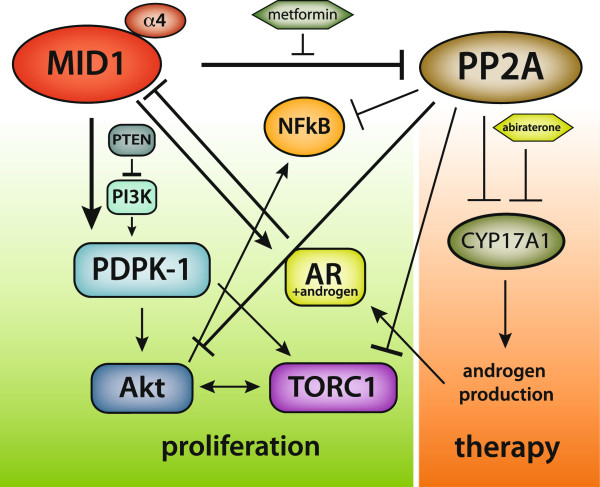
High androgen receptor (AR) level in primary tumour predicts increased prostate cancer (PCa)-specific mortality. Furthermore, activations of the AR, PI3K, mTOR, NFκB and Hedgehog (Hh) signaling pathways are involved in the fatal development of castration-resistant prostate cancer during androgen ablation therapy. MID1, a negative regulator of the tumor-suppressor PP2A, is known to promote PI3K, mTOR, NFκB and Hh signaling. Here we investigate the interaction of MID1 and AR.
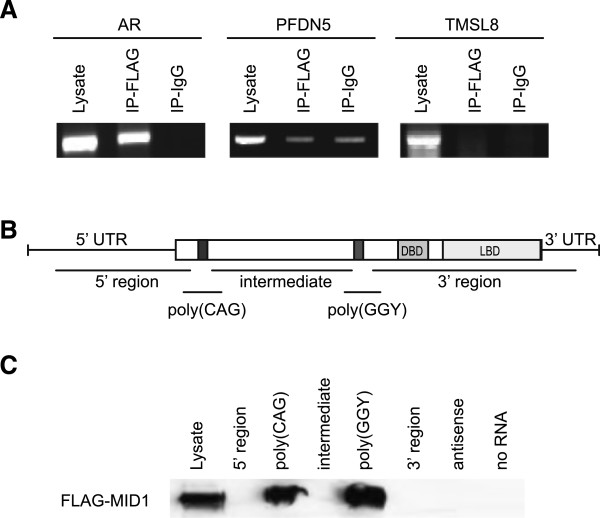
AR and MID1 mRNA and protein levels were measured by qPCR, Western blot and immunohistochemistry. Co-immunoprecipitation followed by PCR and RNA-pull-down followed by Western blot was used to investigate protein-mRNA interaction, chromatin-immunoprecipitation followed by next-generation sequencing for identification of AR chromatin binding sites. AR transcriptional activity and activity of promoter binding sites for AR were analyzed by reporter gene assays. For knockdown or overexpression of proteins of interest prostate cancer cells were transfected with siRNA or expression plasmids, respectively.
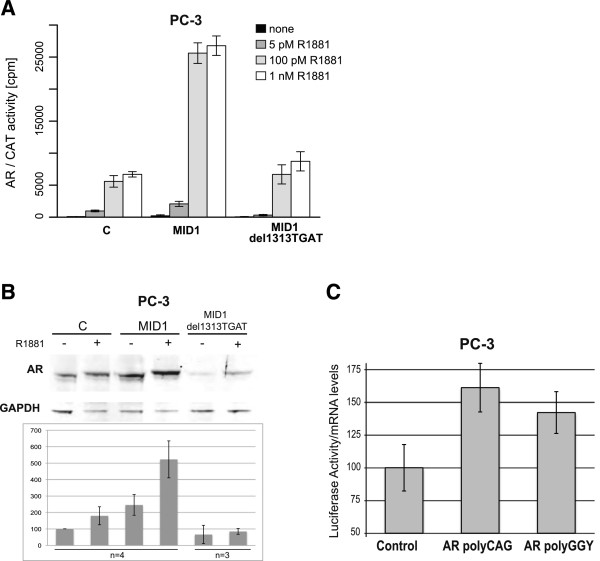
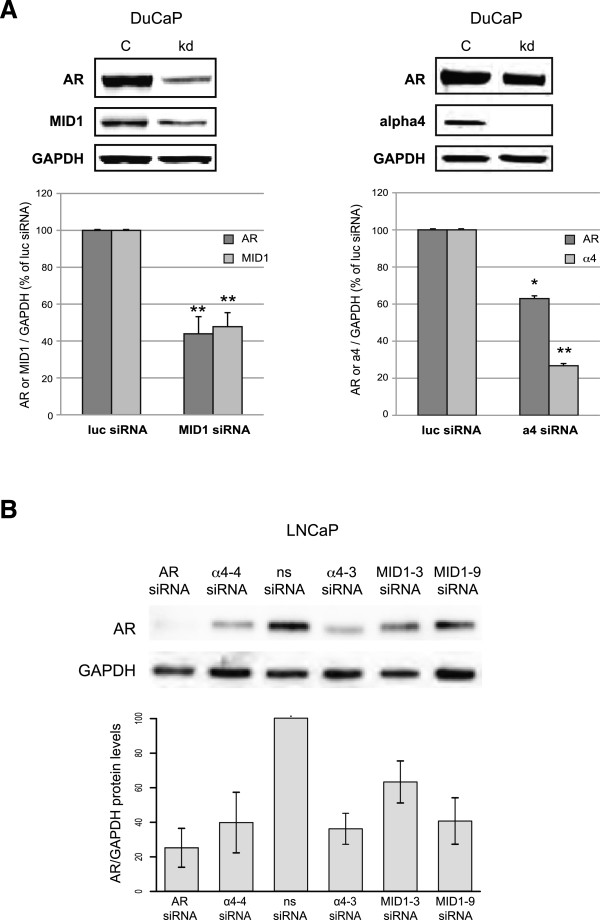
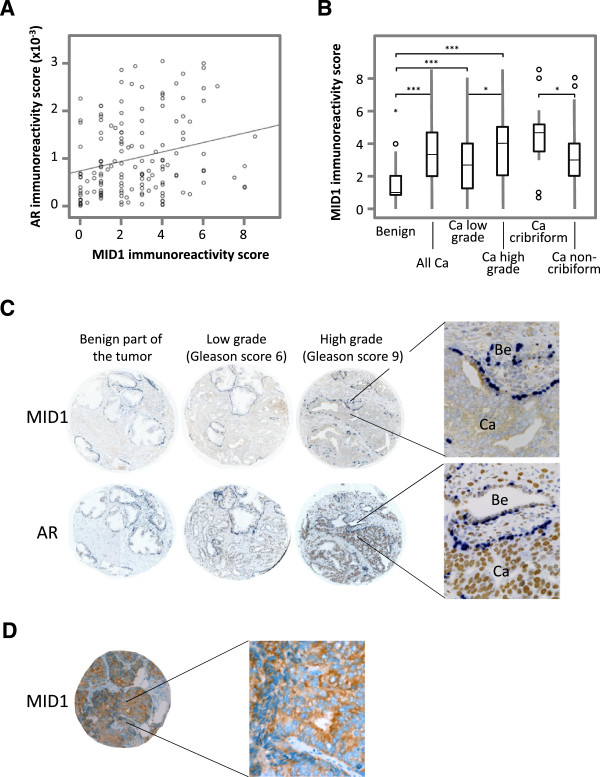
The microtubule-associated MID1 protein complex associates with AR mRNA via purine-rich trinucleotide repeats, expansions of which are known to correlate with ataxia and cancer. The level of MID1 directly correlates with the AR protein level in PCa cells. Overexpression of MID1 results in a several fold increase in AR protein and activity without major changes in mRNA-levels, whereas siRNA-triggered knockdown of MID1 mRNA reduces AR-protein levels significantly. Upregulation of AR protein by MID1 occurs via increased translation as no major changes in AR protein stability could be observed. AR on the other hand, regulates MID1 via several functional AR binding sites in the MID1 gene, and, in the presence of androgens, exerts a negative feedback loop on MID1 transcription. Thus, androgen withdrawal increases MID1 and concomitantly AR-protein levels. In line with this, MID1 is significantly over-expressed in PCa in a stage-dependent manner.
Promotion of AR, in addition to enhancement of the Akt-, NFκB-, and Hh-pathways by sustained MID1-upregulation during androgen deprivation therapy provides a powerful proliferative scenario for PCa progression into castration resistance. Thus MID1 represents a novel, multi-faceted player in PCa and a promising target to treat castration resistant prostate cancer.
原发性肿瘤中高雄激素受体(AR)水平预示前列腺癌(PCa)特异性死亡率增加。此外,AR、PI3K、mTOR、NFκB和Hedgehog(Hh)信号通路的激活参与了雄激素剥夺治疗期间去势抵抗性前列腺癌的致命发展。MID1是肿瘤抑制因子PP2A的负调节因子,已知其可促进PI3K、mTOR、NFκB和Hh信号传导。在此,我们研究MID1与AR的相互作用。
通过qPCR、蛋白质印迹法和免疫组织化学检测AR和MID1的mRNA及蛋白质水平。采用免疫共沉淀后进行PCR以及RNA下拉后进行蛋白质印迹法研究蛋白质 - mRNA相互作用,采用染色质免疫沉淀后进行下一代测序以鉴定AR染色质结合位点。通过报告基因检测分析AR转录活性及AR启动子结合位点的活性。为了敲低或过表达感兴趣的蛋白质,分别用小干扰RNA(siRNA)或表达质粒转染前列腺癌细胞。
微管相关的MID1蛋白复合物通过富含嘌呤的三核苷酸重复序列与AR mRNA结合,已知该序列的扩增与共济失调和癌症相关。MID1水平与PCa细胞中的AR蛋白水平直接相关。MID1的过表达导致AR蛋白和活性增加数倍,而mRNA水平无重大变化,而siRNA触发的MID1 mRNA敲低则显著降低AR蛋白水平。MID1对AR蛋白的上调是通过增加翻译实现的,因为未观察到AR蛋白稳定性有重大变化。另一方面,AR通过MID1基因中的几个功能性AR结合位点调节MID1,并且在雄激素存在的情况下,对MID1转录施加负反馈环。因此,雄激素撤退会增加MID1以及AR蛋白水平。与此一致的是,MID1在PCa中以阶段依赖性方式显著过表达。
在雄激素剥夺治疗期间,持续上调MID1除了增强Akt、NFκB和Hh信号通路外,还促进AR,为PCa进展为去势抵抗提供了强大的增殖情况。因此,MID1是PCa中一个新的、多方面的参与者,也是治疗去势抵抗性前列腺癌的一个有希望的靶点。