Watanabe Nemoto Miho, Isobe Koichi, Togasaki Gentaro, Kanazawa Aki, Kurokawa Marie, Saito Makoto, Harada Rintaro, Kobayashi Hiroyuki, Ito Hisao, Uno Takashi
Diagnostic Radiology and Radiation Oncology, Graduate School of Medicine, Chiba University, 1-8-1 Inohana, Chuo-ku, Chiba, 260-8677, Japan Department of Radiology, Chiba University Hospital, Chiba, Japan
Department of Radiology, Sakura Medical Center, Toho University, Chiba, Japan.
J Radiat Res. 2014 Sep;55(5):996-1001. doi: 10.1093/jrr/rru041. Epub 2014 Jun 8.
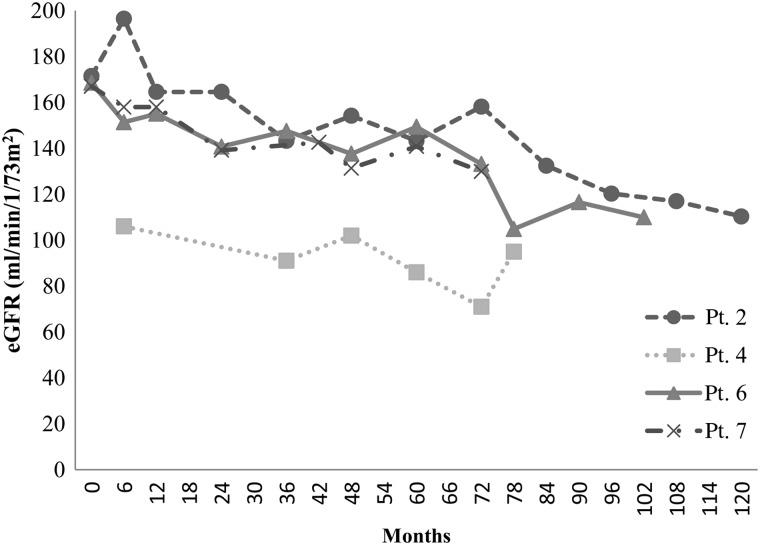
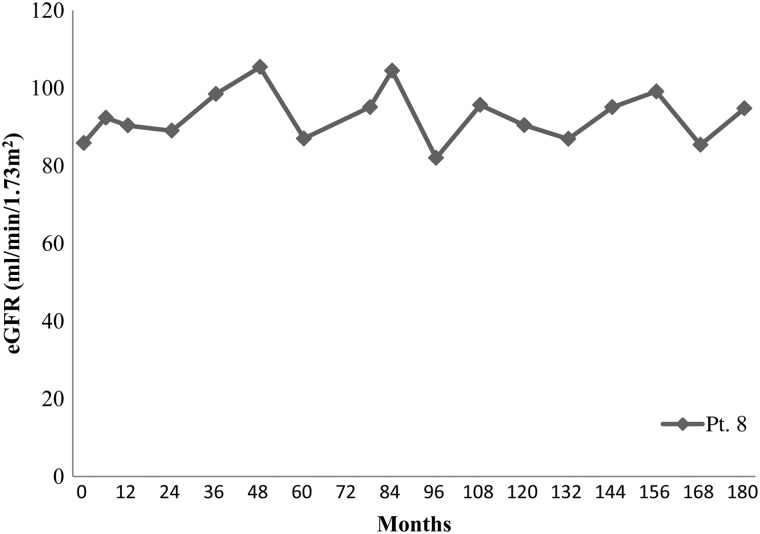
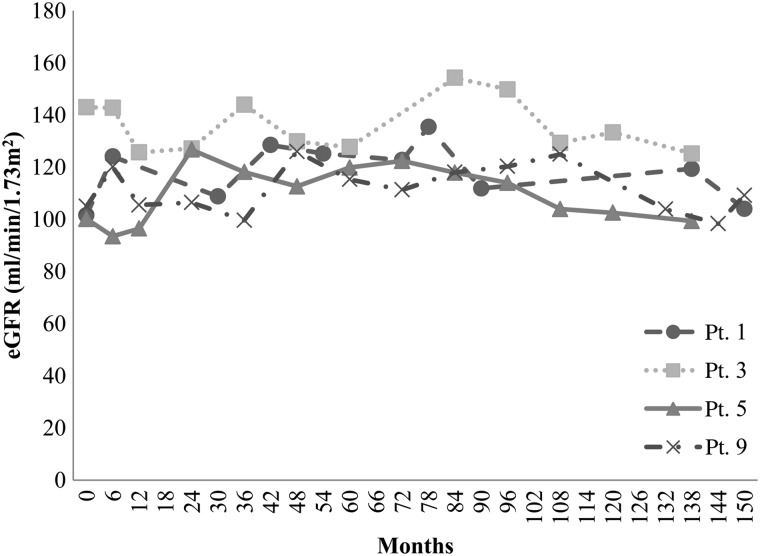
The purpose of this study was to retrospectively evaluate the incidence of delayed renal dysfunction after total body irradiation (TBI) in long-term survivors of TBI/hematopoietic stem cell transplantation (HSCT). Between 1989 and 2006, 24 pediatric patients underwent TBI as part of the conditioning regimen for HSCT at Chiba University Hospital. Nine patients who survived for more than 5 years were enrolled in this study. No patient had any evidence of renal dysfunction prior to the transplant according to their baseline creatinine levels. The median age at the time of diagnosis was 6 years old (range: 1-17 years old). The follow-up period ranged from 79-170 months (median: 140 months). Renal dysfunction was assessed using the estimated glomerular filtration rate (eGFR). The TBI dose ranged from 8-12 Gy delivered in 3-6 fractions over 2-3 d. The patients were treated with linear accelerators in the supine position, and the radiation was delivered to isocentric right-left and left-right fields via the extended distance technique. The kidneys and the liver were not shielded except in one patient with a left adrenal neuroblastoma. No patient required hemodialysis. The eGFR of four patients (44.4%) progressively decreased. The remaining patients did not demonstrate any eGFR deterioration. Only one patient developed hypertension. By evaluating the changes in eGFR, renal dysfunction among long-term survivors of TBI/HSCT could be detected. Our results suggested that the TBI schedule of 12 Gy in 6 fractions over three consecutive days affects renal function.
本研究的目的是回顾性评估全身照射(TBI)/造血干细胞移植(HSCT)长期存活者中TBI后迟发性肾功能不全的发生率。1989年至2006年期间,24例儿科患者在千叶大学医院接受了TBI,作为HSCT预处理方案的一部分。9例存活超过5年的患者纳入本研究。根据基线肌酐水平,移植前无患者有肾功能不全的证据。诊断时的中位年龄为6岁(范围:1 - 17岁)。随访期为79 - 170个月(中位:140个月)。使用估计肾小球滤过率(eGFR)评估肾功能不全。TBI剂量为8 - 12 Gy,分3 - 6次在2 - 3天内给予。患者在仰卧位接受直线加速器治疗,通过延长距离技术将射线照射到等中心的左右和右左野。除1例左肾上腺神经母细胞瘤患者外,肾脏和肝脏未进行屏蔽。无患者需要血液透析。4例患者(44.4%)的eGFR逐渐下降。其余患者未出现eGFR恶化。仅1例患者出现高血压。通过评估eGFR的变化,可以检测到TBI/HSCT长期存活者中的肾功能不全。我们的结果表明,连续三天分6次给予12 Gy的TBI方案会影响肾功能。