School of Pharmacy, Faculty of Medicine, The Chinese University of Hong Kong, 8th Floor, Lo Kwee-Seong Integrated Biomedical Sciences Building, Shatin, N.T, Hong Kong.
Li Ping Medical Library, The Chinese University of Hong Kong, Hong Kong, Hong Kong.
J Cancer Surviv. 2019 Jun;13(3):374-396. doi: 10.1007/s11764-019-00759-9. Epub 2019 May 4.
Survivorship in children with cancer comes at a cost of developing chronic treatment-related complications. Yet, it is still an under-researched area in Asia, which shares the largest proportion of the global childhood cancer burden given its vast population. This systematic review summarizes existing literature on clinically ascertained health outcomes in Asian survivors of childhood cancer.
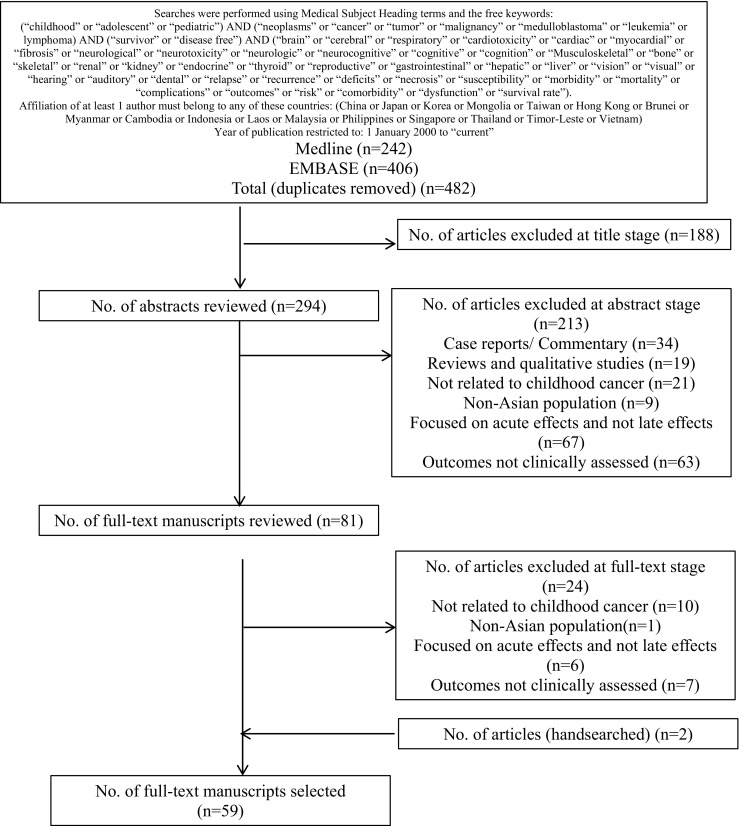
A search was conducted on Ovid Medline and EMBASE for studies that focused on survivors of childhood cancer from countries in East and Southeast Asia; adopted post-treatment clinical ascertainment of organ-specific toxicities or/and secondary malignancy. Studies were excluded if health outcomes were assessed during the acute treatment.
Fifty-nine studies, enrolling a total of 13,442 subjects, were conducted on survivors of leukemia (34%), CNS tumor (14%), and cohorts of survivors with heterogeneous cancer diagnoses (52%). The studies used different medical evaluation methods to assess cardiovascular (15%), metabolic and infertility (32%), and neurological/neurocognitive (20%) outcomes in survivors. The collective findings suggest potential differences in the prevalence of certain late effects (e.g., secondary malignancy and obesity) among Asian and non-Asian populations, which may reflect differences in treatment regimens, practice, genetic variations, or/and socioeconomic disparity.
We recommend developing collaborative initiatives to build a regional repository of systematically assessed health outcomes and biospecimens to investigate treatment, social-environmental and genetic predictors, and interventions for late effects in this population.
The existing types of chronic health problems identified in this review suggest the need for active screening, better access to survivorship care, and promotion of protective health behavior in Asia.
癌症患儿的生存是以发生慢性治疗相关并发症为代价的。然而,由于亚洲人口众多,占全球儿童癌症负担的最大比例,因此该地区仍是癌症儿童生存者研究的一个相对较少涉及的领域。本系统综述总结了亚洲儿童癌症生存者临床确诊的健康结果的现有文献。
在 Ovid Medline 和 EMBASE 上进行了检索,以寻找关注东亚和东南亚国家儿童癌症生存者的研究;采用了针对特定器官毒性或/和继发性恶性肿瘤的治疗后临床确认。如果在急性治疗期间评估健康结果,则排除这些研究。
共进行了 59 项研究,共纳入 13442 名受试者,研究对象分别为白血病(34%)、中枢神经系统肿瘤(14%)和不同癌症诊断队列的幸存者(52%)。这些研究使用了不同的医学评估方法来评估心血管(15%)、代谢和生育力(32%)以及神经/神经认知(20%)结果。综合研究结果表明,某些晚期效应(例如继发性恶性肿瘤和肥胖)在亚洲和非亚洲人群中的流行率可能存在差异,这可能反映了治疗方案、实践、遗传变异或/和社会经济差异的不同。
我们建议开展合作倡议,建立一个系统评估健康结果和生物标本的区域知识库,以研究该人群的治疗、社会环境和遗传预测因素以及晚期效应的干预措施。
本综述中确定的现有慢性健康问题类型表明亚洲地区需要积极进行筛查,更好地获得生存者护理,并促进保护性健康行为。