Christian Rohan P, Rana Devang A, Malhotra Supriya D, Patel Varsha J
Department of Pharmacology, Smt. Nathiba Hargovandas Lakhmichand Municipal Medical College, Ahmedabad, Gujarat, India.
Indian J Crit Care Med. 2014 May;18(5):278-84. doi: 10.4103/0972-5229.132482.
Cardiovascular diseases (CVDs) remain the most common cause of sudden death. Hence, appropriate drug therapy in intensive cardiac care unit (ICCU) is crucial in managing cardiovascular emergencies and to decrease morbidity and mortality.
To evaluate prescribing pattern of drugs and direct cost of therapy in patients admitted in ICCU.
Patients admitted in ICCU of a tertiary care teaching hospital were enrolled. Demographic data, clinical history, and complete drug therapy received during their stay in ICCU were noted. Data were analyzed for drug utilization pattern and direct cost of treatment calculated using patient's hospital and pharmacy bills. Rationality of therapy was evaluated based on American College of Cardiology/American Heart Association (ACC/AHA) guidelines.
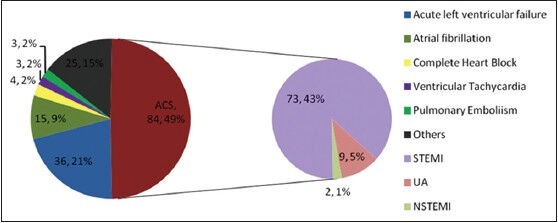
Data of 170 patients were collected over 2 months. Mean age of patients was 54.67 ± 13.42 years. Male to female ratio was 2.33:1. Most common comorbid condition was hypertension 76 (44.7%). Most common diagnosis was acute coronary syndrome (ACS) 49.4%. Mean stay in ICCU was 4.42 ± 1.9 days. Mean number of drugs prescribed per patient was 11.43 ± 2.85. Antiplatelet drugs were the most frequently prescribed drug group (86.5%). Mean cost of pharmacotherapy per patient was '2701.24 ± 3111.94. Mean direct cost of treatment per patient was '10564.74 ± 14968.70. Parenteral drugs constituted 42% of total drugs and 90% of total cost of pharmacotherapy. Cost of pharmacotherapy was positively correlated with number of drugs (P = 0.000) and duration of stay (P = 0.027).
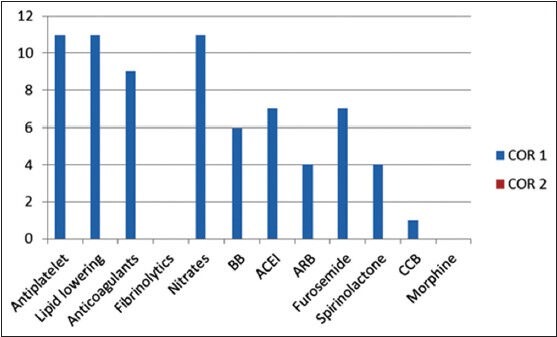
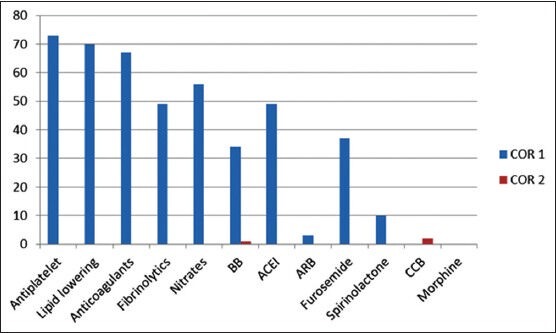
Antiplatelet drugs were the most frequently prescribed drug group. Mean number of drugs per encounter were high, which contributed to the higher cost of pharmacotherapy. ACC/AHA guidelines were followed in majority of the cases.
心血管疾病(CVDs)仍然是猝死最常见的原因。因此,在重症心脏监护病房(ICCU)进行适当的药物治疗对于处理心血管急症以及降低发病率和死亡率至关重要。
评估入住ICCU患者的药物处方模式和治疗直接费用。
纳入一家三级护理教学医院ICCU收治的患者。记录患者的人口统计学数据、临床病史以及在ICCU住院期间接受的完整药物治疗。分析药物使用模式数据,并根据患者的医院和药房账单计算治疗直接费用。根据美国心脏病学会/美国心脏协会(ACC/AHA)指南评估治疗的合理性。
在2个月内收集了170例患者的数据。患者的平均年龄为54.67±13.42岁。男女比例为2.33:1。最常见的合并症是高血压,共76例(44.7%)。最常见的诊断是急性冠状动脉综合征(ACS),占49.4%。在ICCU的平均住院时间为4.42±1.9天。每位患者平均开具的药物数量为11.43±2.85种。抗血小板药物是最常开具的药物类别(86.5%)。每位患者药物治疗的平均费用为2701.24±3111.94印度卢比。每位患者治疗的平均直接费用为10564.74±14968.70印度卢比。注射用药物占总药物的42%,占药物治疗总费用的90%。药物治疗费用与药物数量(P = 0.000)和住院时间(P = 0.027)呈正相关。
抗血小板药物是最常开具的药物类别。每次就诊的平均药物数量较多,这导致了较高的药物治疗费用。大多数病例遵循了ACC/AHA指南。