Xerri Christian, Zennou-Azogui Yoh'i
Neurosciences Intégratives et Adaptatives, Aix-Marseille Université, Centre National de la Recherche Scientifique, Unité Mixte de Recherche 7260, Fédération de Recherches Comportement-Cerveau-Cognition 3512, Marseille, France.
PLoS One. 2014 Jun 10;9(6):e99767. doi: 10.1371/journal.pone.0099767. eCollection 2014.
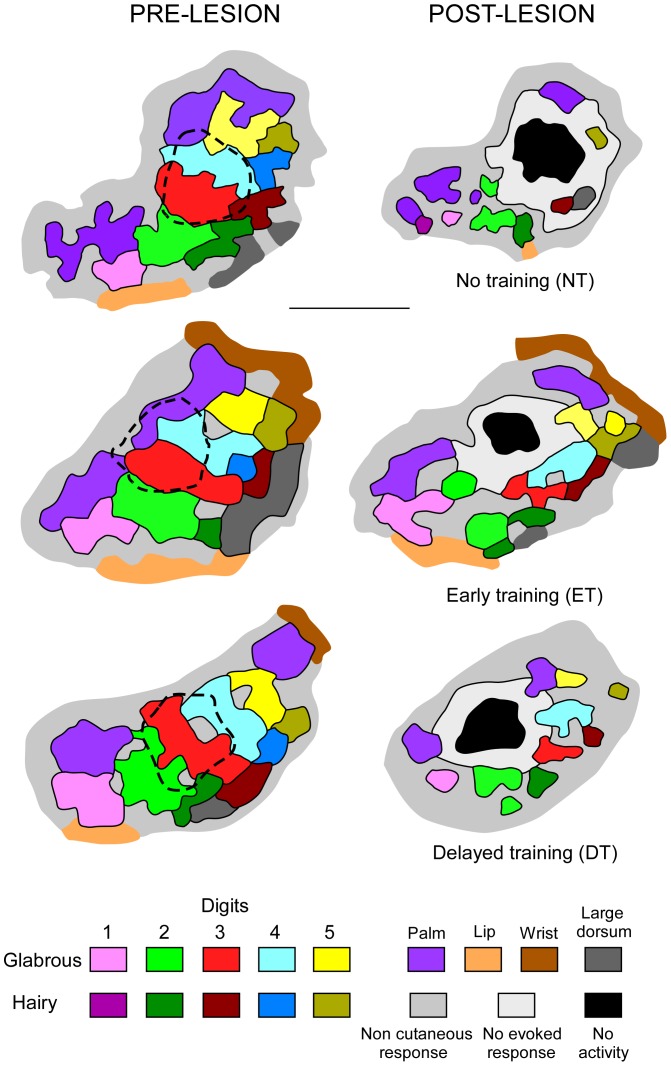
Previous studies have shown that intensive training within an early critical time window after focal cortical ischemia increases the area of damaged tissue and is detrimental to behavioral recovery. We postulated that moderate stimulation initiated soon after the lesion could have protective effects on peri-infarct cortical somatotopic representations. Therefore, we have assessed the effects of mild cutaneous stimulation delivered in an attention-demanding behavioral context on the functional organization of the perilesion somatosensory cortex using high-density electrophysiological mapping. We compared the effects of 6-day training initiated on the 3rd day postlesion (early training; ET) to those of same-duration training started on the 8th day (delayed training; DT). Our findings confirm previous work showing that the absence of training aggravates representational loss in the perilesion zone. In addition, ET was found to be sufficient to limit expansion of the ischemic lesion and reduce tissue loss, and substantially maintain the neuronal responsiveness to tactile stimulation, thereby preserving somatotopic map arrangement in the peri-infarct cortical territories. By contrast, DT did not prevent tissue loss and only partially reinstated lost representations in a use-dependent manner within the spared peri-infarct cortical area. This study differentiates the effects of early versus delayed training on perilesion tissue and cortical map reorganization, and underscores the neuroprotective influence of mild rehabilitative stimulation on neuronal response properties in the peri-infarct cortex during an early critical period.
先前的研究表明,在局灶性皮质缺血后的早期关键时间窗内进行强化训练会增加受损组织的面积,并对行为恢复产生不利影响。我们推测,在损伤后不久开始的适度刺激可能对梗死灶周围皮质躯体感觉区表征具有保护作用。因此,我们使用高密度电生理图谱评估了在需要注意力的行为背景下进行轻度皮肤刺激对损伤周围体感皮层功能组织的影响。我们比较了在损伤后第3天开始的6天训练(早期训练;ET)与在第8天开始的相同持续时间训练(延迟训练;DT)的效果。我们的研究结果证实了先前的研究,即不进行训练会加剧损伤周围区域的表征丧失。此外,我们发现早期训练足以限制缺血性损伤的扩展并减少组织损失,并基本维持神经元对触觉刺激的反应性,从而保留梗死灶周围皮质区域的躯体感觉图谱排列。相比之下,延迟训练并不能防止组织损失,并且仅以使用依赖的方式在梗死灶周围剩余的皮质区域部分恢复已丧失的表征。这项研究区分了早期训练与延迟训练对损伤周围组织和皮质图谱重组的影响,并强调了轻度康复刺激在早期关键期对梗死灶周围皮质神经元反应特性的神经保护作用。