Ramirez Amelie G, Munoz Edgar, Holden Alan E C, Adeigbe Rebecca T, Suarez Lucina
Institute for Health Promotion Research and Cancer Therapy and Research Center, University of Texas Health Science Center at San Antonio, San Antonio, Texas, United States of America.
Institute for Health Promotion Research, University of Texas Health Science Center at San Antonio, San Antonio, Texas, United States of America.
PLoS One. 2014 Jun 10;9(6):e99365. doi: 10.1371/journal.pone.0099365. eCollection 2014.
A previous study showed Hepatocellular Carcinoma (HCC) rates to be higher among Latinos in Texas and highest among South Texas Latinos compared to other non-Hispanic whites (NHW) and other Latinos in the United States (U.S.). We used more recent data to assess trends in HCC among Texas Latinos and to reassess the elevated HCC incidence rate in Texas Latinos.
We used data from the U.S. SEER Program and the Texas Cancer Registry to calculate annual and 3-year moving average age-specific and age-adjusted HCC incidence rates, annual percent changes (APCs), and their corresponding 95% confidence intervals for Latinos and NHW in the U.S., Texas and South Texas.
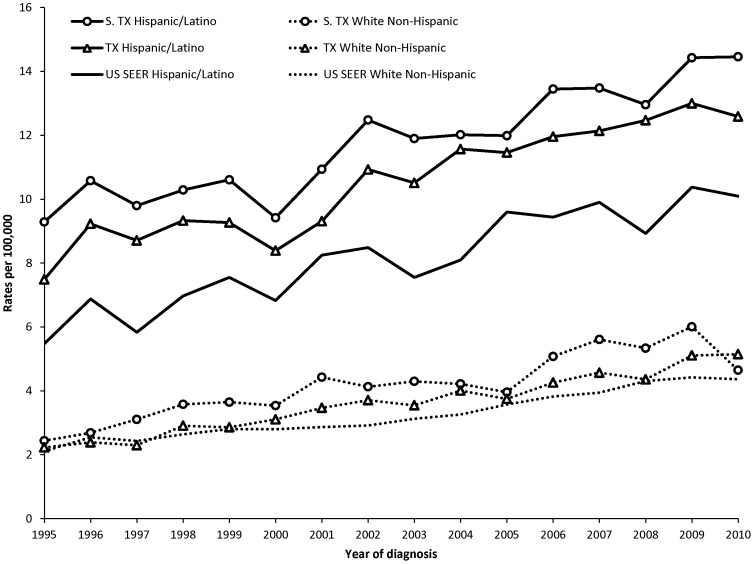
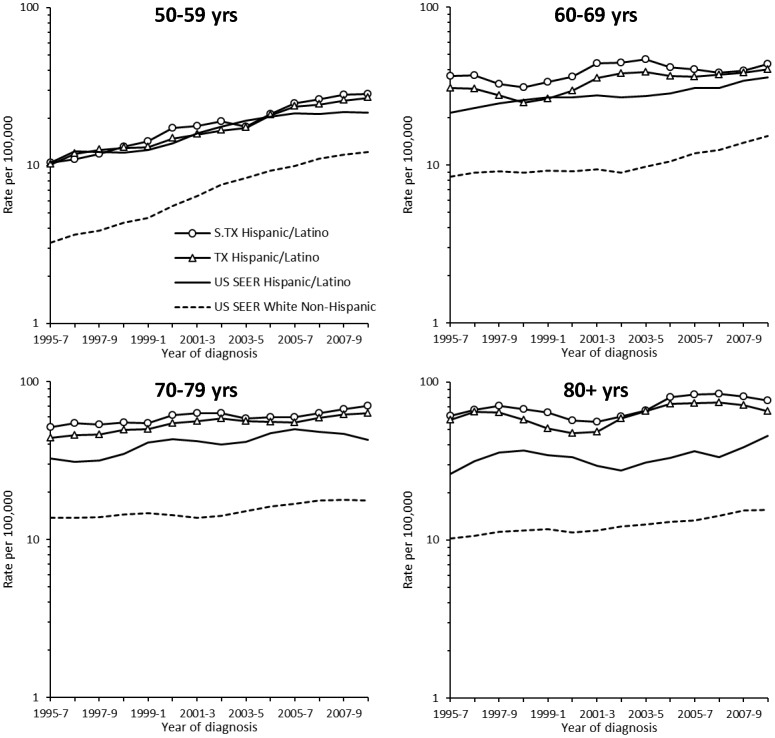
Texas Latino male and female incidence rates were 3.1 and 4.0 times higher than their NHW counterparts in SEER regions. Latino males and females in South Texas had the highest rates of HCC incidence overall; rate ratios were 3.6 and 4.2 among South Texas Latino males and females compared to SEER NHW counterparts. There are statistically significant increases in HCC incidence rates in all groups (Texas and South Texas Latinos and NHW groups) and across all age groups. The elevated HCC rates in Texas Latinos are consistent over the 1995-2010 period.
The incidence of HCC among Latinos in South Texas remains higher than elsewhere in the U.S. and warrants closer investigation of potential risk factors related to prevailing conditions unique to the population including higher obesity and diabetes rates, environmental, cultural and socioeconomic factors and possibly genetic predisposition.
先前的一项研究表明,德克萨斯州拉丁裔的肝细胞癌(HCC)发病率高于其他非西班牙裔白人(NHW)以及美国其他拉丁裔,其中南德克萨斯州拉丁裔的发病率最高。我们使用更新的数据来评估德克萨斯州拉丁裔肝细胞癌的发病趋势,并重新评估德克萨斯州拉丁裔肝细胞癌发病率升高的情况。
我们使用美国监测、流行病学和最终结果(SEER)计划以及德克萨斯州癌症登记处的数据,计算美国、德克萨斯州和南德克萨斯州拉丁裔和非西班牙裔白人的年度和三年移动平均年龄别及年龄调整后的肝细胞癌发病率、年度百分比变化(APC)及其相应的95%置信区间。
在SEER地区,德克萨斯州拉丁裔男性和女性的发病率分别比非西班牙裔白人高3.1倍和4.0倍。南德克萨斯州的拉丁裔男性和女性的肝细胞癌发病率总体最高;与SEER非西班牙裔白人相比,南德克萨斯州拉丁裔男性和女性的发病率比值分别为3.6和4.2。所有组(德克萨斯州和南德克萨斯州的拉丁裔和非西班牙裔白人群体)以及所有年龄组的肝细胞癌发病率均有统计学显著增加。德克萨斯州拉丁裔的肝细胞癌发病率升高在1995 - 2010年期间保持一致。
南德克萨斯州拉丁裔的肝细胞癌发病率仍然高于美国其他地区,有必要对与该人群特有的现有状况相关的潜在风险因素进行更深入调查,这些因素包括较高的肥胖和糖尿病发病率、环境、文化和社会经济因素以及可能的遗传易感性。