Sokol-Hessner Peter, Hartley Catherine A, Hamilton Jeffrey R, Phelps Elizabeth A
a Department of Psychology , New York University , New York , NY , USA.
Cogn Emot. 2015;29(4):695-701. doi: 10.1080/02699931.2014.925426. Epub 2014 Jun 11.
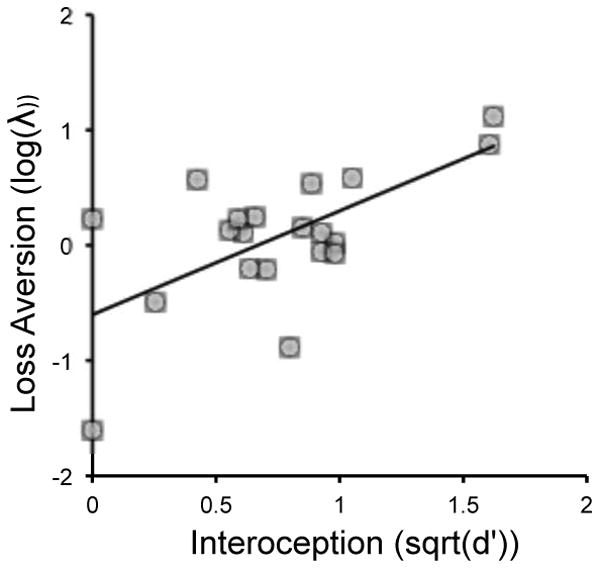
Emotions have been proposed to inform risky decision-making through the influence of affective physiological responses on subjective value. The ability to perceive internal body states, or "interoception" may influence this relationship. Here, we examined whether interoception predicts participants' degree of loss aversion, which has been previously linked to choice-related arousal responses. Participants performed both a heartbeat-detection task indexing interoception and a risky monetary decision-making task, from which loss aversion, risk attitudes and choice consistency were parametrically measured. Interoceptive ability correlated selectively with loss aversion and was unrelated to the other value parameters. This finding suggests that specific and separable component processes underlying valuation are shaped not only by our physiological responses, as shown in previous findings, but also by our interoceptive access to such signals.
有观点认为,情绪通过情感生理反应对主观价值的影响来为风险决策提供信息。感知身体内部状态的能力,即“内感受”,可能会影响这种关系。在此,我们研究了内感受是否能预测参与者的损失厌恶程度,此前已有研究表明损失厌恶程度与选择相关的唤醒反应有关。参与者既进行了一项用于索引内感受的心跳检测任务,又进行了一项风险货币决策任务,从中参数化测量了损失厌恶、风险态度和选择一致性。内感受能力仅与损失厌恶相关,与其他价值参数无关。这一发现表明,估值背后特定且可分离的组成过程不仅如先前研究结果所示受到我们生理反应的影响,还受到我们对这些信号的内感受性获取的影响。