Zandberg Dan P, Liu Sandy, Goloubeva Olga G, Schumaker Lisa M, Cullen Kevin J
University of Maryland Greenebaum Cancer Center, Baltimore, Maryland. Department of Medicine, University of Maryland School of Medicine, Baltimore, Maryland.
Department of Pathology, University of Maryland School of Medicine, Baltimore, Maryland.
Cancer Prev Res (Phila). 2015 Jan;8(1):12-9. doi: 10.1158/1940-6207.CAPR-14-0089-T. Epub 2014 Jun 10.
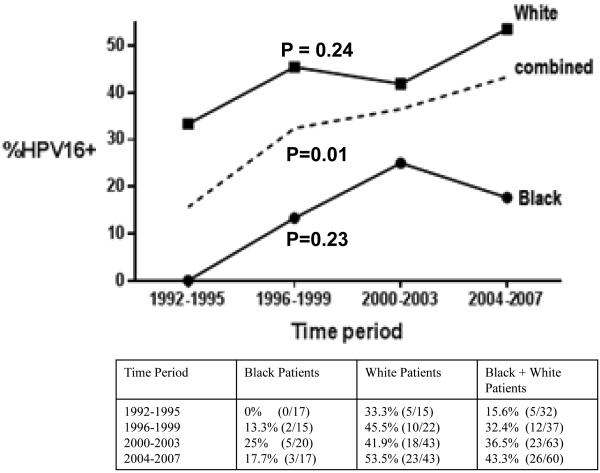
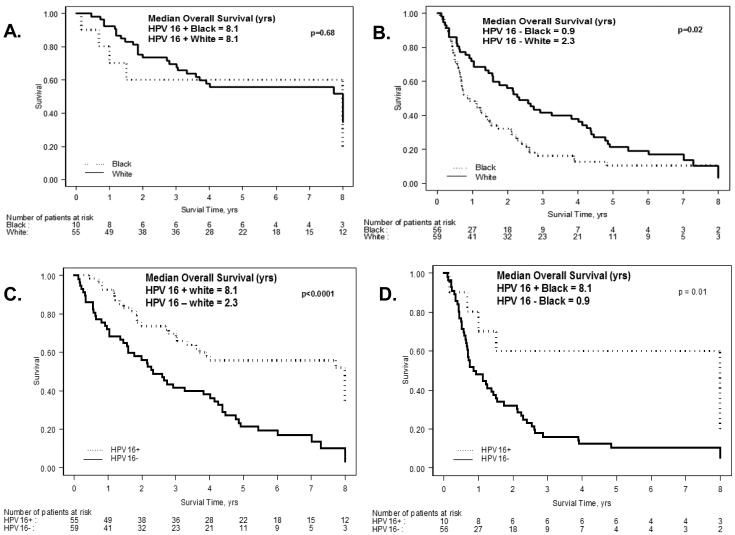
While we previously reported a striking racial difference in the prevalence of human papilloma virus (HPV)-positive squamous cell carcinoma of the oropharynx (OPSCC), less is known about differences in outcomes and trends over time in OPSCC by HPV status and race. We conducted a retrospective analysis of 467 patients with OPSCC treated at the University of Maryland Greenebaum Cancer Center (Baltimore, MD) between 1992 and 2007, of which 200 had tissue available for HPV16 testing. HPV16-positive patients were significantly more likely to be white, with 45.5% of whites and 15.5% of blacks testing positive for HPV16. There was a significant increase in HPV16-positive OPSCC for all patients over time from 15.6% in 1992 to 1995 to 43.3% in 2004 to 2007 (P = 0.01). From 1992 to 1995, 33% of white patients were HPV16-positive, with no black patients positive. From 2004 to 2007, 17.7% of black patients and 54% of white patients were HPV16-positive. White and black patients with HPV16-positive tumors had an identical and favorable overall survival (OS; median, 8.1 and 8.1 years, respectively). However, among HPV16-negative patients, whites had an improved OS compared with blacks (median, 2.3 vs. 0.9 years, respectively; P = 0.02), including when analyzed in a multivariable Cox regression model. From 1992 to 2007, the percentage of HPV16-positive OPSCC increased for white patients and was seen for the first time in black patients. While survival for HPV-positive black and white patients was similar and favorable, outcomes for HPV-negative patients were poor, with blacks having worse survival even after controlling for baseline characteristics.
虽然我们之前报道过口咽鳞状细胞癌(OPSCC)中人类乳头瘤病毒(HPV)阳性率存在显著的种族差异,但关于HPV状态和种族对OPSCC预后及随时间变化趋势的差异,我们了解得较少。我们对1992年至2007年间在马里兰大学格林ebaum癌症中心(巴尔的摩,马里兰州)接受治疗的467例OPSCC患者进行了回顾性分析,其中200例患者有可用组织进行HPV16检测。HPV16阳性患者更有可能是白人,45.5%的白人及15.5%的黑人HPV16检测呈阳性。随着时间推移,所有患者中HPV16阳性的OPSCC显著增加,从1992年至1995年的15.6%增至2004年至2007年的43.3%(P = 0.01)。1992年至1995年,33%的白人患者HPV16阳性,无黑人患者阳性。2004年至2007年,17.7%的黑人患者及54%的白人患者HPV16阳性。HPV16阳性肿瘤的白人和黑人患者总生存率相同且良好(中位生存期分别为8.1年和8.1年)。然而,在HPV16阴性患者中,白人的总生存率优于黑人(中位生存期分别为2.3年和0.9年;P = 0.02),多变量Cox回归模型分析时亦是如此。1992年至2007年,白人患者中HPV16阳性的OPSCC百分比增加,黑人患者中首次出现此类情况。虽然HPV阳性的黑人和白人患者生存率相似且良好,但HPV阴性患者预后较差,即使在控制基线特征后,黑人的生存率仍较差。