Debibakas S, Rocher S, Garsmeur O, Toubi L, Roques D, D'Hont A, Hoarau J-Y, Daugrois J H
Université des Antilles et de la Guyane, 97157, Pointe-à-Pitre, Guadeloupe, France.
Theor Appl Genet. 2014 Aug;127(8):1719-32. doi: 10.1007/s00122-014-2334-7. Epub 2014 Jun 12.
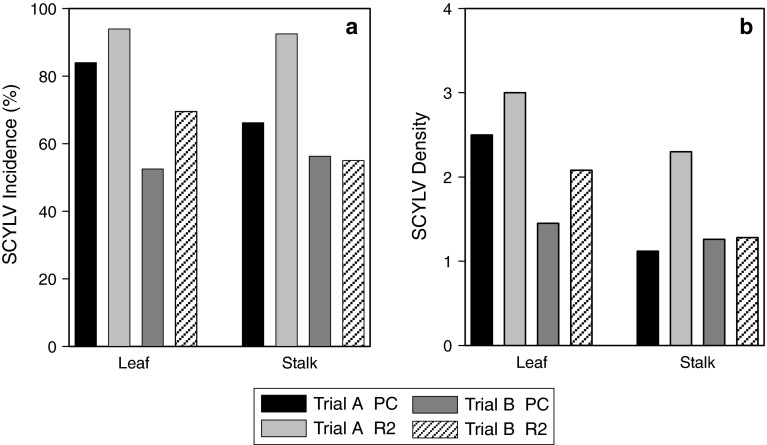
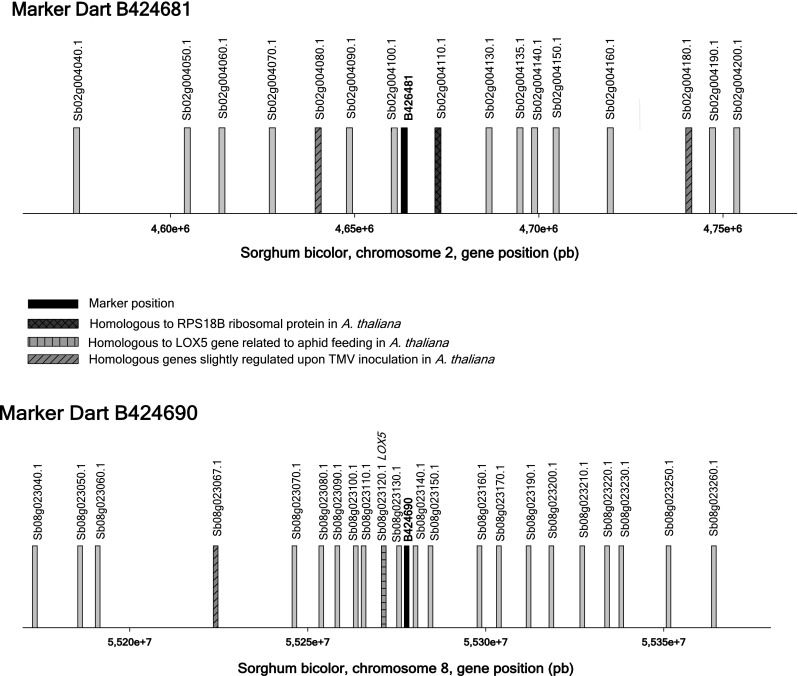
Using GWAS approaches, we detected independent resistant markers in sugarcane towards a vectored virus disease. Based on comparative genomics, several candidate genes potentially involved in virus/aphid/plant interactions were pinpointed. Yellow leaf of sugarcane is an emerging viral disease whose causal agent is a Polerovirus, the Sugarcane yellow leaf virus (SCYLV) transmitted by aphids. To identify quantitative trait loci controlling resistance to yellow leaf which are of direct relevance for breeding, we undertook a genome-wide association study (GWAS) on a sugarcane cultivar panel (n = 189) representative of current breeding germplasm. This panel was fingerprinted with 3,949 polymorphic markers (DArT and AFLP). The panel was phenotyped for SCYLV infection in leaves and stalks in two trials for two crop cycles, under natural disease pressure prevalent in Guadeloupe. Mixed linear models including co-factors representing population structure fixed effects and pairwise kinship random effects provided an efficient control of the risk of inflated type-I error at a genome-wide level. Six independent markers were significantly detected in association with SCYLV resistance phenotype. These markers explained individually between 9 and 14 % of the disease variation of the cultivar panel. Their frequency in the panel was relatively low (8-20 %). Among them, two markers were detected repeatedly across the GWAS exercises based on the different disease resistance parameters. These two markers could be blasted on Sorghum bicolor genome and candidate genes potentially involved in plant-aphid or plant-virus interactions were localized in the vicinity of sorghum homologs of sugarcane markers. Our results illustrate the potential of GWAS approaches to prospect among sugarcane germplasm for accessions likely bearing resistance alleles of significant effect useful in breeding programs.
利用全基因组关联研究(GWAS)方法,我们在甘蔗中检测到了针对一种由媒介传播的病毒病的独立抗性标记。基于比较基因组学,确定了几个可能参与病毒/蚜虫/植物相互作用的候选基因。甘蔗黄叶病是一种新出现的病毒性疾病,其病原体是一种马铃薯Y病毒属病毒,即由蚜虫传播的甘蔗黄叶病毒(SCYLV)。为了鉴定对黄叶病抗性的数量性状位点,这些位点与育种直接相关,我们对一个代表当前育种种质的甘蔗品种群体(n = 189)进行了全基因组关联研究(GWAS)。该群体用3949个多态性标记(DArT和AFLP)进行了指纹图谱分析。在瓜德罗普岛普遍存在的自然病害压力下,对该群体在两个作物周期的两次试验中进行了叶片和茎秆中SCYLV感染的表型分析。包含代表群体结构固定效应的协变量和成对亲缘关系随机效应的混合线性模型在全基因组水平上有效地控制了I型错误膨胀的风险。显著检测到六个与SCYLV抗性表型相关的独立标记。这些标记分别解释了品种群体中9%至14%的病害变异。它们在群体中的频率相对较低(8%-20%)。其中,基于不同的抗病参数,在全基因组关联研究中反复检测到两个标记。这两个标记可以在高粱基因组上进行比对,并且潜在参与植物-蚜虫或植物-病毒相互作用的候选基因定位在甘蔗标记的高粱同源物附近。我们的结果说明了全基因组关联研究方法在甘蔗种质中寻找可能携带对育种计划有用的显著效应抗性等位基因的种质的潜力。