Department of Internal Medicine, Seoul National University Bundang Hospital, Seongnam, Gyeonggi-do, Korea.
Department of Internal Medicine and Liver Research Institute, Seoul National University College of Medicine, Seoul, Korea.
J Neurogastroenterol Motil. 2014 Jul 31;20(3):388-99. doi: 10.5056/jnm14020.
BACKGROUND/AIMS: Despite numerous studies on the relation of genetic polymorphisms with irritable bowel syndrome (IBS), the results still remain inconclusive. The aim of this study was to assess the possible association between SLC6A4 serotonin transporter gene linked polymorphic region (5-HTTLPR), ADRA2A -1291C>G, GNB3 825C>T, CCK1R intron 779T>C and TRPV1 945G>C polymorphisms and IBS based on Rome III criteria in Korea.
Study subjects were prospectively recruited from visitors to Seoul National University Bundang Hospital between July 2009 and January 2014. Ninety-nine IBS patients and 171 healthy controls were enrolled. Polymorphisms of above-mentioned 5 genes were genotyped. Serum serotonin from 101 participants was measured by ELISA and compared according to SLC6A4 5-HTTLPR polymorphisms and IBS subtypes.
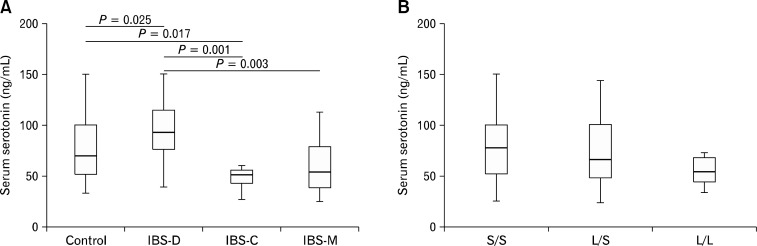
Regarding SLC6A4 5-HTTLPR polymorphism, L/L genotype was significantly associated with the total IBS, constipation predominant IBS (IBS-C) and mixture of diarrhea and constipation IBS (IBS-M) (adjusted OR: 4.35, 95% CI: 1.04-16.67; adjusted OR: 11.11, 95% CI: 1.69-50.00 and adjusted OR: 5.56, 95% CI: 1.05-33.33, respectively). Carrying ADRA2A -1291G allele was significantly associated with total IBS and diarrhea predominant IBS (adjusted OR: 3.37, 95% CI: 1.16-9.77 and adjusted OR: 5.64, 95% CI: 1.18-27.01, respectively). IBS-C patients showed reduced level of serum serotonin compared to controls and patients with diarrhea predominant IBS (50.2 ng/mL vs. 69.0 ng/mL and 92.9 ng/mL, P = 0.017 and P = 0.001, respectively).
Genetic polymorphisms of SLC6A4 5-HTTLPR and ADRA2A -1291C>G could be one of the pathophysiological factors of IBS in Korea. Reduced serum serotonin shown in the IBS-C group suggested a role of serotonin in IBS, but large study is needed for confirming genotypic difference in serum serotonin level.
背景/目的:尽管有许多关于遗传多态性与肠易激综合征(IBS)之间关系的研究,但结果仍不确定。本研究旨在评估韩国根据罗马 III 标准,SLC6A4 血清素转运体基因连接多态区(5-HTTLPR)、ADRA2A-1291C>G、GNB3 825C>T、CCK1R 内含子 779T>C 和 TRPV1 945G>C 多态性与 IBS 之间的可能关联。
本研究前瞻性招募了 2009 年 7 月至 2014 年 1 月期间首尔国立大学盆唐医院的来访者。共纳入 99 例 IBS 患者和 171 例健康对照者。对上述 5 个基因的多态性进行基因分型。通过 ELISA 测量 101 名参与者的血清 5-羟色胺,并根据 SLC6A4 5-HTTLPR 多态性和 IBS 亚型进行比较。
关于 SLC6A4 5-HTTLPR 多态性,L/L 基因型与总 IBS、便秘为主型 IBS(IBS-C)和腹泻与便秘混合型 IBS(IBS-M)显著相关(调整后的 OR:4.35,95%CI:1.04-16.67;调整后的 OR:11.11,95%CI:1.69-50.00 和调整后的 OR:5.56,95%CI:1.05-33.33,分别)。携带 ADRA2A-1291G 等位基因与总 IBS 和腹泻为主型 IBS 显著相关(调整后的 OR:3.37,95%CI:1.16-9.77 和调整后的 OR:5.64,95%CI:1.18-27.01,分别)。与对照组和腹泻为主型 IBS 患者相比,IBS-C 患者的血清 5-羟色胺水平降低(50.2ng/mL 比 69.0ng/mL 和 92.9ng/mL,P=0.017 和 P=0.001)。
SLC6A4 5-HTTLPR 和 ADRA2A-1291C>G 的遗传多态性可能是韩国 IBS 的病理生理因素之一。IBS-C 组显示血清 5-羟色胺降低,提示 5-羟色胺在 IBS 中的作用,但需要更大的研究来证实血清 5-羟色胺水平的基因型差异。