Gu Xin, Cheng Biao, Sun Jian, Tao Kun
Department of Orthopaedic, Shanghai Tenth People's Hospital, Tongji University, No, 301 Middle Yanchang Road, Zhabei District, Shanghai 20072, China.
J Orthop Surg Res. 2014 Jun 11;9:46. doi: 10.1186/1749-799X-9-46.
The aim of this study is to investigate the anatomic changes in the shoulder joints responsible for omalgia after the clavicular hook plate fixation under arthroscope.
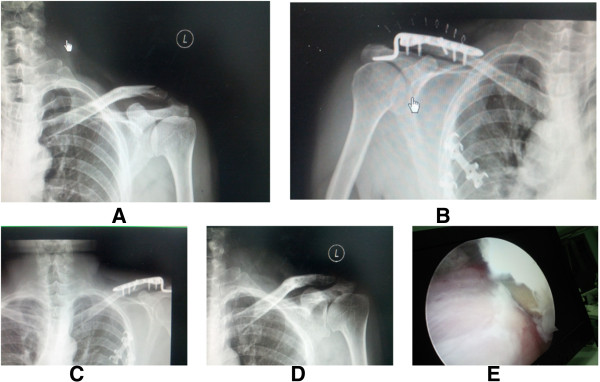
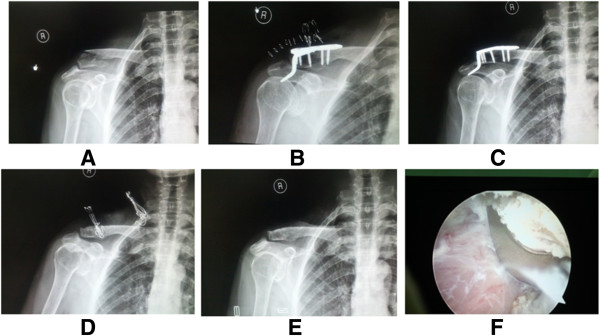
Arthroscopic examination was carried out for 12 omalgia patients who underwent clavicular hook plate fixation due to distal clavicle fractures. Functional outcome of shoulder was measured by the Japanese Orthopaedic Association (JOA) score before and after the withdrawal of the fixation plate.
The rotator cuff compression by the clavicular hook was arthroscopically observed in 11 of the 12 cases. The JOA scores of the shoulder were significantly improved at 1 month after the withdrawal of the fixation plate (pain, 28 ± 2.4 vs. 15 ± 5.2; function, 19.2 ± 1.0 vs. 11.7 ± 1.9; range of movements, 26.8 ± 2.6 vs. 14.8 ± 3.4) compared with before.
The impingement of the hook to the rotator cuff may be the main cause for the omalgia. The appropriate hook and plate that fit to the curve of the clavicle as well as the acromion are necessary to decrease the severity of omalgia.
本研究旨在探讨关节镜下锁骨钩钢板固定术后引起肩部疼痛的肩关节解剖学变化。
对12例因锁骨远端骨折接受锁骨钩钢板固定术的肩部疼痛患者进行关节镜检查。在取出固定钢板前后,采用日本骨科协会(JOA)评分评估肩关节功能结果。
12例患者中,11例在关节镜下观察到锁骨钩对肩袖的压迫。取出固定钢板1个月后,肩关节的JOA评分显著改善(疼痛:28±2.4对15±5.2;功能:19.2±1.0对11.7±1.9;活动范围:26.8±2.6对14.8±3.4)。
钩对肩袖的撞击可能是肩部疼痛的主要原因。需要合适的、符合锁骨及肩峰曲线的钩和钢板,以减轻肩部疼痛的严重程度。