
使用成体干细胞、动态细胞培养和多孔支架,制备预血管化心脏组织构建体的多步骤方法。
A multistep procedure to prepare pre-vascularized cardiac tissue constructs using adult stem sells, dynamic cell cultures, and porous scaffolds.
机构信息
Biomaterials Unit, International Center for Materials Nanoarchitectonics, National Institute for Materials Science Tsukuba, Japan ; International Clinical Research Center, Integrated Center of Cellular Therapy and Regenerative Medicine, St. Anne's University Hospital Brno, Czech Republic.
Interdepartmental Research Center "E. Piaggio", University of Pisa Italy ; Institute of Clinical Physiology, National Research Council (CNR) Pisa, Italy.
出版信息
Front Physiol. 2014 Jun 3;5:210. doi: 10.3389/fphys.2014.00210. eCollection 2014.
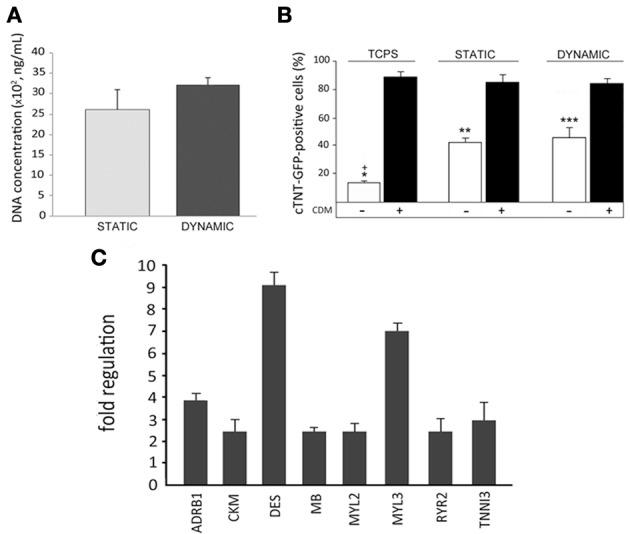
The vascularization of tissue engineered products represents a key issue in regenerative medicine which needs to be addressed before the translation of these protocols to the bedside can be foreseen. Here we propose a multistep procedure to prepare pre-vascularized three-dimensional (3D) cardiac bio-substitutes using dynamic cell cultures and highly porous biocompatible gelatin scaffolds. The strategy adopted exploits the peculiar differentiation potential of two distinct subsets of adult stem cells to obtain human vascularized 3D cardiac tissues. In the first step of the procedure, human mesenchymal stem cells (hMSCs) are seeded onto gelatin scaffolds to provide interconnected vessel-like structures, while human cardiomyocyte progenitor cells (hCMPCs) are stimulated in vitro to obtain their commitment toward the cardiac phenotype. The use of a modular bioreactor allows the perfusion of the whole scaffold, providing superior performance in terms of cardiac tissue maturation and cell survival. Both the cell culture on natural-derived polymers and the continuous medium perfusion of the scaffold led to the formation of a densely packaged proto-tissue composed of vascular-like and cardiac-like cells, which might complete maturation process and interconnect with native tissue upon in vivo implantation. In conclusion, the data obtained through the approach here proposed highlight the importance to provide stem cells with complementary signals in vitro able to resemble the complexity of cardiac microenvironment.
组织工程产品的血管化是再生医学中的一个关键问题,在这些方案能够转化为临床应用之前,需要解决这个问题。在这里,我们提出了一种多步骤的方法,使用动态细胞培养和高多孔生物相容性明胶支架来制备预血管化的三维(3D)心脏生物替代品。所采用的策略利用了两种不同的成人干细胞亚群的特殊分化潜力,以获得人类血管化的 3D 心脏组织。在该程序的第一步中,将人骨髓间充质干细胞(hMSCs)接种到明胶支架上,以提供相互连接的管状结构,同时体外刺激人心肌细胞祖细胞(hCMPCs)以获得其向心脏表型的定向分化。使用模块化生物反应器允许对整个支架进行灌注,从而在心脏组织成熟和细胞存活方面提供卓越的性能。在天然衍生聚合物上进行细胞培养和支架的连续介质灌注都导致了由类似血管和类似心脏的细胞组成的密集包装原组织的形成,该组织在体内植入后可能会完成成熟过程并与天然组织相互连接。总之,通过这里提出的方法获得的数据强调了在体外为干细胞提供能够模拟心脏微环境复杂性的互补信号的重要性。


 Zotero 插件