Tu Min, Liu Xian, Han Bei, Ge Qianqian, Li Zhanjun, Lu Zipeng, Wei Jishu, Song Guoxin, Cai Baobao, Lv Nan, Jiang Kuirong, Wang Shui, Miao Yi, Gao Wentao
Department of General Surgery, The First Affiliated Hospital of Nanjing Medical University, Nanjing, Jiangsu 210029, P.R. China.
Department of Endocrinology, Nanjing Children's Hospital Affiliated to Nanjing Medical University, Nanjing, Jiangsu 210008, P.R. China.
Mol Med Rep. 2014 Aug;10(2):663-9. doi: 10.3892/mmr.2014.2317. Epub 2014 Jun 10.
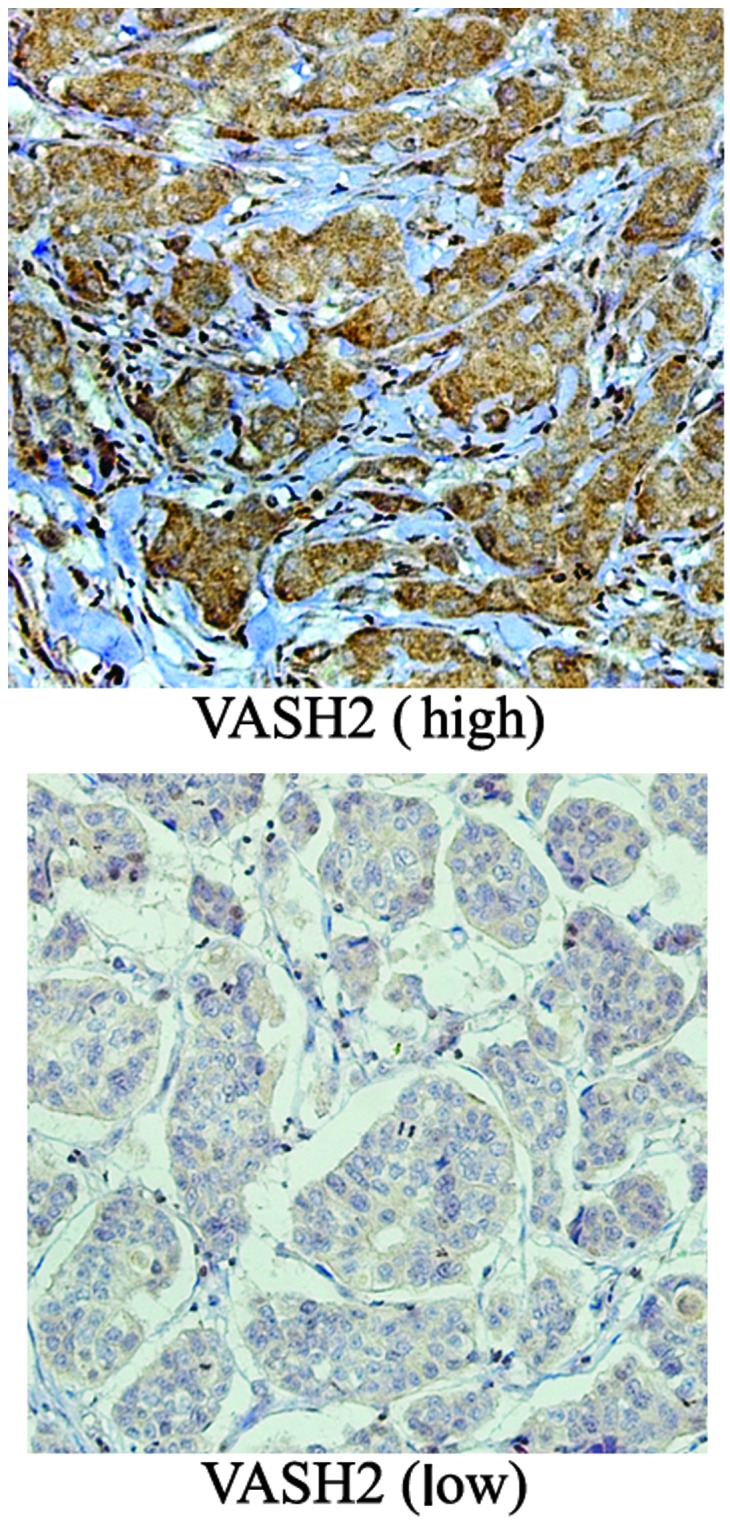
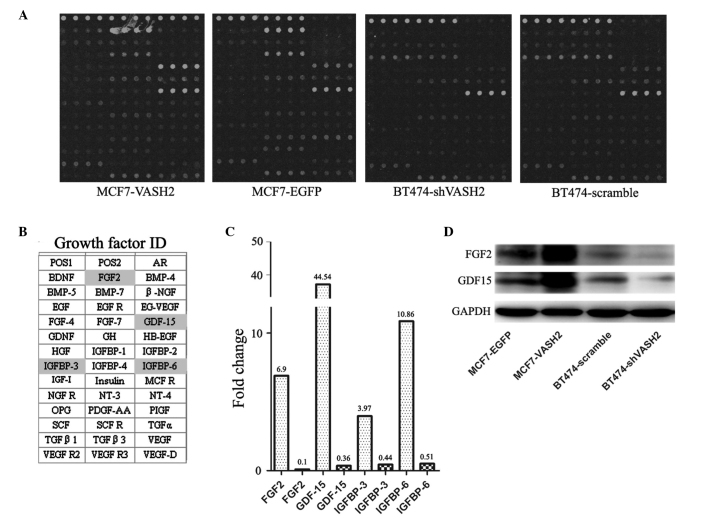
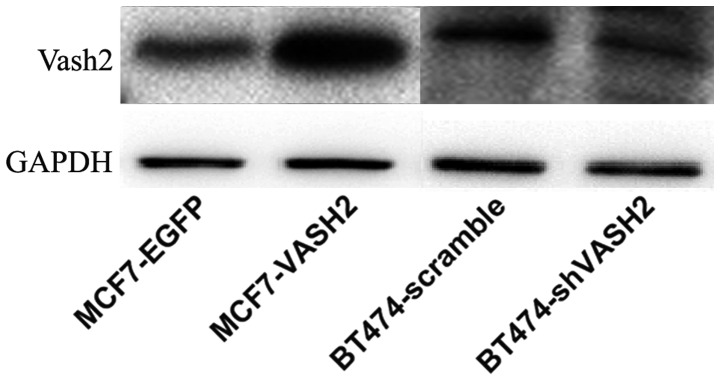
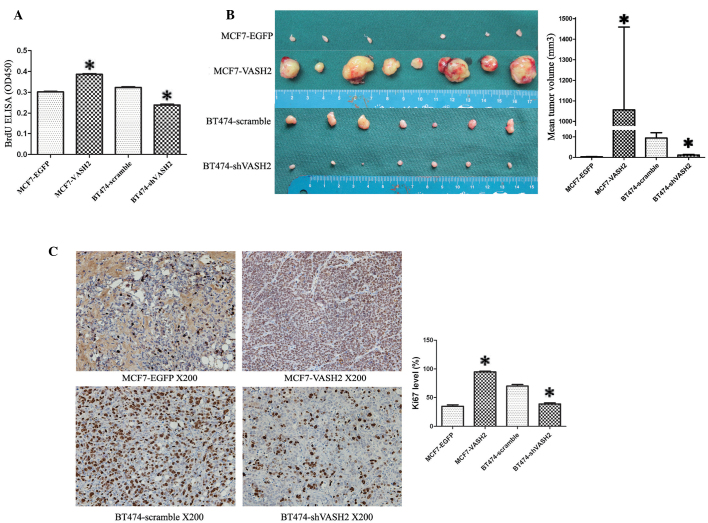
Vasohibin‑2 (VASH2) is an angiogenic factor, and has been previously reported to be a cancer‑related gene, with cytoplasmic and karyotypic forms. In the current study VASH2 expression in human breast cancer tissue and adjacent non‑cancerous tissue was investigated with immunohistochemistry. MCF‑7 and BT474 human breast cancer cells were transfected with lentiviral constructs to generate in vitro VASH2 overexpression and knockdown models. In addition, BALB/cA nude mice were inoculated subcutaneously with transfected cells to generate in vivo models of VASH2 overexpression and knockdown. The effect of VASH2 on cell proliferation was investigated using a bromodeoxyuridine assay in vitro and immunohistochemistry of Ki67 in xenograft tumors. Growth factors were investigated using a human growth factor array, and certain factors were further confirmed by an immunoblot. The results indicated that the expression level of cytoplasmic VASH2 was higher in breast cancer tissues with a Ki67 (a proliferation marker) level of ≥14%, compared with tissues with a Ki67 level of <14%. VASH2 induced proliferation in vitro and in vivo. Four growth factors activated by VASH2 were identified as follows: Fibroblast growth factor 2 (FGF2), growth/differentiation factor‑15 (GDF15), insulin‑like growth factor‑binding protein (IGFBP)3 and IGFBP6. FGF2 and GDF15 may contribute to VASH2‑induced proliferation. The current study identified a novel role for VASH2 in human breast cancer, and this knowledge suggests that VASH2 may be a novel target in breast cancer treatment.
血管抑制素-2(VASH2)是一种血管生成因子,此前有报道称其为一种癌症相关基因,有细胞质和核型两种形式。在本研究中,采用免疫组织化学方法研究了VASH2在人乳腺癌组织及癌旁非癌组织中的表达情况。用慢病毒构建体转染MCF-7和BT474人乳腺癌细胞,以建立体外VASH2过表达和敲低模型。此外,将转染后的细胞皮下接种到BALB/cA裸鼠体内,以建立VASH2过表达和敲低的体内模型。采用溴脱氧尿苷检测法体外研究VASH2对细胞增殖的影响,并通过对异种移植瘤中Ki67进行免疫组织化学检测。使用人生长因子阵列研究生长因子,并通过免疫印迹进一步确认某些因子。结果表明,与Ki67水平<14%的组织相比,Ki67(一种增殖标志物)水平≥14%的乳腺癌组织中细胞质VASH2的表达水平更高。VASH2在体外和体内均诱导细胞增殖。鉴定出由VASH2激活的四种生长因子如下:成纤维细胞生长因子2(FGF2)、生长/分化因子-15(GDF15)、胰岛素样生长因子结合蛋白(IGFBP)3和IGFBP6。FGF2和GDF15可能有助于VASH2诱导的增殖。本研究确定了VASH2在人类乳腺癌中的新作用,这一发现表明VASH2可能是乳腺癌治疗的新靶点。