DeMarchis Emilia H, Swetter Susan M, Jennings Charay D, Kim Jinah
School of Medicine, Stanford University, Stanford, California, USA.
Pediatr Dermatol. 2014 Sep-Oct;31(5):561-9. doi: 10.1111/pde.12382. Epub 2014 Jun 13.
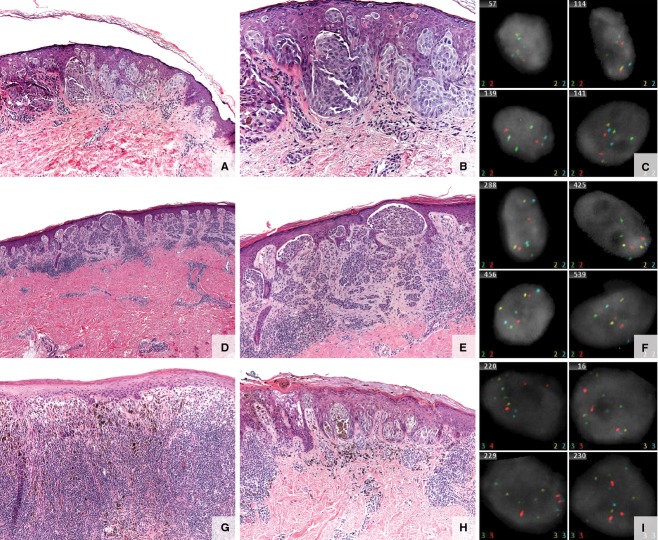
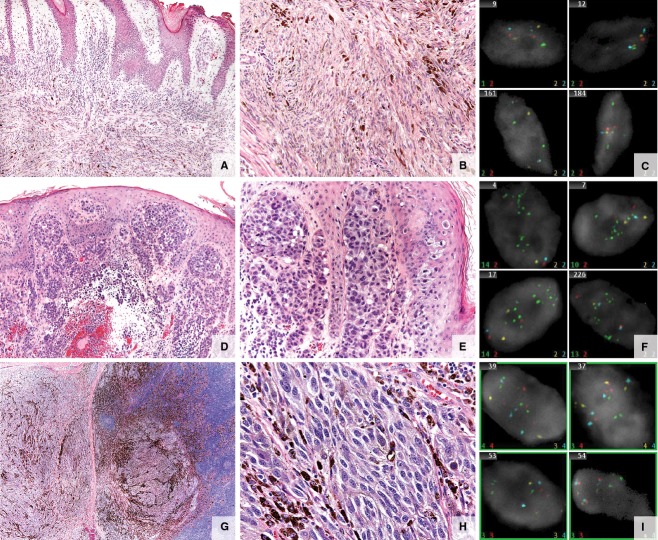
Morphologic heterogeneity among melanocytic proliferations is a common challenge in the diagnosis of melanoma. In particular, atypical melanocytic lesions in children, adolescents, and young adults may be difficult to classify because of significant morphologic overlap with melanoma. Recently a four-probe fluorescence in situ hybridization (FISH) protocol to detect chromosomal abnormalities in chromosomes 6 and 11 has shown promise for improving the classification of melanocytic lesions. We sought to determine the correlation between FISH results, morphology, and clinical outcomes in a series of challenging melanocytic proliferations in young patients. We retrospectively performed the standard four-probe FISH analysis on 21 melanocytic neoplasms from 21 patients younger than 25 years of age (range 5-25 years, mean 14.6 years) from Stanford University Medical Center who were prospectively followed for a median of 51 months (range 1-136 months). The study cohort included patients with 5 confirmed melanomas, 2 melanocytic tumors of uncertain malignant potential (MelTUMPs), 10 morphologically challenging atypical Spitz tumors (ASTs), and 4 typical Spitz nevi. FISH detected chromosomal aberrations in all five melanomas and in one MelTUMP, in which the patient developed subsequent lymph node and distant metastasis. All 10 ASTs, 4 Spitz nevi, and 1 of 2 MelTUMPs were negative for significant gains or losses in chromosomes 6 and 11q. Our findings demonstrated a strong correlation between positive FISH results and the histomorphologic impression of melanoma. This finding was also true for the MelTUMP with poor clinical outcome. Therefore FISH may serve as a helpful adjunct in the classification of controversial melanocytic tumors in young patients.
黑素细胞增殖的形态学异质性是黑色素瘤诊断中常见的挑战。特别是儿童、青少年和年轻成年人中的非典型黑素细胞病变,由于与黑色素瘤存在显著的形态学重叠,可能难以分类。最近,一种用于检测6号和11号染色体染色体异常的四探针荧光原位杂交(FISH)方案显示出有望改善黑素细胞病变的分类。我们试图确定在一系列年轻患者具有挑战性的黑素细胞增殖中FISH结果、形态学和临床结果之间的相关性。我们对来自斯坦福大学医学中心的21例年龄小于25岁(范围5 - 25岁,平均14.6岁)的患者的21个黑素细胞肿瘤进行了回顾性标准四探针FISH分析,这些患者接受了中位51个月(范围1 - 136个月)的前瞻性随访。研究队列包括5例确诊黑色素瘤患者、2例恶性潜能不确定的黑素细胞肿瘤(MelTUMPs)、10例形态学上具有挑战性的非典型斯皮茨肿瘤(ASTs)和4例典型斯皮茨痣。FISH在所有5例黑色素瘤和1例MelTUMP中检测到染色体畸变,该例患者随后发生了淋巴结和远处转移。所有10例ASTs、4例斯皮茨痣以及2例MelTUMPs中的1例在6号染色体和11q染色体上均未出现显著的增益或缺失。我们的研究结果表明FISH阳性结果与黑色素瘤的组织形态学印象之间存在很强的相关性。这一发现对于临床结果较差的MelTUMP也是如此。因此,FISH可能有助于对年轻患者中有争议的黑素细胞肿瘤进行分类。