Kirchhoff Anne C, Fluchel Mark N, Wright Jennifer, Ying Jian, Sweeney Carol, Bodson Julia, Stroup Antoinette M, Smith Ken R, Fraser Alison, Kinney Anita Y
Authors' Affiliations: Cancer Control and Population Sciences Research Program; Center for Children's Cancer Research; Department of Pediatrics, University of Utah School of Medicine;
Center for Children's Cancer Research; Department of Pediatrics, University of Utah School of Medicine;
Cancer Epidemiol Biomarkers Prev. 2014 Jul;23(7):1280-9. doi: 10.1158/1055-9965.EPI-13-1090. Epub 2014 Jun 12.
Childhood cancer survivors may be at increased risk of hospitalization because of cancer-related late effects.
Using data from population-based research resources in Utah, we identified childhood and adolescent cancer survivors who were diagnosed from 1973 to 2005 (N = 2,571). We selected a comparison cohort based on birth year and sex (N = 7,713). Hospitalizations from 1996 to 2010, excluding pregnancy and delivery, were determined from discharge records. Multivariable regressions were used to evaluate hospitalization admissions, length of stay, and diagnosis for survivors starting five years from diagnosis versus the comparison cohort.
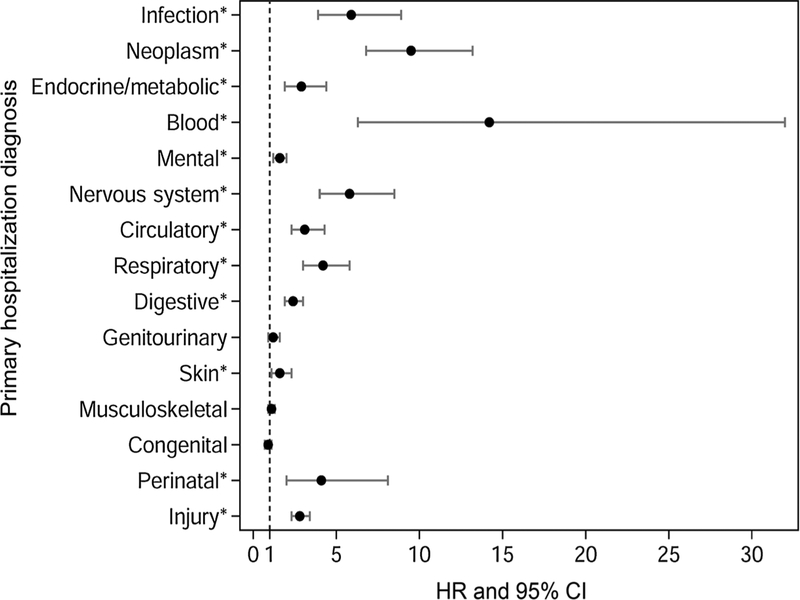
When follow-up began in 1996, there were N = 1,499 survivors and N = 7,219 comparisons who were alive and eligible for follow-up. Average follow-up for survivors was 13.5 years (SD = 8.5) and for the comparison 14.0 years (SD = 8.7; P = 0.05). Survivors were hospitalized, on average, 1.62 (SD = 3.37) times contrasted to 0.79 (SD = 1.73) for the comparison cohort. In multivariable analyses, the hazard ratio (HR) of any hospitalization since 1996 was higher for survivors than the comparison cohort [HR, 1.52, 95% confidence interval (CI), 1.31-1.66]. Survivors experienced a higher hospital admission rate [rate ratio (RR) = 1.67; 95% CI, 1.58-1.77] than the comparison cohort. The number of hospitalizations was highest for neuroblastoma (RR = 2.21; 95% CI, 1.84-2.66) and bone tumors (RR = 2.55; 95% CI, 2.14-3.02) in reference to the comparison cohort. Survivors were hospitalized because of blood disorders more often (HR, 14.2; 95% CI, 6.3-32.0).
The risk of hospitalization and lengths of stay are elevated among childhood cancer survivors.
Research to identify strategies to prevent and manage survivors' health problems in outpatient settings is needed.
儿童癌症幸存者因癌症相关的晚期效应,住院风险可能增加。
利用犹他州基于人群的研究资源数据,我们确定了1973年至2005年期间被诊断的儿童和青少年癌症幸存者(N = 2571)。我们根据出生年份和性别选择了一个对照队列(N = 7713)。从出院记录中确定1996年至2010年期间(不包括妊娠和分娩)的住院情况。多变量回归用于评估自确诊起五年后的幸存者与对照队列的住院入院情况、住院时间和诊断情况。
1996年开始随访时,有N = 1499名幸存者和N = 7219名对照者存活且符合随访条件。幸存者的平均随访时间为13.5年(标准差 = 8.5),对照者为14.0年(标准差 = 8.7;P = 0.05)。幸存者平均住院1.62次(标准差 = 3.37),而对照队列为0.79次(标准差 = 1.73)。在多变量分析中,自1996年以来,幸存者任何住院的风险比(HR)高于对照队列[HR,1.52,95%置信区间(CI),1.31 - 1.66]。幸存者的住院入院率[率比(RR) = 1.67;95% CI,1.58 - 1.77]高于对照队列。与对照队列相比,神经母细胞瘤(RR = 2.21;95% CI,1.84 - 2.66)和骨肿瘤(RR = 2.55;95% CI,2.14 - 3.02)的住院次数最高。幸存者因血液疾病住院更为频繁(HR,14.2;95% CI,6.3 - 32.0)。
儿童癌症幸存者的住院风险和住院时间有所增加。
需要开展研究以确定在门诊环境中预防和管理幸存者健康问题的策略。