Abe Arata, Harada-Abe Mina, Ueda Masayuki, Katano Takehiro, Nakajima Masataka, Muraga Kanako, Suda Satoshi, Nishiyama Yasuhiro, Okubo Seiji, Mishina Masahiro, Katsura Ken-Ichiro, Katayama Yasuo
Department of Neurological Science, Graduate School of Medicine, Nippon Medical School, Tokyo, Japan.
Cerebrovasc Dis Extra. 2014 May 9;4(2):92-101. doi: 10.1159/000362434. eCollection 2014 Jan.
Cerebral infarction of unknown origin at admission accounts for half of all cerebral infarction cases in some institutions. However, the factors associated with cerebral infarction prognosis have not been sufficiently examined. Here, we investigated whether aortic arch plaques (AAPs) on transoesophageal echocardiography (TOE) were associated with the prognosis of cerebral infarction of unknown origin at admission.
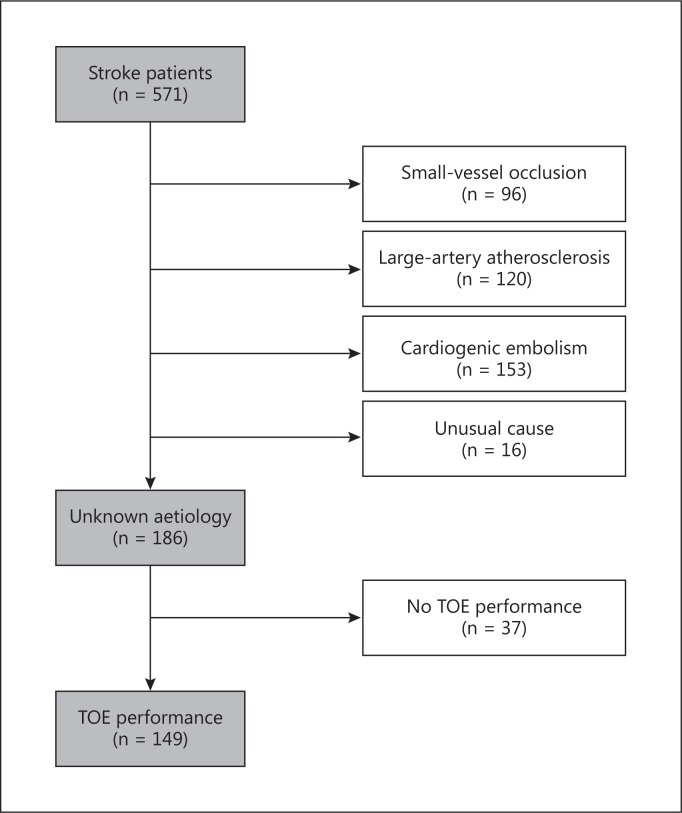
Of 571 patients who were hospitalised between June 2009 and September 2011, 149 (age: 67 ± 14 years; 95 men) with cerebral infarctions of unknown origin at admission underwent TOE and were enrolled in this study. We examined their clinical characteristics, the incidence of intermittent atrial fibrillation detected on 24-hour electrocardiography, and the echographic findings of the carotid artery in the hospital. A poor prognostic outcome was defined as a modified Rankin Scale score of ≥3 after 90 days.
In all, 110 patients (74%) showed good prognoses and 39 patients (26%) showed poor outcomes. A National Institutes of Health Stroke Scale score of >6 on admission [odds ratio (OR) = 6.77; 95% confidence interval (CI): 2.59-18.8; p < 0.001] and AAPs of ≥4 mm (OR = 2.75; 95% CI: 1.19-6.91; p = 0.024) showed significant associations with a poor prognosis of cerebral infarction of unknown origin at admission.
Thick AAPs could be a factor in the prediction of a poor prognosis of cerebral infarction of unknown origin at admission. The establishment of international standards for aortogenic brain embolisms is required. Future prospective studies should examine cerebral infarctions of unknown origin.
在一些机构中,入院时病因不明的脑梗死占所有脑梗死病例的一半。然而,与脑梗死预后相关的因素尚未得到充分研究。在此,我们调查了经食管超声心动图(TOE)检查发现的主动脉弓斑块(AAPs)是否与入院时病因不明的脑梗死预后相关。
在2009年6月至2011年9月期间住院的571例患者中,149例(年龄:67±14岁;95例男性)入院时患有病因不明的脑梗死,接受了TOE检查并纳入本研究。我们检查了他们的临床特征、24小时心电图检测到的间歇性心房颤动发生率以及住院期间颈动脉的超声检查结果。预后不良定义为90天后改良Rankin量表评分≥3分。
总体而言,110例患者(74%)预后良好,39例患者(26%)预后不良。入院时美国国立卫生研究院卒中量表评分>6分[比值比(OR)=6.77;95%置信区间(CI):2.59 - 18.8;p<0.001]以及AAPs≥4 mm(OR = 2.75;95%CI:1.19 - 6.91;p = 0.024)与入院时病因不明的脑梗死预后不良显著相关。
厚的AAPs可能是预测入院时病因不明的脑梗死预后不良的一个因素。需要建立主动脉源性脑栓塞的国际标准。未来的前瞻性研究应检查病因不明的脑梗死。