• 文献检索
  • 文档翻译
  • 深度研究
  • 学术资讯
  • Suppr Zotero 插件Zotero 插件
  • 邀请有礼
  • 套餐&价格
  • 历史记录
应用&插件
Suppr Zotero 插件Zotero 插件浏览器插件Mac 客户端Windows 客户端微信小程序
定价
高级版会员购买积分包购买API积分包
服务
文献检索文档翻译深度研究API 文档MCP 服务
关于我们
关于 Suppr公司介绍联系我们用户协议隐私条款
关注我们

Suppr 超能文献

核心技术专利:CN118964589B侵权必究
粤ICP备2023148730 号-1Suppr @ 2026

文献检索

告别复杂PubMed语法,用中文像聊天一样搜索,搜遍4000万医学文献。AI智能推荐,让科研检索更轻松。

立即免费搜索

文件翻译

保留排版,准确专业,支持PDF/Word/PPT等文件格式,支持 12+语言互译。

免费翻译文档

深度研究

AI帮你快速写综述,25分钟生成高质量综述,智能提取关键信息,辅助科研写作。

立即免费体验

成人不明原因卒中患者栓塞源与特定原因功能结局的相关性。

Association of Embolic Sources With Cause-Specific Functional Outcomes Among Adults With Cryptogenic Stroke.

机构信息

Department of Medicine and Clinical Science, Graduate School of Medical Sciences, Kyushu University, Fukuoka, Japan.

Department of Health Care Administration and Management, Graduate School of Medical Sciences, Kyushu University, Fukuoka, Japan.

出版信息

JAMA Netw Open. 2018 Sep 7;1(5):e182953. doi: 10.1001/jamanetworkopen.2018.2953.

DOI:10.1001/jamanetworkopen.2018.2953
PMID:30646186
原文链接:https://pmc.ncbi.nlm.nih.gov/articles/PMC6324510/
Abstract

IMPORTANCE

It is unknown whether poststroke outcome varies between different potential causes in patients with cryptogenic stroke.

OBJECTIVE

To investigate whether functional outcome differs according to potential embolic sources after cryptogenic stroke.

DESIGN, SETTING, AND PARTICIPANTS: This multicenter, hospital-based, prospective stroke registry cohort study investigated potential embolic sources on admission and assessed 3-month outcome in patients with ischemic stroke hospitalized at 7 stroke centers in the Fukuoka Stroke Registry. This registry enlisted 9866 consecutive patients with acute ischemic stroke who were enrolled from June 11, 2007, to May 31, 2016, in Fukuoka, Japan. Patients with small vessel occlusion (n = 3130), extracranial and intracranial atherosclerosis causing at least 50% luminal stenosis in arteries supplying the area of ischemia (n = 2011), and other specific uncommon causes of stroke identified (n = 301) were excluded. Potential embolic sources were diagnosed in patients with embolic stroke of undetermined source (ESUS) based on the following criteria proposed by the Cryptogenic Stroke/ESUS International Working Group: minor-risk potential cardioembolic sources (MCS) (n = 209), covert paroxysmal atrial fibrillation (CPAF) (n = 43), cancer associated (CA) (n = 79), arteriogenic emboli (AE) (n = 522), paradoxical embolism (PE) (n = 190), and undetermined embolism (unidentified or ≥2 potential embolic sources) (UE) (n = 1120).

MAIN OUTCOMES AND MEASURES

The association between potential causes and functional outcome was evaluated in reference to cardioembolic stroke (CE) caused by major-risk cardioembolic sources after adjusting for age, sex, National Institutes of Health Stroke Scale score on admission, and reperfusion therapy using logistic regression analysis. Functional dependency (modified Rankin Scale score, 3-5) was evaluated at 3 months after onset.

RESULTS

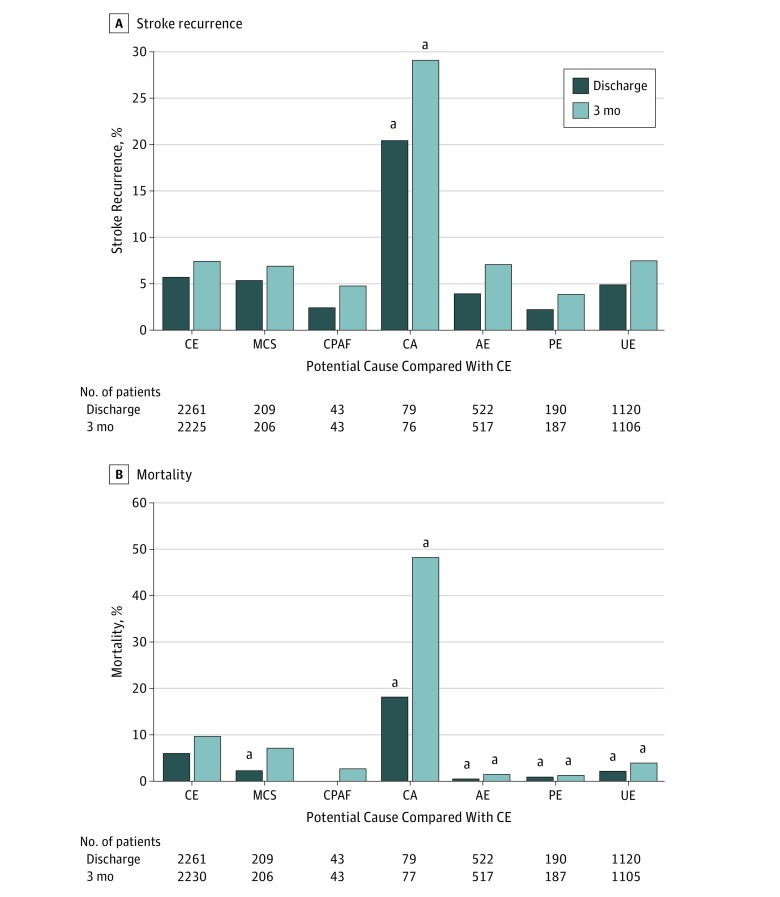
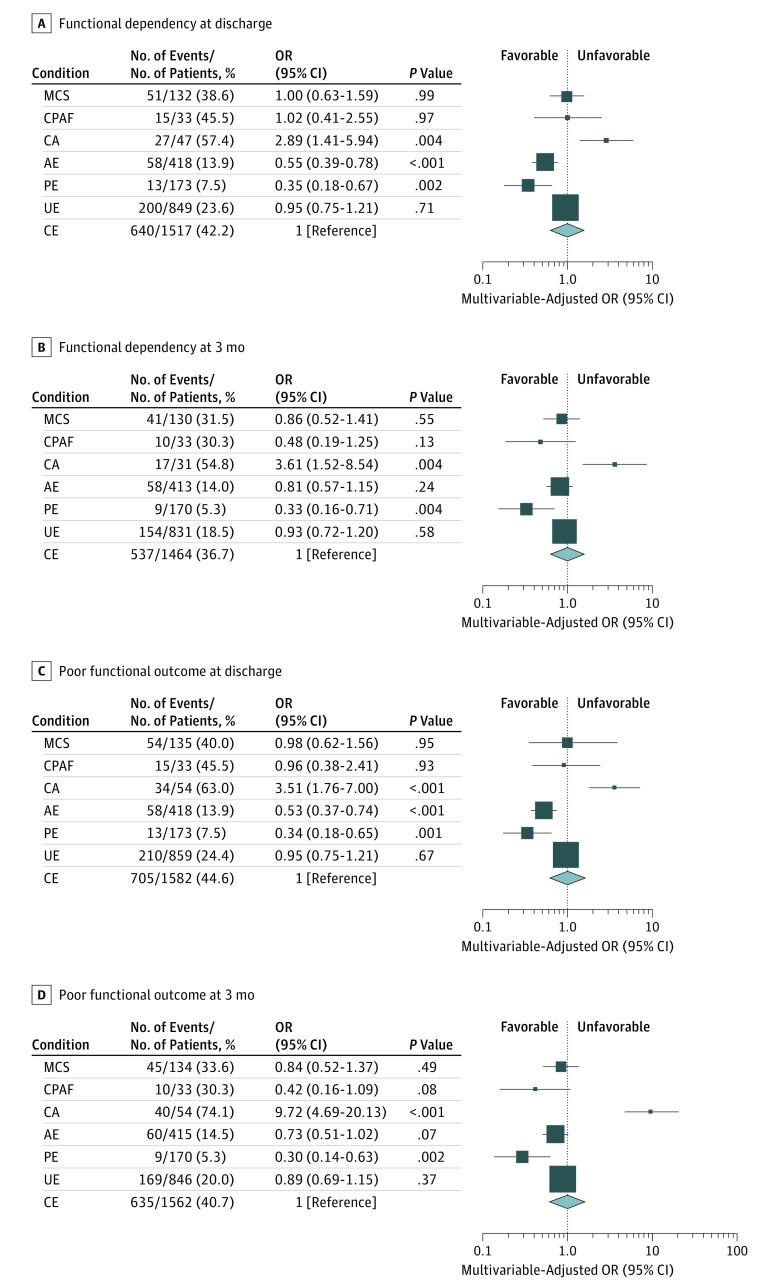
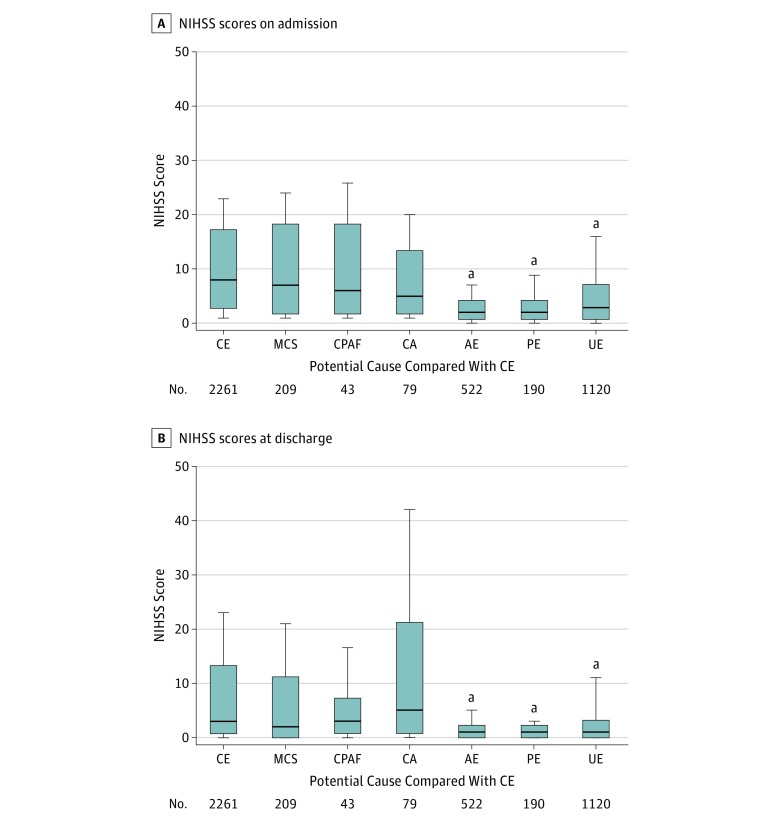
The study enrolled 2261 patients with CE (mean [SD] age, 78.4 [10.7] years, 51.8% male) and 2163 patients with ESUS (mean [SD] age, 72.4 [12.6] years, 57.1% male). Compared with CE (median National Institutes of Health Stroke Scale score, 8 [interquartile range {IQR}, 3-17]), baseline neurological deficits did not differ in MCS (median, 7 [IQR, 2-18]), CPAF (median, 6 [IQR, 2-18]), and CA (median, 5 [IQR, 2-13]) but were less severe in AE (median, 2 [IQR, 1-4]), PE (median, 2 [IQR, 1-4]), and UE (median, 3 [IQR, 1-7]). Multivariable-adjusted odds ratios of functional dependency significantly increased in CA (3.61; 95% CI, 1.52-8.54 vs CE) but decreased in PE (0.33; 95% CI, 0.16-0.71 vs CE).

CONCLUSIONS AND RELEVANCE

Potential causes are associated with poststroke outcome in patients with cryptogenic stroke. Embolic sources potentially underlying cryptogenic stroke should be considered significant variables associated with outcome.

摘要

重要性

尚不清楚隐匿性卒中患者的不同潜在病因与卒中后结局之间是否存在差异。

目的

研究隐匿性卒中患者的潜在栓塞源与功能结局是否存在差异。

设计、地点和参与者:这是一项多中心、基于医院的前瞻性卒中登记队列研究,在福冈卒中登记处的 7 家卒中中心对入院时的潜在栓塞源进行了研究,并评估了缺血性卒中患者的 3 个月结局。该登记处纳入了 9866 例连续急性缺血性卒中患者,他们于 2007 年 6 月 11 日至 2016 年 5 月 31 日在日本福冈登记。排除小血管闭塞(n=3130)、至少 50%的管腔狭窄导致颅内和颅外动脉供应区域缺血的动脉粥样硬化(n=2011)和其他特定少见原因的卒中(n=301)。根据隐源性卒中和 ESUS 国际工作组提出的以下标准,对栓塞性卒中来源不明(ESUS)患者进行潜在栓塞源诊断:低危心源性栓塞源(MCS)(n=209)、隐匿性阵发性房颤(CPAF)(n=43)、癌症相关(CA)(n=79)、动脉源栓子(AE)(n=522)、反常栓塞(PE)(n=190)和不明原因栓塞(不明原因或≥2 个潜在栓塞源)(UE)(n=1120)。

主要结局和测量指标

采用逻辑回归分析,在校正年龄、性别、入院时 NIH 卒中量表评分和再灌注治疗后,评估潜在病因与功能结局的相关性。采用改良 Rankin 量表(mRS)(3-5 分)评估发病 3 个月后的功能依赖性。

结果

该研究纳入了 2261 例心源性栓塞(CE)患者(平均[标准差]年龄 78.4[10.7]岁,51.8%为男性)和 2163 例 ESUS 患者(平均[标准差]年龄 72.4[12.6]岁,57.1%为男性)。与 CE 患者(中位数 NIH 卒中量表评分,8[四分位距 {IQR},3-17])相比,MCS(中位数,7[IQR,2-18])、CPAF(中位数,6[IQR,2-18])和 CA(中位数,5[IQR,2-13])患者的基线神经功能缺损无差异,但 AE(中位数,2[IQR,1-4])、PE(中位数,2[IQR,1-4])和 UE(中位数,3[IQR,1-7])患者的神经功能缺损程度较轻。多变量校正后,CA(3.61;95%CI,1.52-8.54)患者的功能依赖性比值比显著升高,但 PE(0.33;95%CI,0.16-0.71)患者的比值比显著降低。

结论和相关性

潜在病因与隐匿性卒中患者的卒中后结局相关。潜在的栓塞源可能是隐匿性卒中的重要变量。
https://cdn.ncbi.nlm.nih.gov/pmc/blobs/b620/6324510/f43cafa3aa14/jamanetwopen-1-e182953-g003.jpg
https://cdn.ncbi.nlm.nih.gov/pmc/blobs/b620/6324510/97af975cd8c7/jamanetwopen-1-e182953-g001.jpg
https://cdn.ncbi.nlm.nih.gov/pmc/blobs/b620/6324510/cbed84221338/jamanetwopen-1-e182953-g002.jpg
https://cdn.ncbi.nlm.nih.gov/pmc/blobs/b620/6324510/f43cafa3aa14/jamanetwopen-1-e182953-g003.jpg
https://cdn.ncbi.nlm.nih.gov/pmc/blobs/b620/6324510/97af975cd8c7/jamanetwopen-1-e182953-g001.jpg
https://cdn.ncbi.nlm.nih.gov/pmc/blobs/b620/6324510/cbed84221338/jamanetwopen-1-e182953-g002.jpg
https://cdn.ncbi.nlm.nih.gov/pmc/blobs/b620/6324510/f43cafa3aa14/jamanetwopen-1-e182953-g003.jpg

相似文献

1
Association of Embolic Sources With Cause-Specific Functional Outcomes Among Adults With Cryptogenic Stroke.成人不明原因卒中患者栓塞源与特定原因功能结局的相关性。
JAMA Netw Open. 2018 Sep 7;1(5):e182953. doi: 10.1001/jamanetworkopen.2018.2953.
2
Embolic strokes of undetermined source in the Athens stroke registry: a descriptive analysis.雅典卒中登记中不明来源的栓塞性卒中:一项描述性分析。
Stroke. 2015 Jan;46(1):176-81. doi: 10.1161/STROKEAHA.114.007240. Epub 2014 Nov 6.
3
Clinical and Neuroimaging Characteristics in Embolic Stroke of Undetermined versus Cardioembolic Origin: A Population-Based Study.不明来源栓塞性卒中和心源性栓塞性卒中的临床和神经影像学特征:一项基于人群的研究。
J Neuroimaging. 2019 Nov;29(6):737-742. doi: 10.1111/jon.12660. Epub 2019 Aug 28.
4
Embolic infarct topology differs between atrial fibrillation subtypes and embolic stroke of undetermined source.栓塞性梗死的拓扑结构在心房颤动的不同亚型和不明来源的栓塞性卒中之间存在差异。
J Stroke Cerebrovasc Dis. 2022 Nov;31(11):106782. doi: 10.1016/j.jstrokecerebrovasdis.2022.106782. Epub 2022 Sep 18.
5
Incidence, characteristics and outcomes in patients with embolic stroke of undetermined source: A population-based study.不明来源栓塞性卒中患者的发病率、特征和结局:一项基于人群的研究。
J Neurol Sci. 2019 Jun 15;401:5-11. doi: 10.1016/j.jns.2019.04.008. Epub 2019 Apr 6.
6
Characteristics of Recurrent Ischemic Stroke After Embolic Stroke of Undetermined Source: Secondary Analysis of a Randomized Clinical Trial.不明来源栓塞性卒中后复发缺血性卒中的特征:一项随机临床试验的二次分析。
JAMA Neurol. 2020 Oct 1;77(10):1233-1240. doi: 10.1001/jamaneurol.2020.1995.
7
Distinction in Prevalence of Atherosclerotic Embolic Sources in Cryptogenic Stroke With Cancer Status.癌症状态与不明原因卒中患者动脉粥样硬化栓子来源患病率的差异。
J Am Heart Assoc. 2021 Nov 2;10(21):e021375. doi: 10.1161/JAHA.120.021375. Epub 2021 Oct 23.
8
Embolic strokes of undetermined source in a cohort of Polish stroke patients.波兰卒中患者队列中的不明来源栓塞性卒中。
Neurol Sci. 2018 Jun;39(6):1041-1047. doi: 10.1007/s10072-018-3322-5. Epub 2018 Mar 19.
9
From cryptogenic to ESUS: Toward precision medicine?从隐源性到 ESUS:走向精准医学?
Rev Neurol (Paris). 2022 Nov;178(9):939-952. doi: 10.1016/j.neurol.2022.01.016. Epub 2022 May 18.
10
[ESUS (embolic stroke of undetermined sources)].[不明来源栓塞性卒中(ESUS)]
Nihon Rinsho. 2016 Apr;74(4):597-602.

引用本文的文献

1
Intravenous thrombolysis in the context of stroke and cancer.中风与癌症背景下的静脉溶栓治疗。
J Thromb Thrombolysis. 2025 Jul 17. doi: 10.1007/s11239-025-03156-5.
2
Pathogenesis and Biomarkers of Cancer-Related Ischemic Stroke.癌症相关缺血性卒中的发病机制与生物标志物
J Inflamm Res. 2024 Nov 9;17:8589-8597. doi: 10.2147/JIR.S493406. eCollection 2024.
3
Acute ischaemic stroke in active cancer versus non-cancer patients: stroke characteristics, mechanisms and clinical outcomes.活动性癌症与非癌症患者的急性缺血性脑卒中:脑卒中特征、发病机制和临床转归。

本文引用的文献

1
Rivaroxaban for secondary stroke prevention in patients with embolic strokes of undetermined source: Design of the NAVIGATE ESUS randomized trial.利伐沙班用于不明来源栓塞性卒中患者的二级预防:NAVIGATE ESUS随机试验设计
Eur Stroke J. 2016 Sep;1(3):146-154. doi: 10.1177/2396987316663049. Epub 2016 Aug 3.
2
Rivaroxaban for Stroke Prevention after Embolic Stroke of Undetermined Source.利伐沙班预防来源不明的栓塞性卒中后卒中
N Engl J Med. 2018 Jun 7;378(23):2191-2201. doi: 10.1056/NEJMoa1802686. Epub 2018 May 16.
3
Age- and sex-specific analysis of patients with embolic stroke of undetermined source.
Eur J Neurol. 2024 Apr;31(4):e16200. doi: 10.1111/ene.16200. Epub 2024 Jan 18.
4
ADAMTS-13 activity in stroke of known and unknown cause: Relation to vascular risk factor burden.已知和未知病因的卒中中ADAMTS-13活性:与血管危险因素负荷的关系
Front Neurol. 2023 Jan 10;13:1045478. doi: 10.3389/fneur.2022.1045478. eCollection 2022.
5
Causes of ischemic stroke in young adults versus non-young adults: A multicenter hospital-based observational study.中青年与非中青年缺血性脑卒中病因分析:一项多中心医院观察性研究。
PLoS One. 2022 Jul 13;17(7):e0268481. doi: 10.1371/journal.pone.0268481. eCollection 2022.
6
Cancer and stroke: commonly encountered by clinicians, but little evidence to guide clinical approach.癌症和中风:临床医生常遇到,但几乎没有证据可指导临床治疗方法。
Ther Adv Neurol Disord. 2022 Jun 28;15:17562864221106362. doi: 10.1177/17562864221106362. eCollection 2022.
7
Ischemic stroke with cancer: Hematologic and embolic biomarkers and clinical outcomes.伴有癌症的缺血性脑卒中:血液学和栓塞生物标志物及临床结局。
J Thromb Haemost. 2022 Sep;20(9):2046-2057. doi: 10.1111/jth.15779. Epub 2022 Jun 21.
8
Review and update of the concept of embolic stroke of undetermined source.不明来源栓塞性卒中概念的回顾与更新。
Nat Rev Neurol. 2022 Aug;18(8):455-465. doi: 10.1038/s41582-022-00663-4. Epub 2022 May 10.
9
Mechanisms of Ischemic Stroke in Patients with Cancer: A Prospective Study.癌症患者缺血性脑卒中的发病机制:一项前瞻性研究。
Ann Neurol. 2021 Jul;90(1):159-169. doi: 10.1002/ana.26129. Epub 2021 Jun 3.
10
Cancer and Embolic Stroke of Undetermined Source.无法确定来源的癌症和栓塞性脑卒中。
Stroke. 2021 Mar;52(3):1121-1130. doi: 10.1161/STROKEAHA.120.032002. Epub 2021 Jan 28.
不明来源栓塞性卒中患者的年龄和性别特异性分析。
Neurology. 2017 Aug 8;89(6):532-539. doi: 10.1212/WNL.0000000000004199. Epub 2017 Jul 7.
4
Embolic Stroke of Undetermined Source: A Systematic Review and Clinical Update.不明来源栓塞性卒中:系统评价与临床进展
Stroke. 2017 Apr;48(4):867-872. doi: 10.1161/STROKEAHA.116.016414. Epub 2017 Mar 6.
5
Cryptogenic Stroke: Research and Practice.隐源性卒中:研究与实践。
Circ Res. 2017 Feb 3;120(3):527-540. doi: 10.1161/CIRCRESAHA.116.308447.
6
Apixaban for treatment of embolic stroke of undetermined source (ATTICUS randomized trial): Rationale and study design.阿哌沙班治疗来源不明的栓塞性卒中(ATTICUS 随机试验):原理和研究设计。
Int J Stroke. 2017 Dec;12(9):985-990. doi: 10.1177/1747493016681019. Epub 2016 Nov 23.
7
Comparison of Functional Outcome and Stroke Recurrence in Patients with Embolic Stroke of Undetermined Source (ESUS) vs. Cardioembolic Stroke Patients.不明来源栓塞性卒中(ESUS)患者与心源性栓塞性卒中患者的功能结局及卒中复发情况比较。
PLoS One. 2016 Nov 10;11(11):e0166091. doi: 10.1371/journal.pone.0166091. eCollection 2016.
8
Embolic strokes of undetermined source: Prevalence and patient features in the ESUS Global Registry.不明来源栓塞性卒中:ESUS全球注册研究中的患病率及患者特征
Int J Stroke. 2016 Jul;11(5):526-33. doi: 10.1177/1747493016641967. Epub 2016 Apr 11.
9
Characteristics of cryptogenic stroke in cancer patients.癌症患者隐源性卒中的特征。
Ann Clin Transl Neurol. 2016 Feb 11;3(4):280-7. doi: 10.1002/acn3.291. eCollection 2016 Apr.
10
An Approach to Working Up Cases of Embolic Stroke of Undetermined Source.不明来源栓塞性卒中病例的诊治方法
J Am Heart Assoc. 2016 Mar 22;5(3):e002975. doi: 10.1161/JAHA.115.002975.