Qin Yunbin, Xin Zhongbao, Yu Xinxiao, Xiao Yuling
Institute of Soil and Water Conservation, Beijing Forestry University, Beijing, China.
PLoS One. 2014 Jun 13;9(6):e94489. doi: 10.1371/journal.pone.0094489. eCollection 2014.
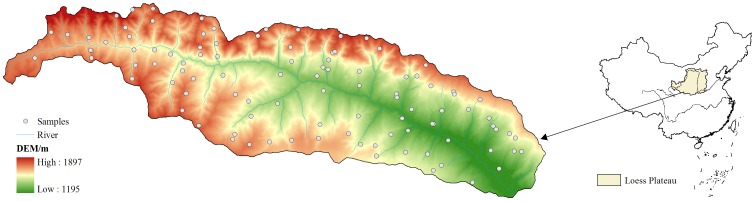
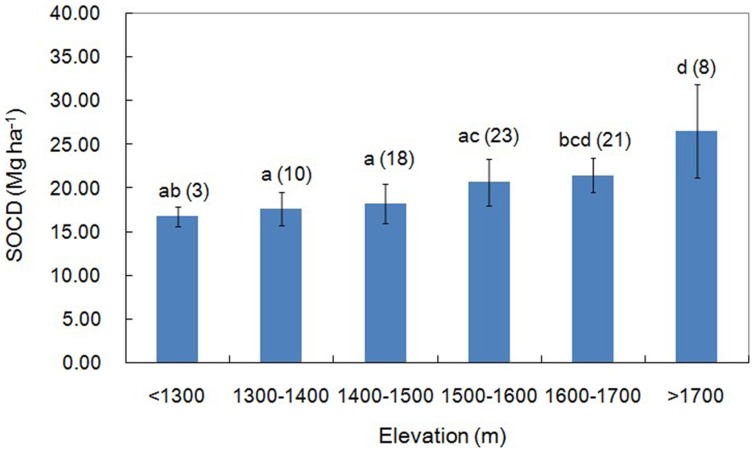
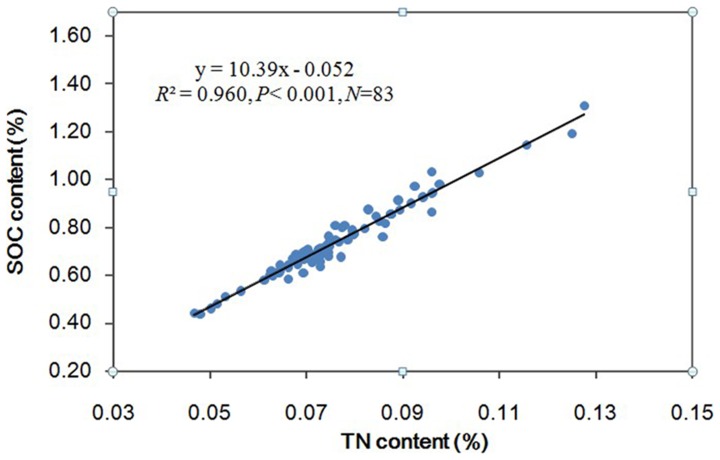
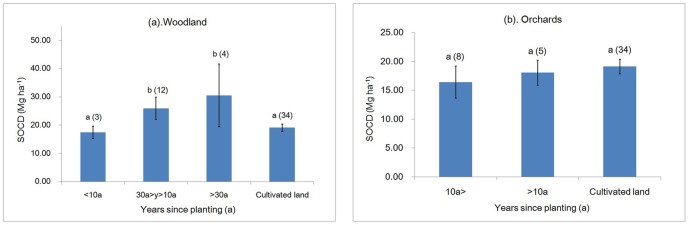
Understanding effects of land-use changes driven by the implementation of the "Grain for Green" project and the corresponding changes in soil organic carbon (SOC) storage is important in evaluating the environmental benefits of this ecological restoration project. The goals of this study were to quantify the current soil organic carbon density (SOCD) in different land-use types [cultivated land, abandoned land (cessation of farming), woodland, wild grassland and orchards] in a catchment of the loess hilly and gully region of China to evaluate the benefits of SOC sequestration achieved by vegetation restoration in the past 10 years as well as to discuss uncertain factors affecting future SOC sequestration. Based on soil surveys (N = 83) and laboratory analyses, the results show that the topsoil (0-20 cm) SOCD was 20.44 Mg/ha in this catchment. Using the SOCD in cultivated lands (19.08 Mg/ha) as a reference, the SOCD in woodlands and abandoned lands was significantly higher by 33.81% and 8.49%, respectively, whereas in orchards, it was lower by 10.80%. The correlation analysis showed that SOC and total nitrogen (TN) were strongly correlated (R2 = 0.98) and that the average C∶N (SOC∶TN) ratio was 9.69. With increasing years since planting, the SOCD in woodlands showed a tendency to increase; however, no obvious difference was observed in orchards. A high positive correlation was found between SOCD and elevation (R2 = 0.395), but a low positive correlation was found between slope and SOCD (R2 = 0.170, P = 0.127). In the past 10 years of restoration, SOC storage did not increase significantly (2.74% or 3706.46 t) in the catchment where the conversion of cultivated land to orchards was the primary restoration pattern. However, the potential contribution of vegetation restoration to SOC sequestration in the next several decades would be massive if the woodland converted from the cropland is well managed and maintained.
了解“退耕还林”工程实施所驱动的土地利用变化影响以及土壤有机碳(SOC)储量的相应变化,对于评估这一生态恢复工程的环境效益具有重要意义。本研究的目的是量化中国黄土丘陵沟壑区一个流域内不同土地利用类型[耕地、弃耕地(停止耕种)、林地、荒草地和果园]当前的土壤有机碳密度(SOCD),以评估过去10年植被恢复所实现的SOC固存效益,并探讨影响未来SOC固存的不确定因素。基于土壤调查(N = 83)和实验室分析,结果表明该流域表层土壤(0 - 20厘米)的SOCD为20.44 Mg/ha。以耕地的SOCD(19.08 Mg/ha)为参照,林地和弃耕地的SOCD分别显著高出33.81%和8.49%,而果园的SOCD则低10.80%。相关性分析表明,SOC与总氮(TN)高度相关(R2 = 0.98),平均C∶N(SOC∶TN)比为9.69。随着造林年份增加,林地的SOCD呈增加趋势;然而,果园中未观察到明显差异。发现SOCD与海拔高度呈高度正相关(R2 = 0.395),但坡度与SOCD之间呈低度正相关(R2 = 0.170,P = 0.127)。在过去10年的恢复过程中,以耕地转变为果园为主要恢复模式的流域内,SOC储量没有显著增加(2.74%或3706.46吨)。然而,如果由农田转变而来的林地得到良好管理和维护,未来几十年植被恢复对SOC固存的潜在贡献将是巨大的。