Carter James R, Keith James H, Fraser Tresa S, Dawson James L, Kucharski Cheryl A, Horne Kate M, Higgs Stephen, Fraser Malcolm J
Department of Biological Sciences, Eck Institute of Global Health, University of Notre Dame, Notre Dame, Indiana 46556, USA.
Virol J. 2014 Jun 13;11:111. doi: 10.1186/1743-422X-11-111.
Approximately 100 million confirmed infections and 20,000 deaths are caused by Dengue virus (DENV) outbreaks annually. Global warming and rapid dispersal have resulted in DENV epidemics in formally non-endemic regions. Currently no consistently effective preventive measures for DENV exist, prompting development of transgenic and paratransgenic vector control approaches. Production of transgenic mosquitoes refractory for virus infection and/or transmission is contingent upon defining antiviral genes that have low probability for allowing escape mutations, and are equally effective against multiple serotypes. Previously we demonstrated the effectiveness of an anti-viral group I intron targeting U143 of the DENV genome in mediating trans-splicing and expression of a marker gene with the capsid coding domain. In this report we examine the effectiveness of coupling expression of ΔN Bax to trans-splicing U143 intron activity as a means of suppressing DENV infection of mosquito cells.
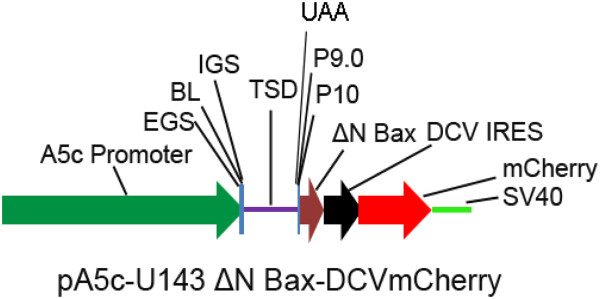
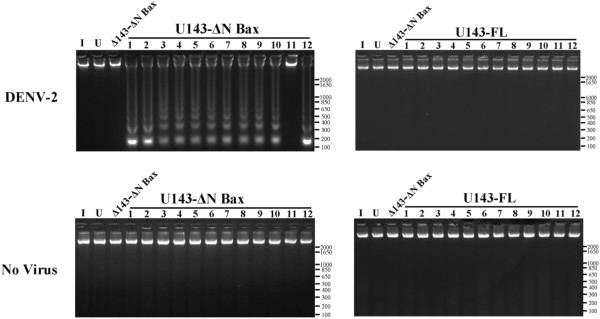
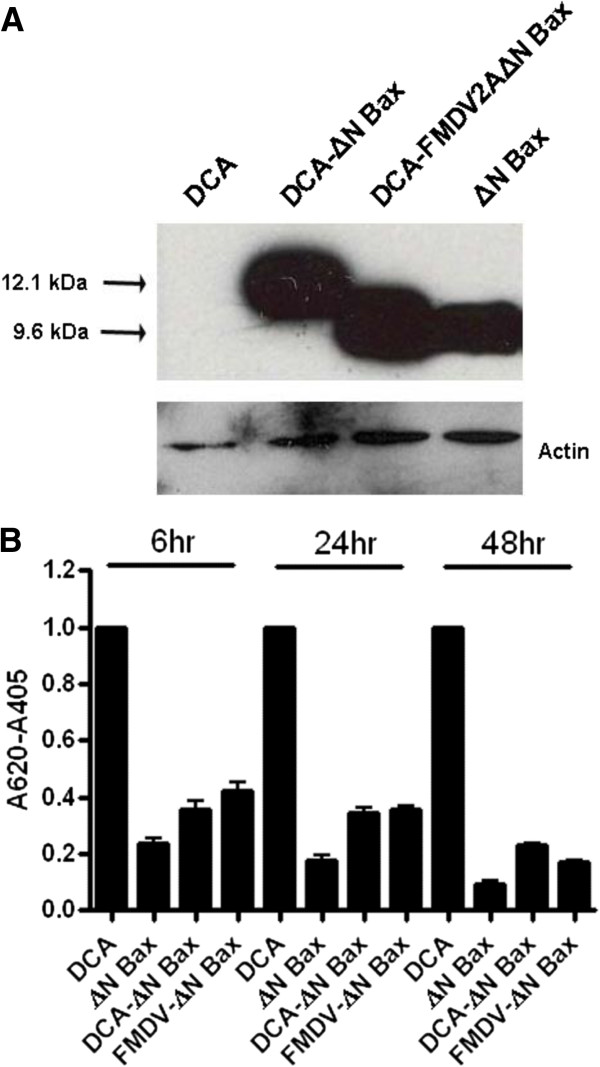
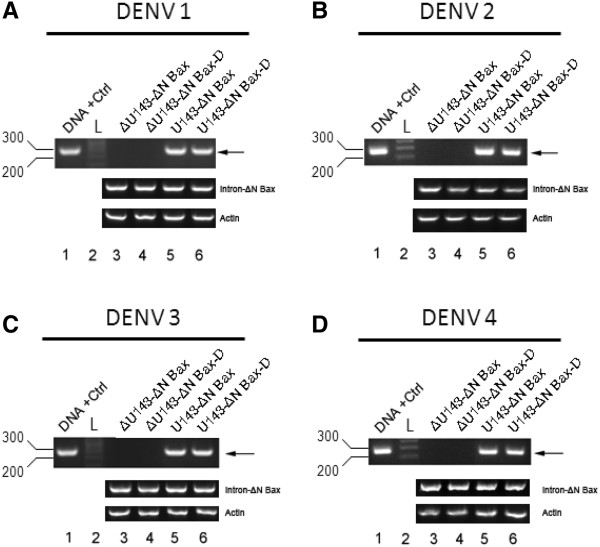
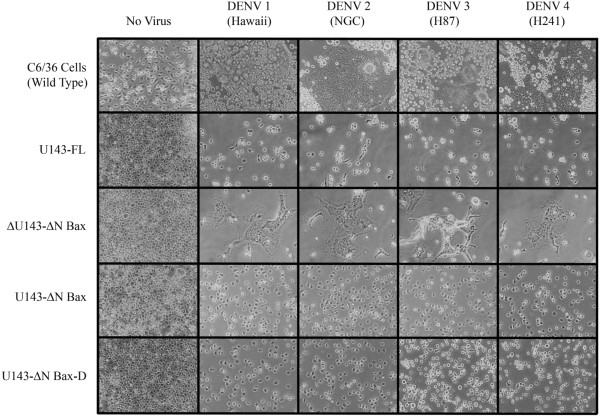
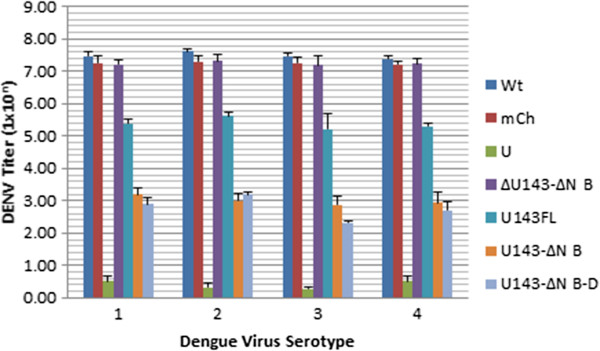
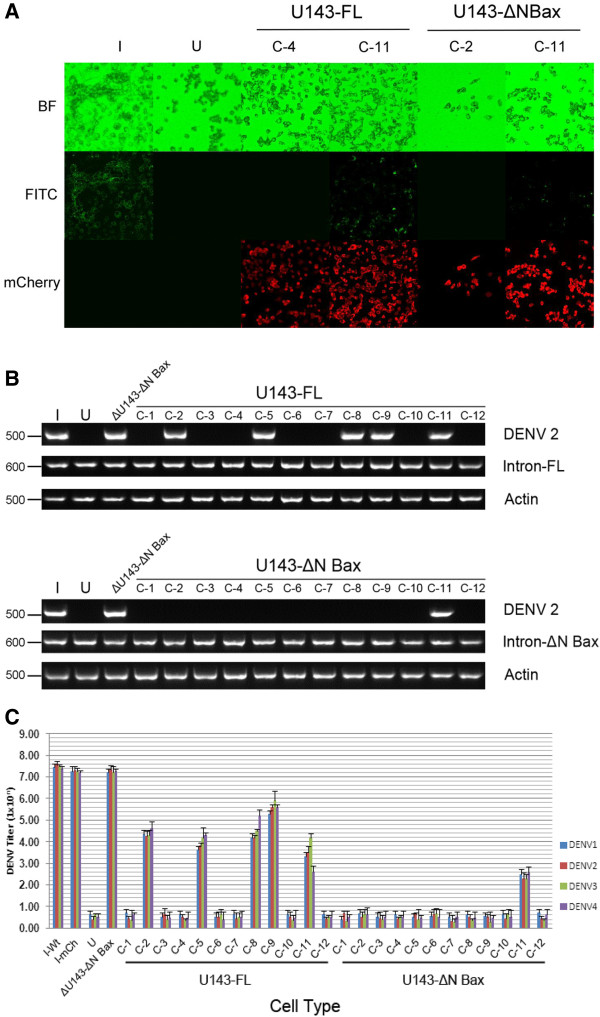
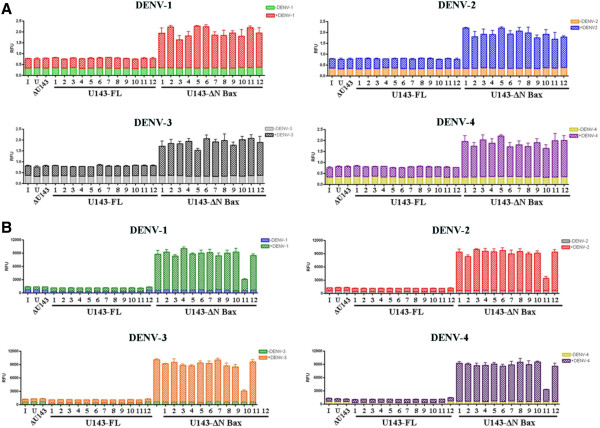
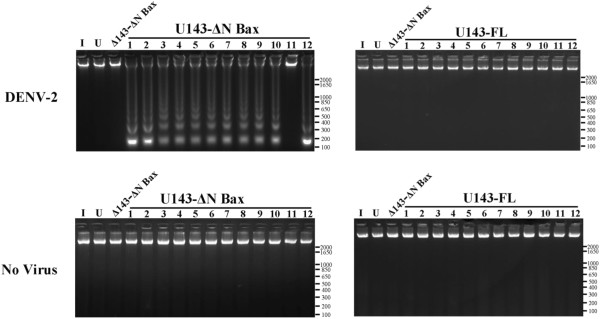
Targeting the conserved DENV circularization sequence (CS) by U143 intron trans-splicing activity appends a 3' exon RNA encoding ΔN Bax to the capsid coding region of the genomic RNA, resulting in a chimeric protein that induces premature cell death upon infection. TCID50-IFA analyses demonstrate an enhancement of DENV suppression for all DENV serotypes tested over the identical group I intron coupled with the non-apoptotic inducing firefly luciferase as the 3' exon. These cumulative results confirm the increased effectiveness of this αDENV-U143-ΔN Bax group I intron as a sequence specific antiviral that should be useful for suppression of DENV in transgenic mosquitoes. Annexin V staining, caspase 3 assays, and DNA ladder observations confirm DCA-ΔN Bax fusion protein expression induces apoptotic cell death.
This report confirms the relative effectiveness of an anti-DENV group I intron coupled to an apoptosis-inducing ΔN Bax 3' exon that trans-splices conserved sequences of the 5' CS region of all DENV serotypes and induces apoptotic cell death upon infection. Our results confirm coupling the targeted ribozyme capabilities of the group I intron with the generation of an apoptosis-inducing transcript increases the effectiveness of infection suppression, improving the prospects of this unique approach as a means of inducing transgenic refractoriness in mosquitoes for all serotypes of this important disease.
每年登革热病毒(DENV)爆发导致约1亿例确诊感染和2万例死亡。全球变暖和快速传播已导致在以前的非流行地区出现登革热病毒流行。目前尚无针对登革热病毒的始终有效的预防措施,这促使了转基因和共生转基因载体控制方法的发展。生产对病毒感染和/或传播具有抗性的转基因蚊子取决于确定具有低逃逸突变概率且对多种血清型均有效的抗病毒基因。此前我们证明了靶向DENV基因组U143的抗病毒I组内含子在介导反式剪接和衣壳编码域标记基因表达方面的有效性。在本报告中,我们研究了将ΔN Bax的表达与反式剪接U143内含子活性偶联作为抑制蚊子细胞DENV感染的一种手段的有效性。
通过U143内含子反式剪接活性靶向保守的DENV环化序列(CS),将编码ΔN Bax的3'外显子RNA附加到基因组RNA的衣壳编码区域,产生一种嵌合蛋白,该蛋白在感染时诱导细胞过早死亡。TCID50-IFA分析表明,与作为3'外显子的非凋亡诱导萤火虫荧光素酶偶联的相同I组内含子相比,所有测试的DENV血清型的DENV抑制作用均增强。这些累积结果证实了这种αDENV-U143-ΔN Bax I组内含子作为序列特异性抗病毒剂的有效性增加,这对于在转基因蚊子中抑制DENV应该是有用的。膜联蛋白V染色、半胱天冬酶3检测和DNA梯状观察证实DCA-ΔN Bax融合蛋白表达诱导凋亡性细胞死亡。
本报告证实了与诱导凋亡的ΔN Bax 3'外显子偶联的抗DENV I组内含子的相对有效性,该内含子反式剪接所有DENV血清型5' CS区域的保守序列并在感染时诱导凋亡性细胞死亡。我们的结果证实,将I组内含子的靶向核酶能力与诱导凋亡转录本的产生相结合,可提高感染抑制的有效性,改善这种独特方法作为诱导蚊子对这种重要疾病的所有血清型产生转基因抗性手段的前景。