Laboratório de Trasmissores de Hematozoários, Av. Brasil 4365, Rio de Janeiro, RJ 21045-900, Brasil.
Virol J. 2013 Jan 2;10:3. doi: 10.1186/1743-422X-10-3.
Dengue, a mosquito-borne viral infection caused by one of the four dengue virus (DENV) serotypes (DENV-1 to 4), replicate alternately on the mosquito vector and human host and are responsible for infections throughout tropical and subtropical regions of the world. In Brazil, the disease has become a major public health problem and the introduction of DENV-3 in 2000 in Rio de Janeiro (RJ) was associated with severe dengue epidemics. The potential emergence of strains associated with severe disease highlights the need for the surveillance of DENV in human host and vectors.
Aiming to contribute for DENV phylogenetic and vector-virus-human host studies, we sequenced the entire genome of one DENV-3 isolated from naturally infected Aedes aegypti from RJ in 2001 and characterized the 3' UTR from strains isolated from mosquitoes and humans. Mosquitoes were pooled and submitted to virus isolation in Ae. albopictus C6/36 cells and the infecting serotype was identified by immunofluorescence using type-specific monoclonal antibody. Sequence analysis was performed using BioEdit software, the multiple alignments were performed using CLUSTAL W and the phylogenetic analysis by MEGA 5, using the Neighbor-joining method. Secondary structure prediction was performed by using the MFOLD program.
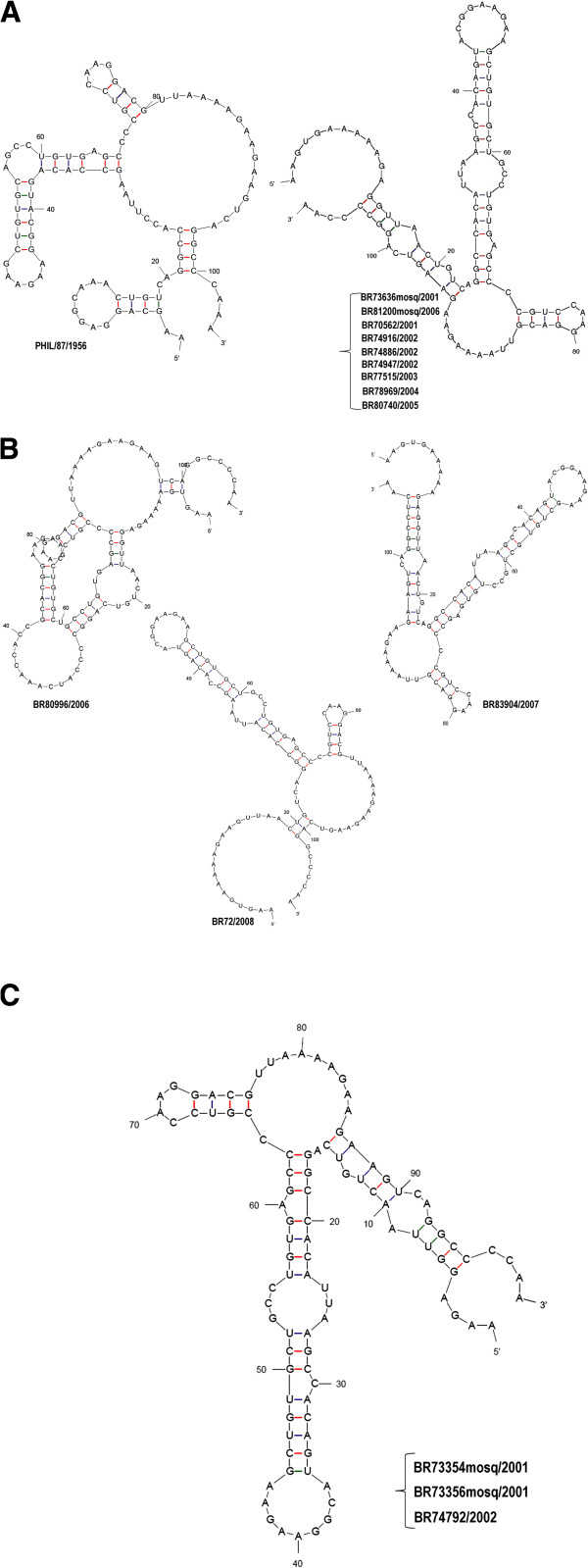
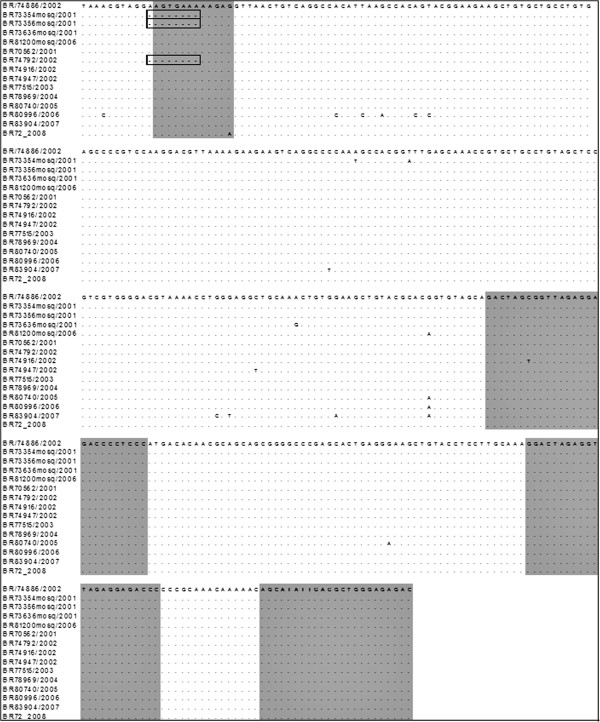
Exclusive substitutions and a substitution leading to a stop codon on the NS5 gene were observed in the DENV-3 isolated from a naturally infected Ae. aegypti and fully sequenced. As an 8- nucleotides deletion was observed within the 11- nucleotides (nts) insertion on the variable region (VR) from the 3'UTR in this isolate, we further sequenced other DENV-3 from both mosquitoes and humans. The majority of DENV-3 from RJ analyzed were characterized by the 11-nts insertion in the VR of the 3'UTR, despite the observation of strains carrying the 8-nts deletion. The latter presented similar secondary structures, however not all strains presenting the 11-nts insertion were similar in the predicted secondary structure.
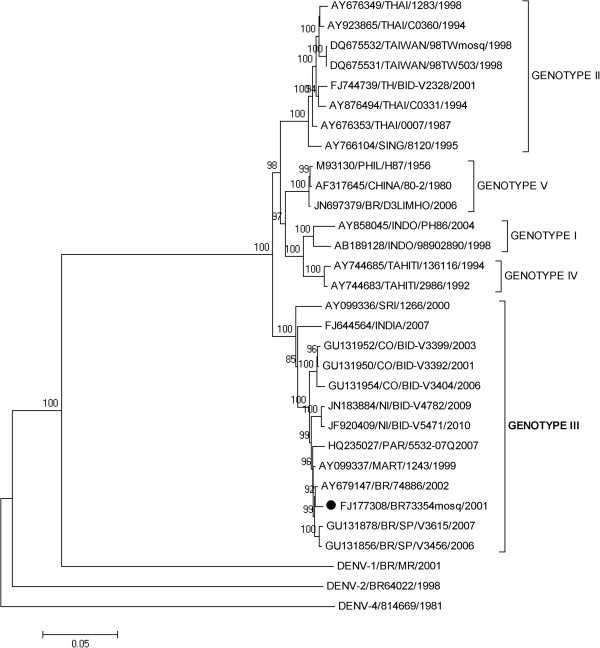
The phylogeny based on the analysis of the complete genome and 3'UTR characterized the DENV-3 isolated from both vector and human host as belonging to Genotype III (GIII), despite the differences observed on the 3' UTR. Further studies are needed to address the role of those mutations in the transmission of the different viral populations and vector competence.
登革热是一种由四种登革病毒(DENV-1 至 4)之一引起的蚊媒病毒感染,在蚊媒和人类宿主之间交替复制,导致全球热带和亚热带地区的感染。在巴西,该疾病已成为一个主要的公共卫生问题,2000 年在里约热内卢(RJ)引入的 DENV-3 与严重的登革热疫情有关。与严重疾病相关的菌株的潜在出现突出了监测人类宿主和媒介中 DENV 的必要性。
为了为 DENV 的系统发育和媒介-病毒-人类宿主研究做出贡献,我们对 2001 年从 RJ 自然感染的埃及伊蚊中分离的一株 DENV-3 进行了全基因组测序,并对从蚊子和人类中分离的株系的 3'UTR 进行了特征描述。将蚊子汇集起来,在 Ae. albopictus C6/36 细胞中进行病毒分离,并使用针对特定类型的单克隆抗体通过免疫荧光法鉴定感染的血清型。使用 BioEdit 软件进行序列分析,使用 CLUSTAL W 进行多重比对,使用 MEGA 5 进行系统发育分析,使用邻接法。使用 MFOLD 程序进行二级结构预测。
从自然感染的埃及伊蚊中分离并完全测序的 DENV-3 中观察到 NS5 基因上的特有替换和导致终止密码子的替换。由于在 3'UTR 的可变区(VR)上观察到 11 个核苷酸(nts)插入处的 8 个核苷酸缺失,因此我们进一步对来自蚊子和人类的其他 DENV-3 进行了测序。分析的大多数来自 RJ 的 DENV-3 在 VR 中具有 11-nts 插入,尽管观察到携带 8-nts 缺失的株系。后者表现出相似的二级结构,但并非所有具有 11-nts 插入的株系在预测的二级结构中都是相似的。
基于对完整基因组和 3'UTR 的分析的系统发育将从媒介和人类宿主中分离的 DENV-3 鉴定为属于基因型 III(GIII),尽管在 3'UTR 上观察到差异。需要进一步研究以解决这些突变在不同病毒群体传播和媒介适应性中的作用。