Langelier Marie-France, Riccio Amanda A, Pascal John M
Department of Biochemistry & Molecular Biology, Kimmel Cancer Center, Thomas Jefferson University, Philadelphia, PA 19107, USA.
Department of Biochemistry & Molecular Biology, Kimmel Cancer Center, Thomas Jefferson University, Philadelphia, PA 19107, USA
Nucleic Acids Res. 2014 Jul;42(12):7762-75. doi: 10.1093/nar/gku474. Epub 2014 Jun 13.
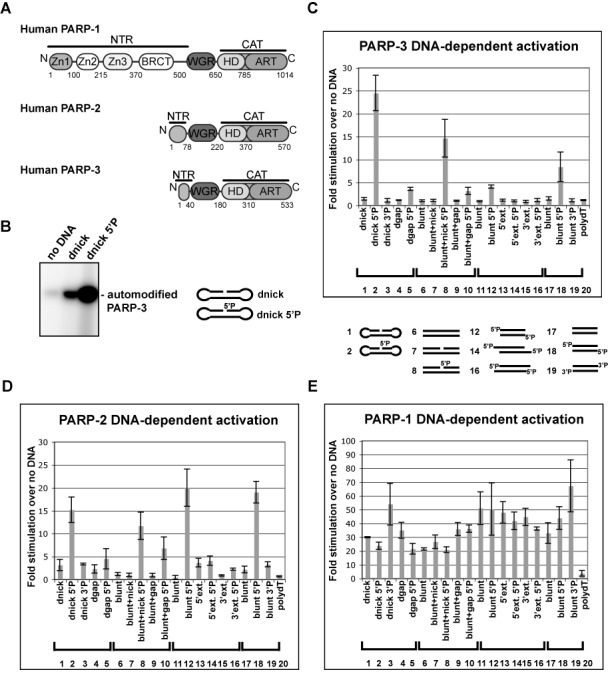
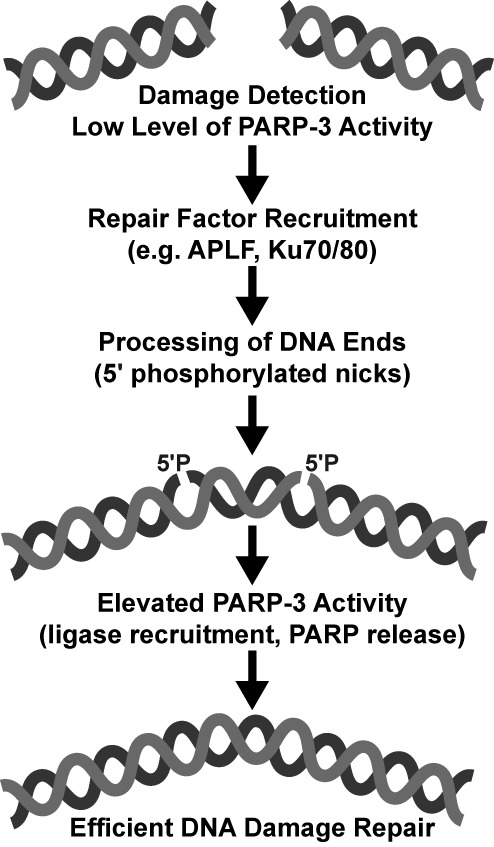
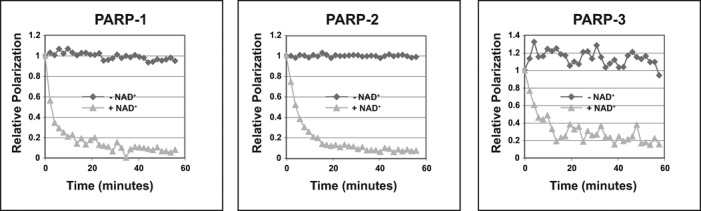
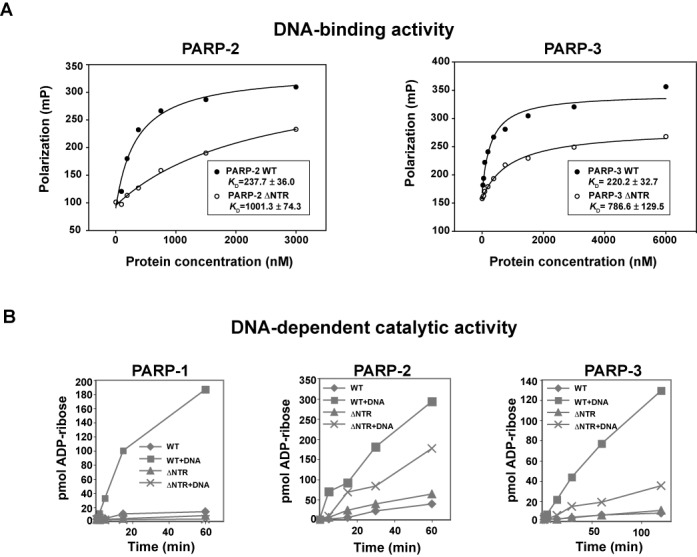
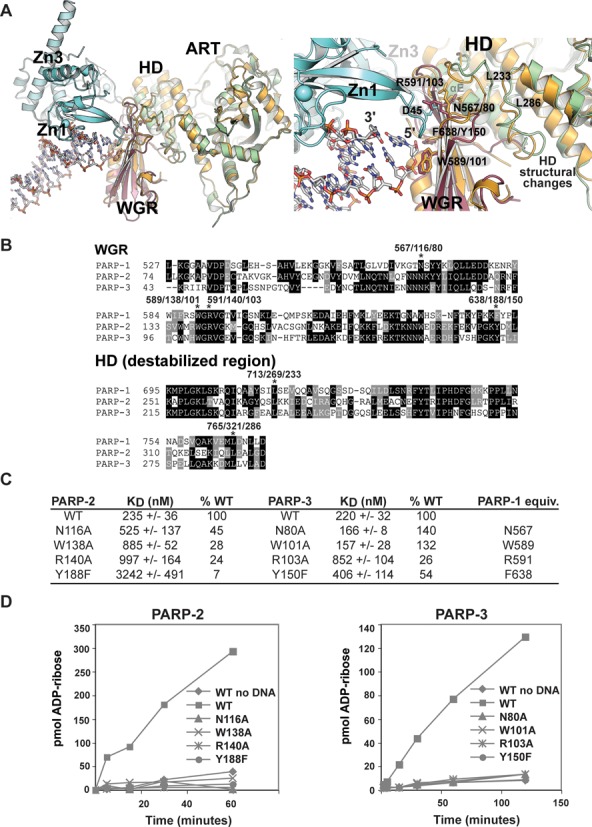
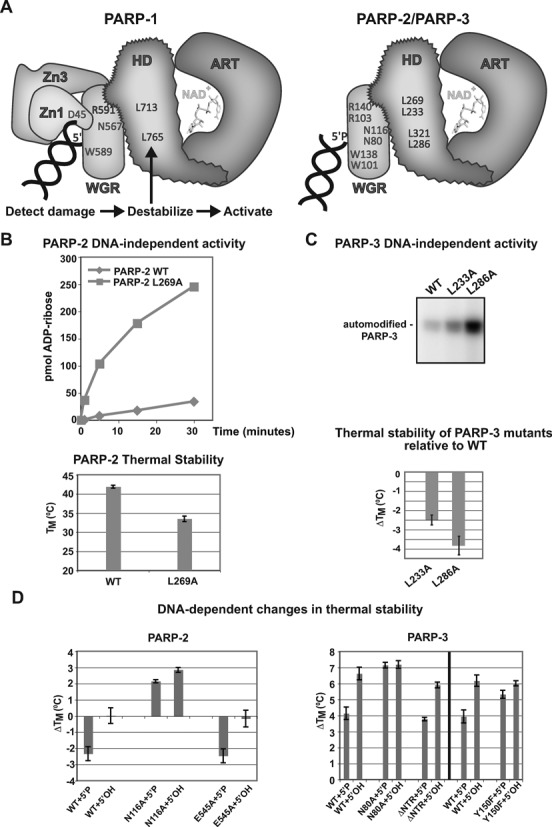
PARP-1, PARP-2 and PARP-3 are DNA-dependent PARPs that localize to DNA damage, synthesize poly(ADP-ribose) (PAR) covalently attached to target proteins including themselves, and thereby recruit repair factors to DNA breaks to increase repair efficiency. PARP-1, PARP-2 and PARP-3 have in common two C-terminal domains-Trp-Gly-Arg (WGR) and catalytic (CAT). In contrast, the N-terminal region (NTR) of PARP-1 is over 500 residues and includes four regulatory domains, whereas PARP-2 and PARP-3 have smaller NTRs (70 and 40 residues, respectively) of unknown structural composition and function. Here, we show that PARP-2 and PARP-3 are preferentially activated by DNA breaks harboring a 5' phosphate (5'P), suggesting selective activation in response to specific DNA repair intermediates, in particular structures that are competent for DNA ligation. In contrast to PARP-1, the NTRs of PARP-2 and PARP-3 are not strictly required for DNA binding or for DNA-dependent activation. Rather, the WGR domain is the central regulatory domain of PARP-2 and PARP-3. Finally, PARP-1, PARP-2 and PARP-3 share an allosteric regulatory mechanism of DNA-dependent catalytic activation through a local destabilization of the CAT. Collectively, our study provides new insights into the specialization of the DNA-dependent PARPs and their specific roles in DNA repair pathways.
PARP - 1、PARP - 2和PARP - 3是依赖DNA的聚(ADP - 核糖)聚合酶,它们定位于DNA损伤部位,合成共价连接到包括自身在内的靶蛋白上的聚(ADP - 核糖)(PAR),从而将修复因子招募到DNA断裂处,以提高修复效率。PARP - 1、PARP - 2和PARP - 3共有两个C末端结构域——色氨酸 - 甘氨酸 - 精氨酸(WGR)结构域和催化(CAT)结构域。相比之下,PARP - 1的N末端区域(NTR)有超过500个残基,包括四个调节结构域,而PARP - 2和PARP - 3的NTR较小(分别为70和40个残基),其结构组成和功能未知。在这里,我们表明PARP - 2和PARP - 3优先被带有5'磷酸基团(5'P)的DNA断裂激活,这表明它们是响应特定的DNA修复中间体,特别是能够进行DNA连接的结构而被选择性激活的。与PARP - 1不同,PARP - 2和PARP - 3的NTR对于DNA结合或依赖DNA的激活并非严格必需。相反,WGR结构域是PARP - 2和PARP - 3的核心调节结构域。最后,PARP - 1、PARP - 2和PARP - 3通过CAT结构域的局部去稳定化共享一种依赖DNA的催化激活的变构调节机制。总的来说,我们的研究为依赖DNA的聚(ADP - 核糖)聚合酶的特化及其在DNA修复途径中的特定作用提供了新的见解。