Ratanasit Nithima, Karaketklang Khemajira, Chirakarnjanakorn Srisakul, Krittayaphong Rungroj, Jakrapanichakul Decho
Division of Cardiology, Department of Medicine, Siriraj Hospital, Mahidol University, Bangkok 10700, Thailand.
Cardiovasc Ultrasound. 2014 Jun 14;12:19. doi: 10.1186/1476-7120-12-19.
Left atrial volume (LAV) and exercise capacity are important prognostic determinants of cardiovascular risk. Exercise intolerance and increased LAV are expected in patients with diastolic dysfunction. While dyspnea is the symptom reported by the patient and considered subjective, exercise capacity obtained by exercise testing provides an objective measure of cardiovascular fitness. The objective of this study is to determine the relationship between LAV index and exercise capacity in patients with isolated diastolic dysfunction who presented with exertional dyspnea.
We studied consecutive patients with dyspnea who underwent treadmill exercise testing and transthoracic echocardiography on the same day. LAV was assessed using the biplane area-length method. Symptom-limited exercise testing was performed immediately after echocardiography. Patients with coronary artery disease, valvular or congenital heart disease, left ventricular systolic dysfunction, pulmonary hypertension or positive exercise test were excluded.
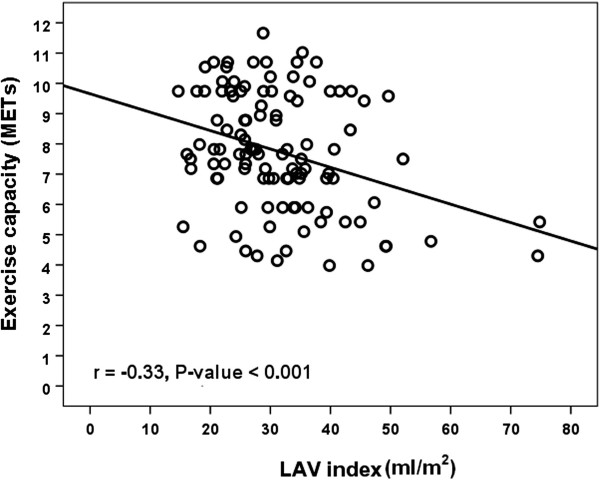
The study consisted of 111 patients (58.1 ± 9.2 years of age, 54.1% male, 64% hypertension, 57.7% dyslipidemia and 20.7% diabetes). The exercise duration and capacity were 6.8 ± 2.1 minutes and 7.7 ± 1.9 METs, respectively. Left ventricular ejection fraction and LAV index was 71.0 ± 5.8% and 31.4 ± 10.5 ml/m2, respectively. In multivariate analysis, age [odds ratios (OR) 0.94; 95% confidence interval (CI) 0.89-0.99], body mass index (OR 0.82, 95% CI 0.72-0.93), and LAV index (OR 0.92, 95% CI 0.87-0.97) were associated with good exercise capacity.
In patients with isolated diastolic dysfunction and exertional dyspnea, an increased LAV index, a marker of chronic diastolic dysfunction, is associated with poor exercise capacity.
左心房容积(LAV)和运动能力是心血管风险的重要预后决定因素。舒张功能障碍患者预计会出现运动不耐受和LAV增加。虽然呼吸困难是患者报告的症状且被认为是主观的,但通过运动测试获得的运动能力提供了心血管健康状况的客观指标。本研究的目的是确定出现劳力性呼吸困难的单纯舒张功能障碍患者中LAV指数与运动能力之间的关系。
我们研究了同日接受跑步机运动测试和经胸超声心动图检查的连续的呼吸困难患者。使用双平面面积-长度法评估LAV。在超声心动图检查后立即进行症状限制运动测试。排除患有冠状动脉疾病、瓣膜或先天性心脏病、左心室收缩功能障碍、肺动脉高压或运动测试阳性的患者。
该研究包括111名患者(年龄58.1±9.2岁,男性占54.1%,高血压占64%,血脂异常占57.7%,糖尿病占20.7%)。运动持续时间和运动能力分别为6.8±2.1分钟和7.7±1.9梅脱。左心室射血分数和LAV指数分别为71.0±5.8%和31.4±10.5 ml/m²。在多变量分析中,年龄[比值比(OR)0.94;95%置信区间(CI)0.89-0.99]、体重指数(OR 0.82,95% CI 0.72-0.93)和LAV指数(OR 0.92,95% CI 0.87-0.97)与良好的运动能力相关。
在患有单纯舒张功能障碍和劳力性呼吸困难的患者中,LAV指数增加作为慢性舒张功能障碍的一个指标,与运动能力差相关。