Masuda Hiroki, Mori Masahiro, Ito Shoichi, Yagishita Toshiyuki, Kuwabara Satoshi
Department of Neurology, Kimitsu Chuo Hospital, Chiba, Japan.
Department of Neurology, Graduate School of Medicine, Chiba University, Chiba, Japan.
Case Rep Neurol. 2014 May 17;6(2):166-70. doi: 10.1159/000363178. eCollection 2014 May.
When a neuropsychiatric symptom due to encephalopathy develops in a patient with anti-thyroid antibodies, especially when the symptom is steroid-responsive, Hashimoto's encephalopathy (HE) needs to be included in the differential diagnosis of the patient. Although HE is an elusive disease, it is thought to cause various clinical presentations including seizures, myoclonus, and epilepsia partialis continua (EPC).
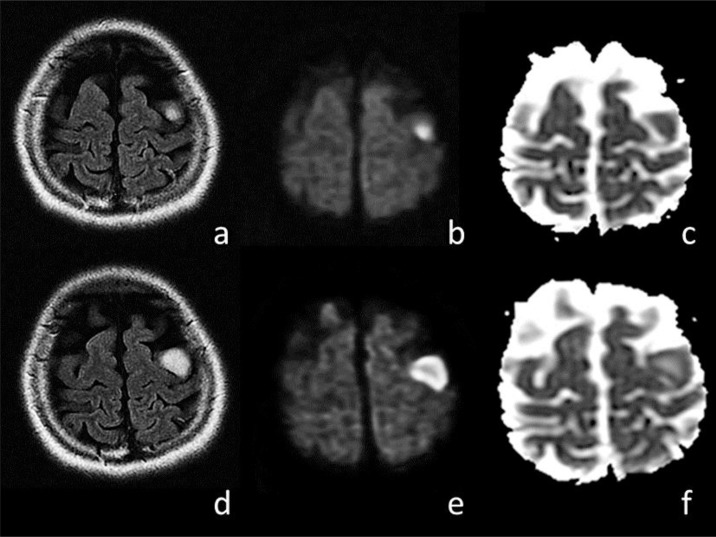
We present the case of a 33-year-old Japanese woman who acutely developed EPC in the right hand as an isolated manifestation. A thyroid ultrasound showed an enlarged hypoechogenic gland, and a thyroid status assessment showed euthyroid with high titers of thyroid antibodies. A brain MRI revealed a nodular lesion in the left precentral gyrus. Corticosteroid treatment resulted in a cessation of the symptom.
A precentral nodular lesion can be responsible for steroid-responsive EPC in a patient with anti-thyroid antibodies and may be caused by HE. The serial MRI findings of our case suggest the presence of primary demyelination, with ischemia possibly due to vasculitis around the demyelinating lesion.
当患有抗甲状腺抗体的患者出现因脑病引起的神经精神症状时,尤其是当症状对类固醇有反应时,桥本脑病(HE)需要纳入该患者的鉴别诊断。尽管HE是一种难以捉摸的疾病,但它被认为会导致包括癫痫发作、肌阵挛和持续性部分性癫痫(EPC)在内的各种临床表现。
我们报告了一名33岁日本女性的病例,她右手急性出现EPC,为孤立性表现。甲状腺超声显示甲状腺低回声增大,甲状腺状态评估显示甲状腺功能正常但甲状腺抗体滴度高。脑部MRI显示左侧中央前回有一个结节性病变。皮质类固醇治疗使症状停止。
中央前回结节性病变可能是导致患有抗甲状腺抗体的患者出现类固醇反应性EPC的原因,可能由HE引起。我们病例的系列MRI结果提示存在原发性脱髓鞘,缺血可能是由于脱髓鞘病变周围的血管炎所致。