Bégin Philippe, Nadeau Kari C
Allergy, Immunology, and Rheumatology Division, Stanford University, 269 Campus Drive, Stanford, California, USA.
Allergy Asthma Clin Immunol. 2014 May 28;10(1):27. doi: 10.1186/1710-1492-10-27. eCollection 2014.
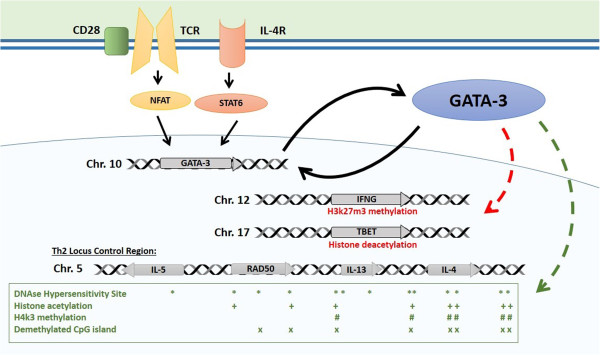
Epigenetics of asthma and allergic disease is a field that has expanded greatly in the last decade. Previously thought only in terms of cell differentiation, it is now evident the epigenetics regulate many processes. With T cell activation, commitment toward an allergic phenotype is tightly regulated by DNA methylation and histone modifications at the Th2 locus control region. When normal epigenetic control is disturbed, either experimentally or by environmental exposures, Th1/Th2 balance can be affected. Epigenetic marks are not only transferred to daughter cells with cell replication but they can also be inherited through generations. In animal models, with constant environmental pressure, epigenetically determined phenotypes are amplified through generations and can last up to 2 generations after the environment is back to normal. In this review on the epigenetic regulation of asthma and allergic diseases we review basic epigenetic mechanisms and discuss the epigenetic control of Th2 cells. We then cover the transgenerational inheritance model of epigenetic traits and discuss how this could relate the amplification of asthma and allergic disease prevalence and severity through the last decades. Finally, we discuss recent epigenetic association studies for allergic phenotypes and related environmental risk factors as well as potential underlying mechanisms for these associations.
哮喘与过敏性疾病的表观遗传学是一个在过去十年中大幅扩展的领域。以前仅从细胞分化的角度来考虑,现在很明显表观遗传学调控着许多过程。随着T细胞活化,在辅助性T细胞2(Th2)基因座控制区域的DNA甲基化和组蛋白修饰严格调控着向过敏表型的分化。当正常的表观遗传控制受到干扰时,无论是通过实验手段还是环境暴露,Th1/Th2平衡都会受到影响。表观遗传标记不仅会随着细胞复制传递给子细胞,还可以代代相传。在动物模型中,在持续的环境压力下,表观遗传决定的表型会逐代放大,并且在环境恢复正常后可持续多达两代。在这篇关于哮喘与过敏性疾病表观遗传调控的综述中,我们回顾了基本的表观遗传机制,并讨论了Th2细胞的表观遗传控制。然后我们阐述了表观遗传特征的跨代遗传模型,并讨论了这如何与过去几十年中哮喘和过敏性疾病患病率及严重程度的增加相关。最后,我们讨论了近期针对过敏表型及相关环境风险因素的表观遗传关联研究,以及这些关联潜在的基础机制。