Troche Michelle S, Rosenbek John C, Okun Michael S, Sapienza Christine M
PO Box 117420, Gainesville, FL 32611.
J Rehabil Res Dev. 2014;51(2):305-10. doi: 10.1682/JRRD.2013.05.0101.
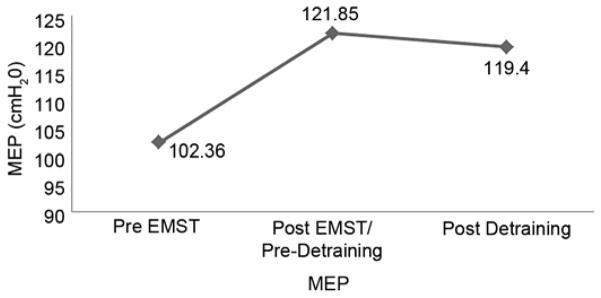
Expiratory muscle strength training (EMST) is efficacious for improving maximum expiratory pressure (MEP), cough function, and swallowing safety in Parkinson disease (PD). However, there are no published reports describing detraining effects following EMST in persons with PD. Moreover, there are no published reports describing detraining effects following any behavioral swallowing intervention. Ten participants with PD underwent 3 mo of detraining following EMST. Measures of MEP and swallowing safety were made prior to beginning EMST (baseline), posttreatment (predetraining), and 3 mo postdetraining. Participants demonstrated, on average, a 19% improvement in MEP from pre- to post-EMST. Following the 3 mo detraining period, MEP declined by 2% yet remained 17% above the baseline value. No statistically significant changes were found in swallowing safety from post-EMST to postdetraining period. Following the 3 mo detraining period, seven participants demonstrated no change in swallowing safety, one worsened, and two had improvements. This preliminary study highlights the need for the design of maintenance programs to sustain function following intensive periods of training.
呼气肌力量训练(EMST)对于改善帕金森病(PD)患者的最大呼气压(MEP)、咳嗽功能和吞咽安全性是有效的。然而,尚无已发表的报告描述PD患者进行EMST后的失用效应。此外,也没有已发表的报告描述任何行为性吞咽干预后的失用效应。10名PD患者在EMST后进行了3个月的失用训练。在开始EMST之前(基线)、治疗后(失用训练前)和失用训练后3个月测量MEP和吞咽安全性。参与者平均在EMST前后MEP提高了19%。在3个月的失用训练期后,MEP下降了2%,但仍比基线值高17%。从EMST后到失用训练后期,吞咽安全性未发现有统计学意义的变化。在3个月的失用训练期后,7名参与者的吞咽安全性没有变化,1名恶化,2名有所改善。这项初步研究强调了设计维持计划以在强化训练期后维持功能的必要性。