Luo Ying, He Qin, Kuang Ge, Jiang Qingsong, Yang Junqing
Department of Pharmacology, Chongqing Key Laboratory of Biochemistry and Molecular Pharmacology, Chongqing Medical University, Medical College Rd, No 1, Chongqing 400016, P, R, China.
Behav Brain Funct. 2014 Jun 16;10(1):21. doi: 10.1186/1744-9081-10-21.
Peroxisome proliferator-activated receptors (PPARs, including alpha, beta and gamma subtypes) and their agonists have a protective role in treatment of central nervous system (CNS) diseases. The present study was designed to investigate the expression changes of PPAR-alpha, -beta, -gamma and NF-kappa B in the hippocampus of rats with global cerebral ischemia/reperfusion injury (GCIRI) after treatment with agonists or antagonists of PPAR-gamma.
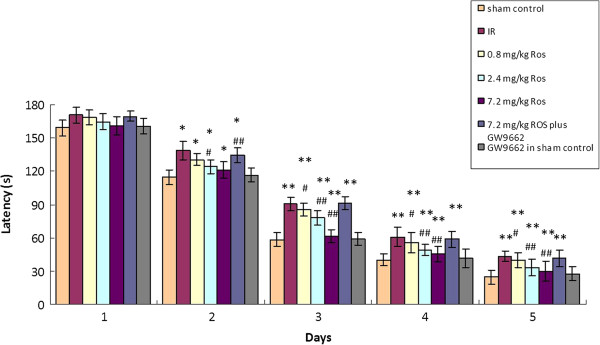
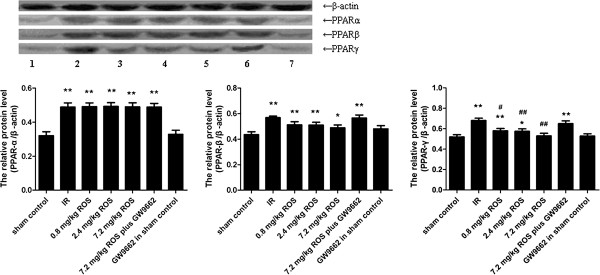
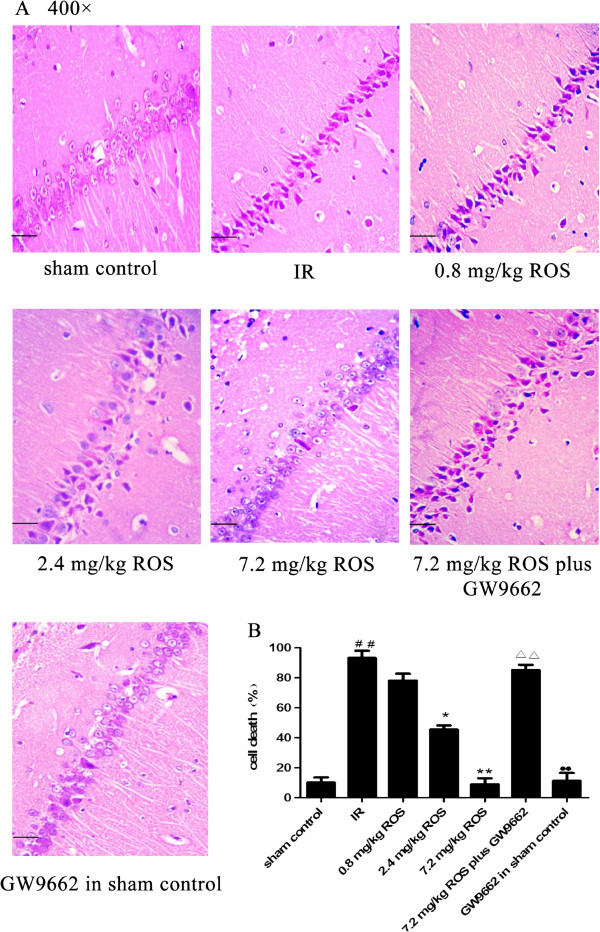
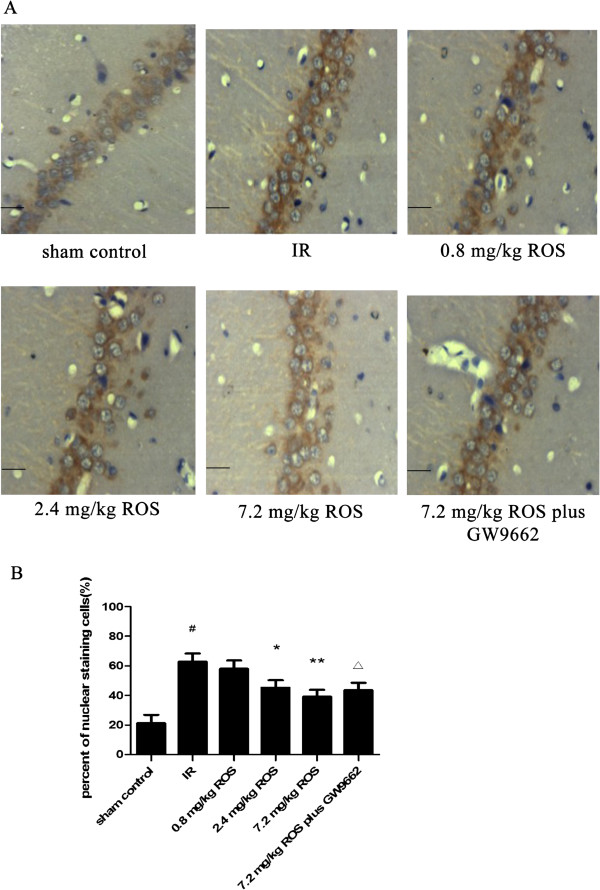
A rat GCIRI model was established by occlusion of bilateral common carotid arteries and cervical vena retransfusion. GW9662 (5 μg), a selective PPAR- gamma antagonist, was intraventricularly injected at 0.5 h before GCIR; Rosiglitazone (0.8, 2.4 and 7.2 mg/kg), a selective PPAR- gamma agonist, was injected intraperitoneally at 1 h before GCIRI. The expression changes of PPAR-alpha, -beta and -gamma at mRNA and protein levels were detected by RT-PCR and western blotting. The changes of spatial learning and memory (SLM) functions were assessed by using a Morris water maze; the pathohistological changes of hippocampal neurons were evaluated by hematoxylin-eosin (HE) staining; the contents of IL-1, IL-6, IL-10 and TNF-alpha, and the NF- kappa B expression were measured by enzyme-linked immunosorbent assay (ELISA) and immunohistochemical staining. The superoxide dismutase (SOD) activity and malondialdehyde (MDA) content were also detected.
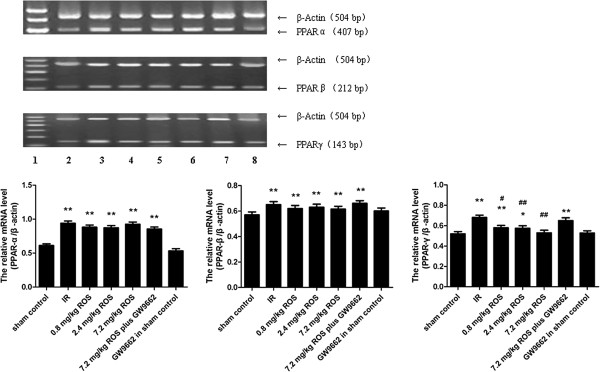
The SLM function and hippocampal neurons were significantly impaired after the occurrence of GCIRI. The MDA, IL-1, IL-6, IL-10, TNF-alpha content and expression of PPARs increased significantly, but the SOD activity and NF-kappa B expression were weakened in the hippocampus. Rosiglitazone treatment significantly protected rats from SLM function impairment and neuron death, and resulted in higher expressions of SOD activity and NF-kappa B, but lower contents of MDA and inflammatory factors. After treatment with rosiglitazone or GW9662, no significant change in PPAR-alpha or -beta expression was detected.
Rosiglitazone, a PPAR-gamma agonist, plays a protective role in hippocampal neuron damage of GCIRI rats by inhibiting the oxidative stress response and inflammation. The activation or antagonism of PPAR-gamma did not affect the expression of PPAR-alpha or -beta, indicating that the three subtypes of PPARs act in independent pathways in the CNS.
过氧化物酶体增殖物激活受体(PPARs,包括α、β和γ亚型)及其激动剂在中枢神经系统(CNS)疾病治疗中具有保护作用。本研究旨在探讨用PPAR-γ激动剂或拮抗剂处理后,全脑缺血/再灌注损伤(GCIRI)大鼠海马中PPAR-α、-β、-γ和NF-κB的表达变化。
通过双侧颈总动脉闭塞和颈静脉再灌注建立大鼠GCIRI模型。在GCIR前0.5小时脑室内注射选择性PPAR-γ拮抗剂GW9662(5μg);在GCIRI前1小时腹腔注射选择性PPAR-γ激动剂罗格列酮(0.8、2.4和7.2mg/kg)。采用RT-PCR和蛋白质印迹法检测PPAR-α、-β和-γ在mRNA和蛋白质水平的表达变化。使用Morris水迷宫评估空间学习和记忆(SLM)功能的变化;通过苏木精-伊红(HE)染色评估海马神经元的病理组织学变化;采用酶联免疫吸附测定(ELISA)和免疫组织化学染色法检测IL-1、IL-6、IL-10和TNF-α的含量以及NF-κB的表达。同时检测超氧化物歧化酶(SOD)活性和丙二醛(MDA)含量。
GCIRI发生后,SLM功能和海马神经元明显受损。海马中MDA、IL-1、IL-6、IL-10、TNF-α含量及PPARs表达显著增加,但SOD活性和NF-κB表达减弱。罗格列酮治疗显著保护大鼠免受SLM功能损害和神经元死亡,并导致SOD活性和NF-κB表达升高,但MDA和炎性因子含量降低。用罗格列酮或GW9662处理后,未检测到PPAR-α或-β表达有显著变化。
PPAR-γ激动剂罗格列酮通过抑制氧化应激反应和炎症对GCIRI大鼠海马神经元损伤起保护作用。PPAR-γ的激活或拮抗不影响PPAR-α或-β的表达,表明PPARs的三种亚型在中枢神经系统中以独立途径发挥作用。