Shimo Takenori, Tachibana Keisuke, Saito Kiwamu, Yoshida Tokuyuki, Tomita Erisa, Waki Reiko, Yamamoto Tsuyoshi, Doi Takefumi, Inoue Takao, Kawakami Junji, Obika Satoshi
Graduate School of Pharmaceutical Sciences, Osaka University, 1-6, Yamadaoka, Suita, Osaka, 565-0871, Japan.
Graduate School of Pharmaceutical Sciences, Osaka University, 1-6, Yamadaoka, Suita, Osaka, 565-0871, Japan Division of Cellular and Gene Therapy Products, National Institute of Health Sciences, 1-18-1 Kamiyoga, Setagaya-ku, Tokyo 158-8501, Japan.
Nucleic Acids Res. 2014 Jul;42(12):8174-87. doi: 10.1093/nar/gku512. Epub 2014 Jun 16.
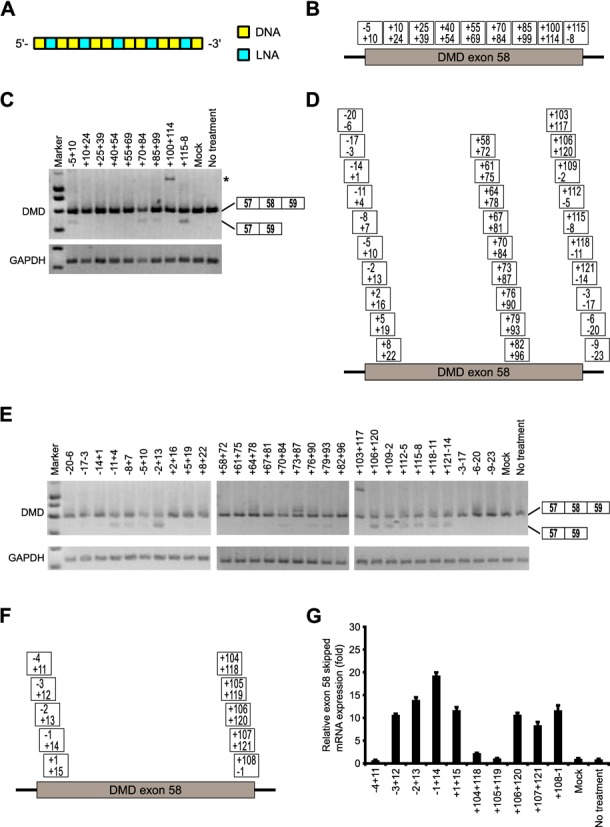
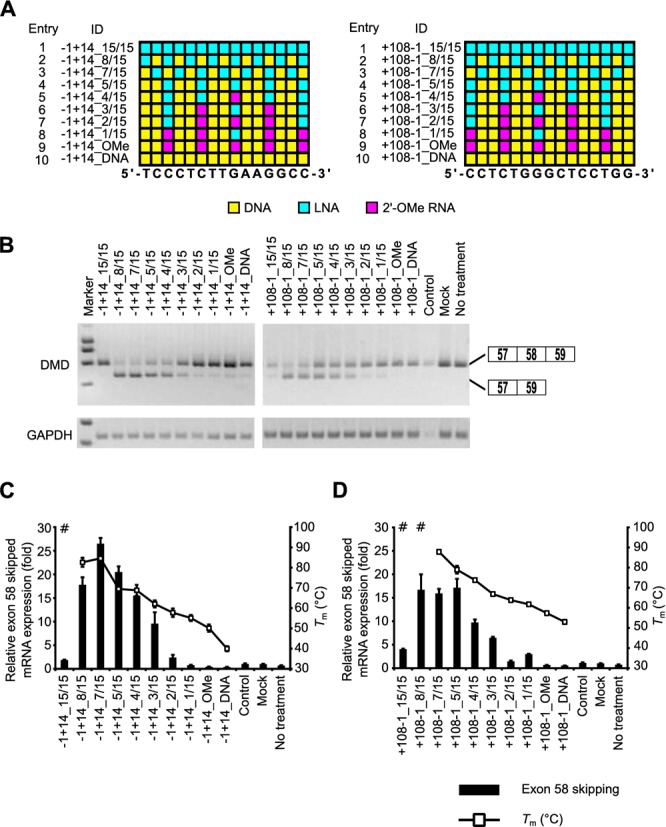
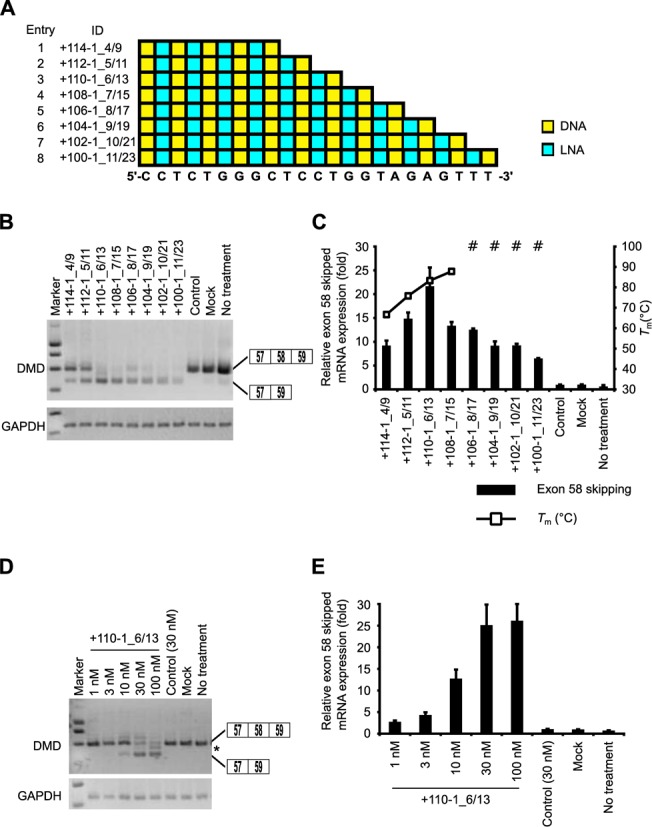
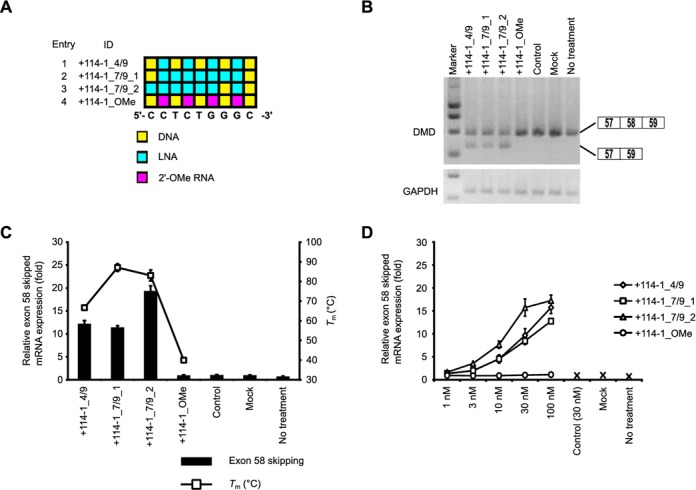
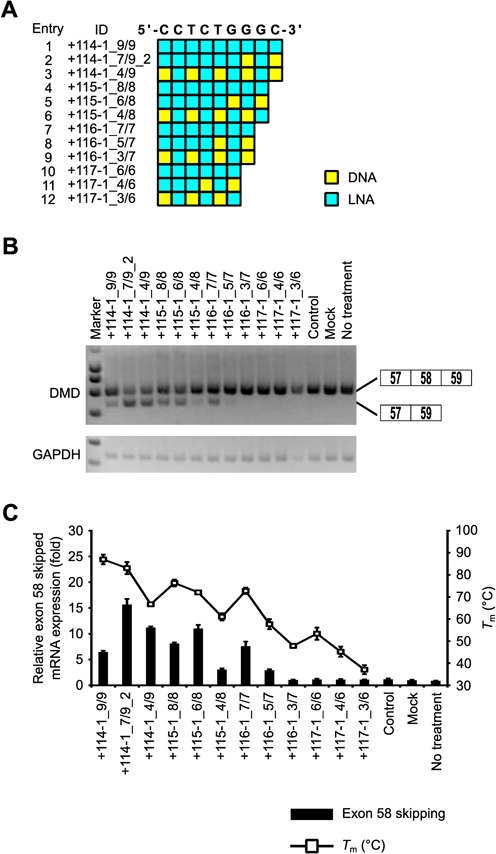
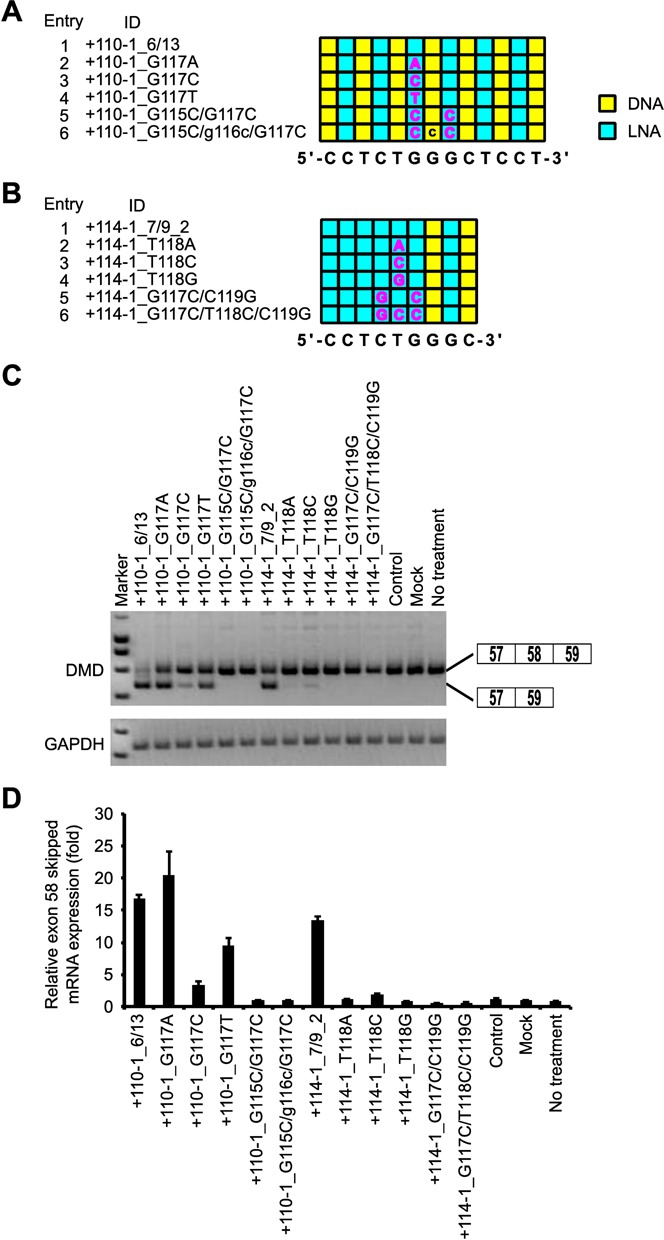
Antisense-mediated modulation of pre-mRNA splicing is an attractive therapeutic strategy for genetic diseases. Currently, there are few examples of modulation of pre-mRNA splicing using locked nucleic acid (LNA) antisense oligonucleotides, and, in particular, no systematic study has addressed the optimal design of LNA-based splice-switching oligonucleotides (LNA SSOs). Here, we designed a series of LNA SSOs complementary to the human dystrophin exon 58 sequence and evaluated their ability to induce exon skipping in vitro using reverse transcription-polymerase chain reaction. We demonstrated that the number of LNAs in the SSO sequence and the melting temperature of the SSOs play important roles in inducing exon skipping and seem to be key factors for designing efficient LNA SSOs. LNA SSO length was an important determinant of activity: a 13-mer with six LNA modifications had the highest efficacy, and a 7-mer was the minimal length required to induce exon skipping. Evaluation of exon skipping activity using mismatched LNA/DNA mixmers revealed that 9-mer LNA SSO allowed a better mismatch discrimination. LNA SSOs also induced exon skipping of endogenous human dystrophin in primary human skeletal muscle cells. Taken together, our findings indicate that LNA SSOs are powerful tools for modulating pre-mRNA splicing.
反义介导的前体mRNA剪接调控是一种针对遗传疾病颇具吸引力的治疗策略。目前,使用锁核酸(LNA)反义寡核苷酸调控前体mRNA剪接的例子较少,尤其是尚未有系统性研究探讨基于LNA的剪接转换寡核苷酸(LNA SSO)的最佳设计。在此,我们设计了一系列与人类抗肌萎缩蛋白外显子58序列互补的LNA SSO,并利用逆转录-聚合酶链反应评估其在体外诱导外显子跳跃的能力。我们证明,SSO序列中LNA的数量以及SSO的解链温度在诱导外显子跳跃中起重要作用,似乎是设计高效LNA SSO的关键因素。LNA SSO长度是活性的重要决定因素:具有六个LNA修饰的13聚体具有最高的功效,7聚体是诱导外显子跳跃所需的最小长度。使用错配的LNA/DNA混合体评估外显子跳跃活性表明,9聚体LNA SSO具有更好的错配识别能力。LNA SSO还能诱导原代人骨骼肌细胞中内源性人类抗肌萎缩蛋白的外显子跳跃。综上所述,我们的研究结果表明LNA SSO是调控前体mRNA剪接的有力工具。