Department of Psychiatry and Suicide Prevention Center, Mackay Memorial Hospital, Taipei, Taiwan.
Support Care Cancer. 2014 Dec;22(12):3165-74. doi: 10.1007/s00520-014-2290-4. Epub 2014 Jun 17.
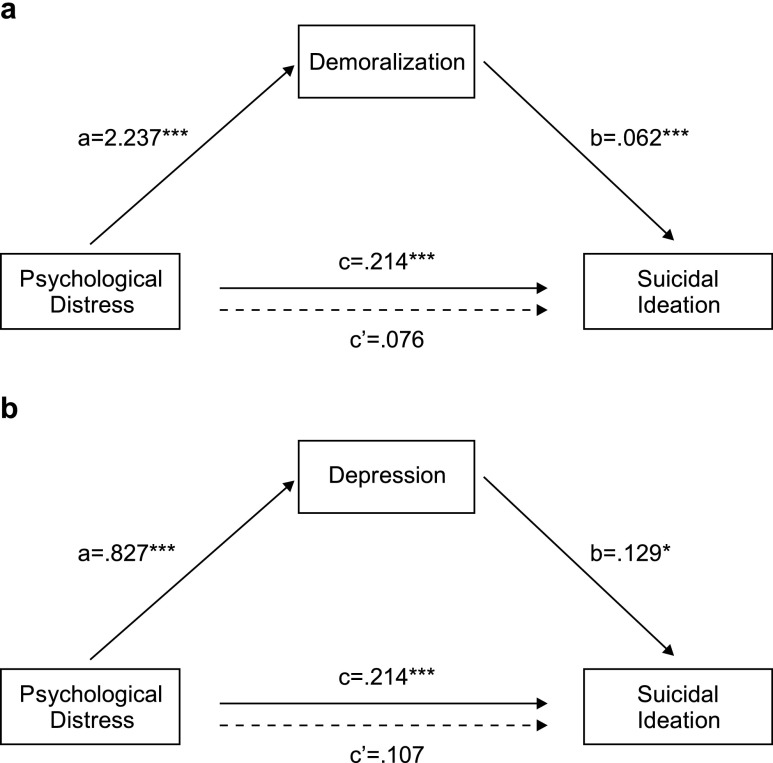
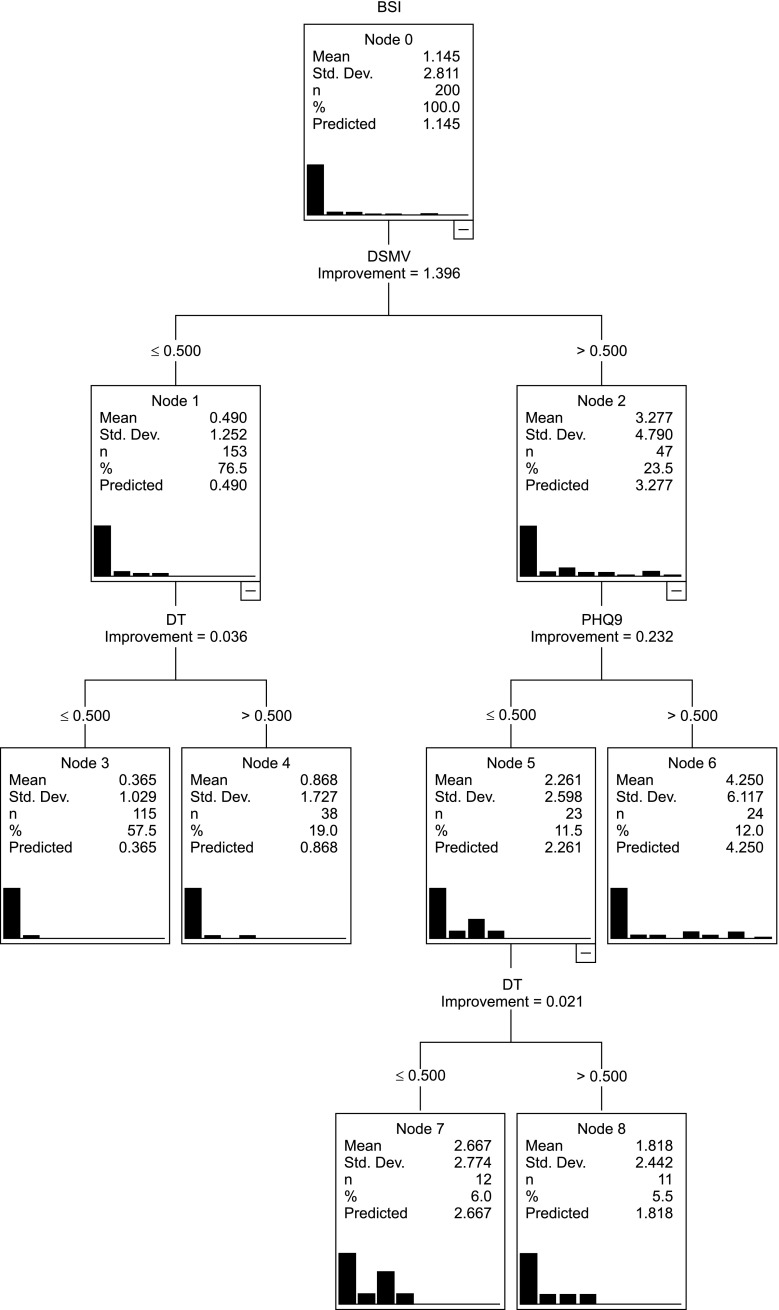
This study aims to study the effects of depression and demoralization on suicidal ideation and to determine the feasibility of the Distress Thermometer as a screening tool for patients with cancer who experience depression and demoralization, and thus to establish a model screening process for suicide prevention.
Purposive sampling was used to invite inpatients and outpatients with lung cancer, leukemia, and lymphoma. Two hundred participants completed the questionnaire, which included the Distress Thermometer (DT), Patient Health Questionnaire-9 (PHQ-9), Demoralization Scale-Mandarin Version (DS-MV), and Beck Scale for Suicide Ideation. All data obtained were analyzed using SPSS 18.0 and SAS 9.3.
Tobit regression analysis showed that demoralization influenced suicidal ideation more than depression did (t = 2.84, p < 0.01). When PHQ-9 ≥ 10 and DS-MV ≥42 were used as criteria for the DT, receiver operating characteristic analysis revealed that the AUC values were 0.77-0.79, with optimal cutoff points for both of DT ≥5; sensitivity 76.9 and 80.6 %, respectively; and specificity of 73.9 and 72.2 %, respectively.
Demoralization had more influence on suicidal ideation than depression did. Therefore, attention should be paid to highly demoralized patients with cancer or high demoralization comorbid with depression for the purposes of suicide evaluation and prevention. The DT scale (with a cutoff of ≥5 points) has discriminative ability as a screening tool for demoralization or depression and can also be used in clinical settings for the preliminary screening of patients with cancer and high suicide risk.
本研究旨在探讨抑郁和绝望情绪对自杀意念的影响,并确定抑郁和绝望患者使用苦恼温度计作为筛查工具的可行性,从而建立一个预防自杀的模型筛查流程。
采用目的抽样法,邀请肺癌、白血病和淋巴瘤的住院和门诊患者。共有 200 名参与者完成了问卷,其中包括苦恼温度计(DT)、患者健康问卷-9(PHQ-9)、中文版绝望量表(DS-MV)和贝克自杀意念量表。使用 SPSS 18.0 和 SAS 9.3 分析所有获得的数据。
Tobit 回归分析显示,绝望情绪对自杀意念的影响大于抑郁(t=2.84,p<0.01)。当 PHQ-9≥10 和 DS-MV≥42 作为 DT 的标准时,受试者工作特征分析显示 AUC 值为 0.77-0.79,DT≥5 的最佳截断点;灵敏度分别为 76.9%和 80.6%;特异性分别为 73.9%和 72.2%。
绝望情绪对自杀意念的影响大于抑郁。因此,对于癌症患者或患有高绝望情绪合并抑郁的患者,应注意自杀评估和预防。DT 量表(截断值≥5 分)具有区分能力,可用作抑郁或绝望的筛查工具,也可用于临床环境中对高自杀风险的癌症患者进行初步筛查。