Department of Biomedical, Metabolic and Neural Sciences, University of Modena and Reggio Emilia , Modena , Italy.
OPTIMA Project, Nuffield Department of Clinical Medicine and FMRIB Centre, University of Oxford , Oxford , UK.
Front Neurol. 2014 Jun 6;5:92. doi: 10.3389/fneur.2014.00092. eCollection 2014.
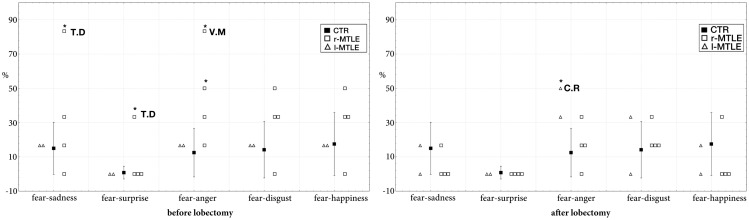
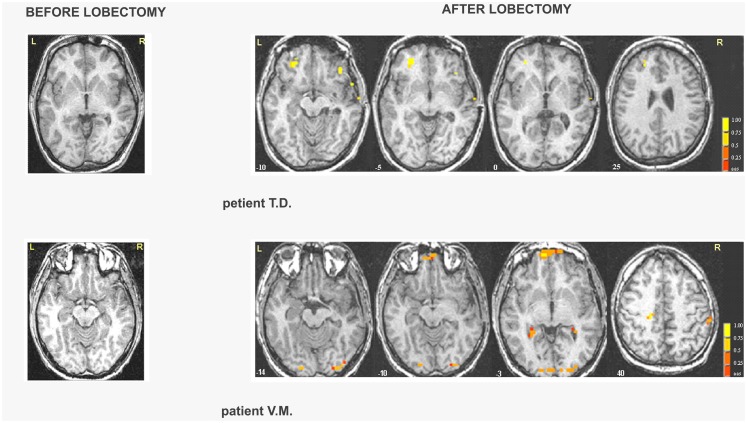
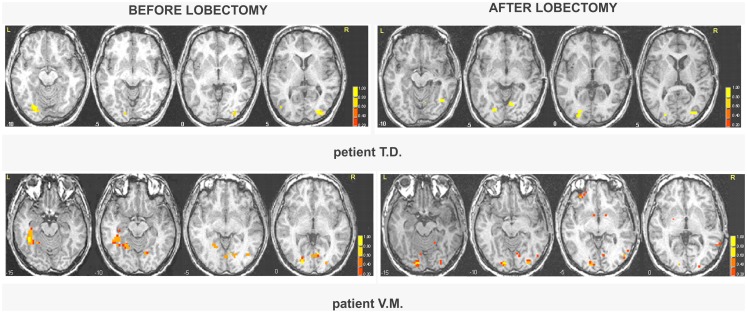
Mesial temporal lobe epilepsy (MTLE) can be associated with emotion recognition impairment that can be particularly severe in patients with early onset seizures (1-3). Whereas, there is growing evidence that memory and language can improve in seizure-free patients after anterior temporal lobectomy (ATL) (4), the effects of surgery on emotional processing are still unknown. We used functional magnetic resonance imaging (fMRI) to investigate short-term reorganization of networks engaged in facial emotion recognition in MTLE patients. Behavioral and fMRI data were collected from six patients before and after ATL. During the fMRI scan, patients were asked to make a gender decision on fearful and neutral faces. Behavioral data demonstrated that two patients with early onset right MTLE were impaired in fear recognition while fMRI results showed they lacked specific activations for fearful faces. Post-ATL behavioral data showed improved emotion recognition ability, while fMRI demonstrated the recruitment of a functional network for fearful face processing. Our results suggest that ATL elicited brain plasticity mechanisms allowing behavioral and fMRI improvement in emotion recognition.
内侧颞叶癫痫(MTLE)可伴有情绪识别障碍,在早发性癫痫发作的患者中尤为严重(1-3)。然而,越来越多的证据表明,在前颞叶切除术(ATL)后,无癫痫发作的患者的记忆和语言能力可以得到改善(4),但手术对情绪处理的影响仍不清楚。我们使用功能磁共振成像(fMRI)研究了 MTLE 患者面部情绪识别中参与的网络的短期重组。在 ATL 之前和之后,从六名患者中收集了行为和 fMRI 数据。在 fMRI 扫描期间,要求患者对恐惧和中性面孔做出性别判断。行为数据表明,两名右 MTLE 早发性患者在恐惧识别方面存在障碍,而 fMRI 结果表明他们缺乏对恐惧面孔的特定激活。ATL 后的行为数据显示情绪识别能力提高,而 fMRI 显示出恐惧面孔处理的功能网络的招募。我们的研究结果表明,ATL 引发了大脑可塑性机制,使情绪识别的行为和 fMRI 得到改善。