Fichman Galit, Adler-Abramovich Lihi, Manohar Suresh, Mironi-Harpaz Iris, Guterman Tom, Seliktar Dror, Messersmith Phillip B, Gazit Ehud
Department of Molecular Microbiology and Biotechnology, George S. Wise Faculty of Life Sciences, Tel Aviv University , Tel Aviv 6997801, Israel.
ACS Nano. 2014 Jul 22;8(7):7220-8. doi: 10.1021/nn502240r. Epub 2014 Jun 23.
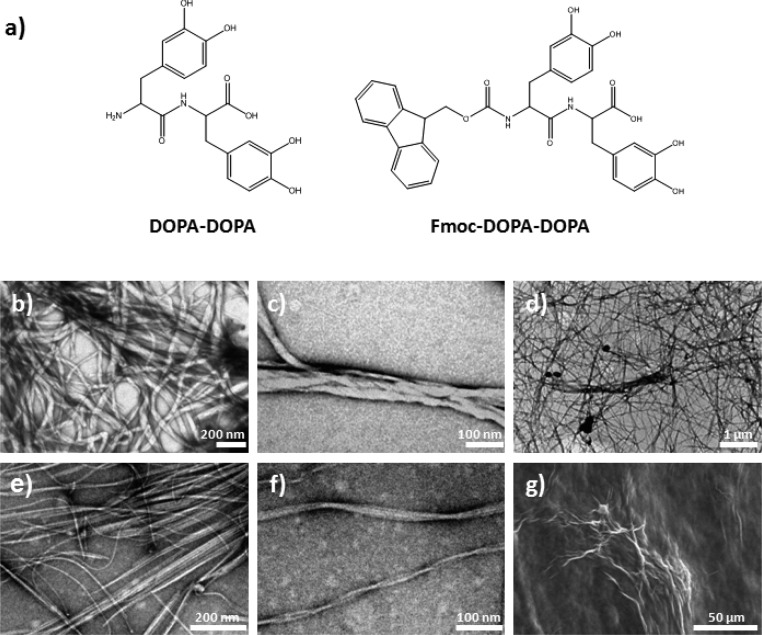
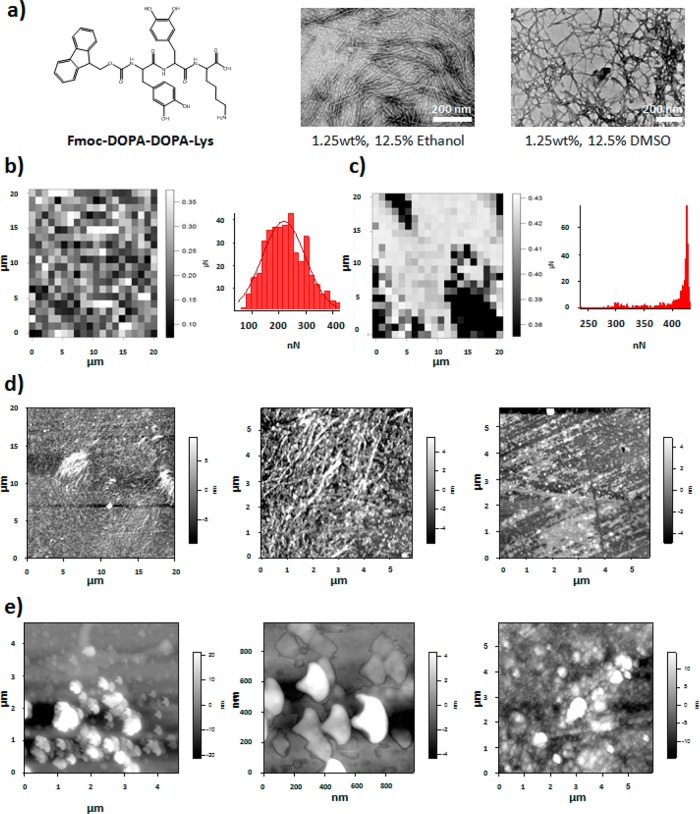
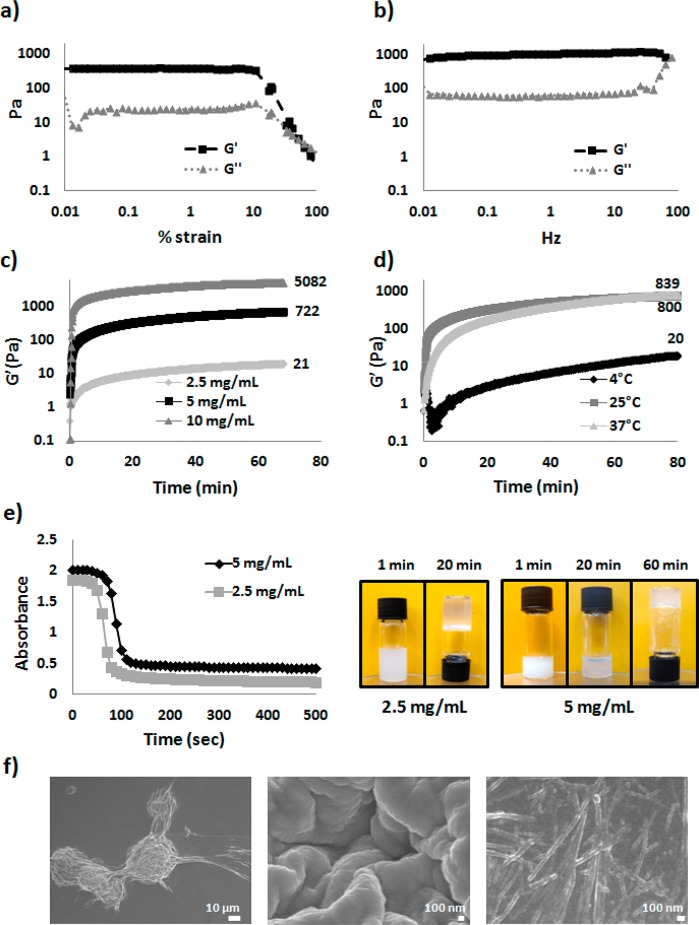
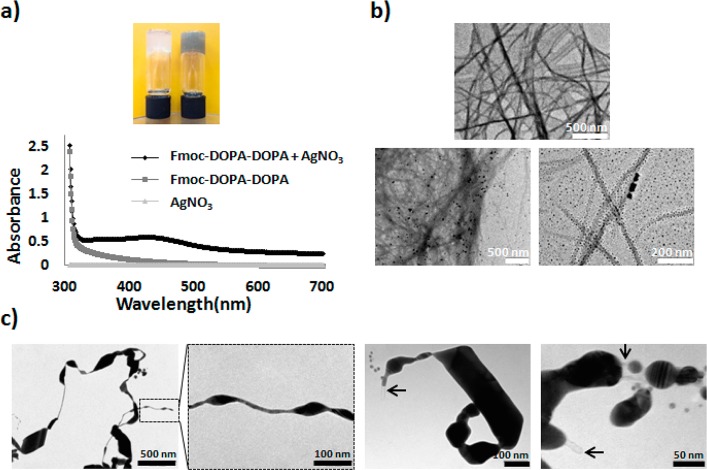
The noncoded aromatic 3,4-dihydroxy-L-phenylalanine (DOPA) amino acid has a pivotal role in the remarkable adhesive properties displayed by marine mussels. These properties have inspired the design of adhesive chemical entities through various synthetic approaches. DOPA-containing bioinspired polymers have a broad functional appeal beyond adhesion due to the diverse chemical interactions presented by the catechol moieties. Here, we harnessed the molecular self-assembly abilities of very short peptide motifs to develop analogous DOPA-containing supramolecular polymers. The DOPA-containing DOPA-DOPA and Fmoc-DOPA-DOPA building blocks were designed by substituting the phenylalanines in the well-studied diphenylalanine self-assembling motif and its 9-fluorenylmethoxycarbonyl (Fmoc)-protected derivative. These peptides self-organized into fibrillar nanoassemblies, displaying high density of catechol functional groups. Furthermore, the Fmoc-DOPA-DOPA peptide was found to act as a low molecular weight hydrogelator, forming self-supporting hydrogel which was rheologically characterized. We studied these assemblies using electron microscopy and explored their applicative potential by examining their ability to spontaneously reduce metal cations into elementary metal. By applying ionic silver to the hydrogel, we observed efficient reduction into silver nanoparticles and the remarkable seamless metallic coating of the assemblies. Similar redox abilities were observed with the DOPA-DOPA assemblies. In an effort to impart adhesiveness to the obtained assemblies, we incorporated lysine (Lys) into the Fmoc-DOPA-DOPA building block. The assemblies of Fmoc-DOPA-DOPA-Lys were capable of gluing together glass surfaces, and their adhesion properties were investigated using atomic force microscopy. Taken together, a class of DOPA-containing self-assembling peptides was designed. These nanoassemblies display unique properties and can serve as multifunctional platforms for various biotechnological applications.
非编码芳香族3,4-二羟基-L-苯丙氨酸(DOPA)氨基酸在海洋贻贝所展现出的卓越粘附特性中起着关键作用。这些特性通过各种合成方法激发了对粘附性化学实体的设计。含DOPA的仿生聚合物由于儿茶酚部分呈现出的多样化学相互作用,除了粘附性之外还具有广泛的功能吸引力。在此,我们利用极短肽基序的分子自组装能力来开发类似的含DOPA超分子聚合物。通过在经过充分研究的二苯丙氨酸自组装基序及其9-芴甲氧羰基(Fmoc)保护衍生物中取代苯丙氨酸,设计了含DOPA的DOPA-DOPA和Fmoc-DOPA-DOPA构建块。这些肽自组装成纤维状纳米聚集体,显示出高密度的儿茶酚官能团。此外,发现Fmoc-DOPA-DOPA肽可作为低分子量水凝胶剂,形成具有流变学特征的自支撑水凝胶。我们使用电子显微镜研究了这些聚集体,并通过检查它们将金属阳离子自发还原为单质金属的能力来探索其应用潜力。通过将离子银应用于水凝胶,我们观察到银高效还原为银纳米颗粒以及聚集体上显著的无缝金属涂层。DOPA-DOPA聚集体也观察到了类似的氧化还原能力。为了使所得聚集体具有粘附性,我们将赖氨酸(Lys)掺入Fmoc-DOPA-DOPA构建块中。Fmoc-DOPA-DOPA-Lys的聚集体能够将玻璃表面粘合在一起,并使用原子力显微镜研究了它们的粘附特性。综上所述,设计了一类含DOPA的自组装肽。这些纳米聚集体具有独特的性质,可作为各种生物技术应用的多功能平台。