Silva Aderbal R T, Santos Ana Cecília Feio, Farfel Jose M, Grinberg Lea T, Ferretti Renata E L, Campos Antonio Hugo Jose Froes Marques, Cunha Isabela Werneck, Begnami Maria Dirlei, Rocha Rafael M, Carraro Dirce M, de Bragança Pereira Carlos Alberto, Jacob-Filho Wilson, Brentani Helena
Laboratory of Clinical Pathology - Laboratory of Medical Investigations 23 (LIM 23), Department and Institute of Psychiatry, University of São Paulo, Medical School, São Paulo, Brazil.
Brazilian Brain Bank of the Aging Brain Study Group - Laboratory of Medical Investigations 22 (LIM 22), University of São Paulo, Medical School, São Paulo, Brazil; Division of Geriatrics, University of São Paulo, Medical School, São Paulo, Brazil.
PLoS One. 2014 Jun 17;9(6):e99897. doi: 10.1371/journal.pone.0099897. eCollection 2014.
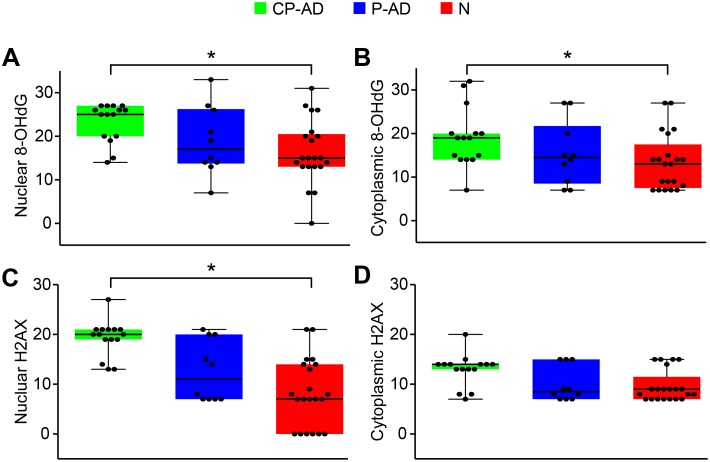
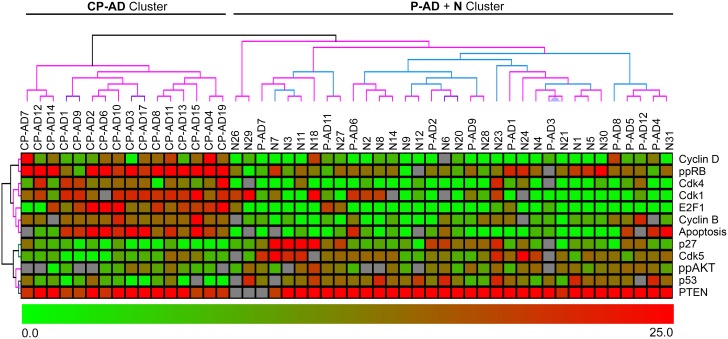
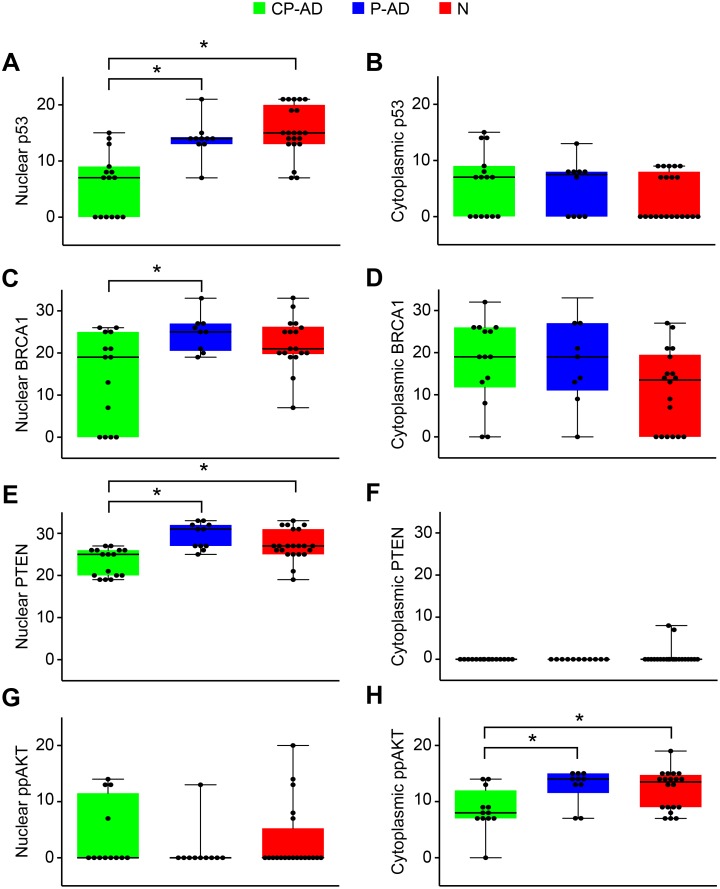
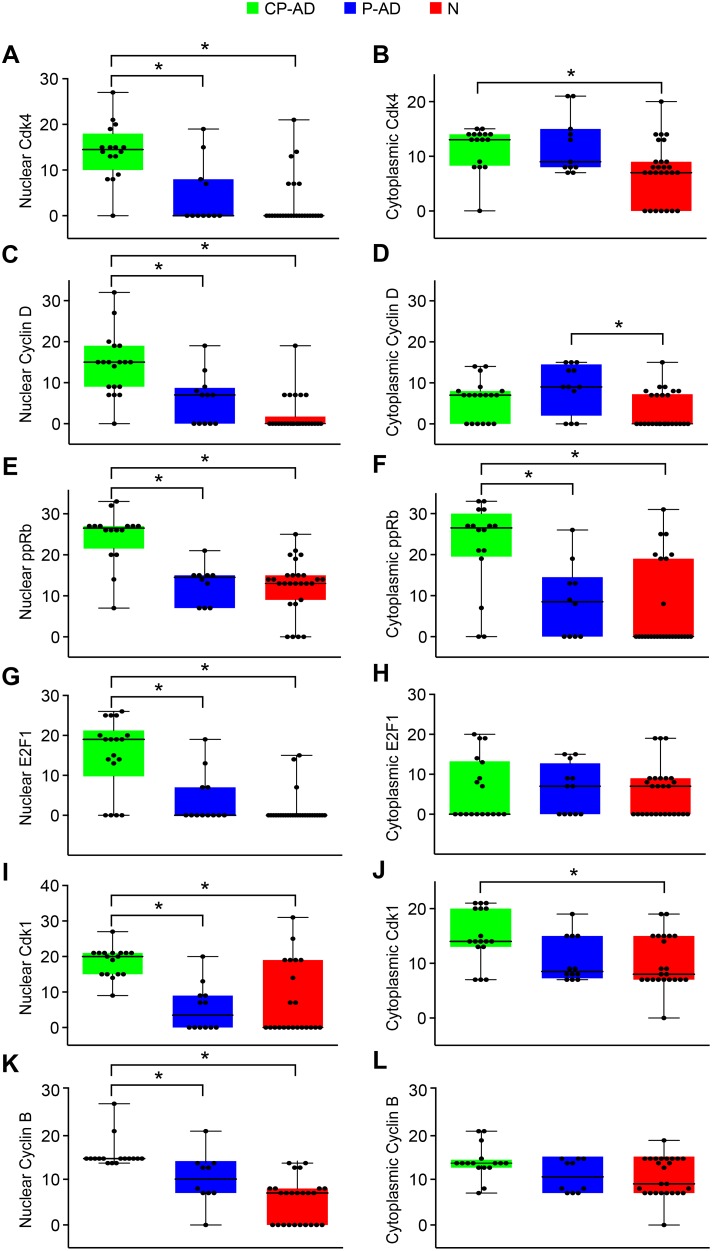
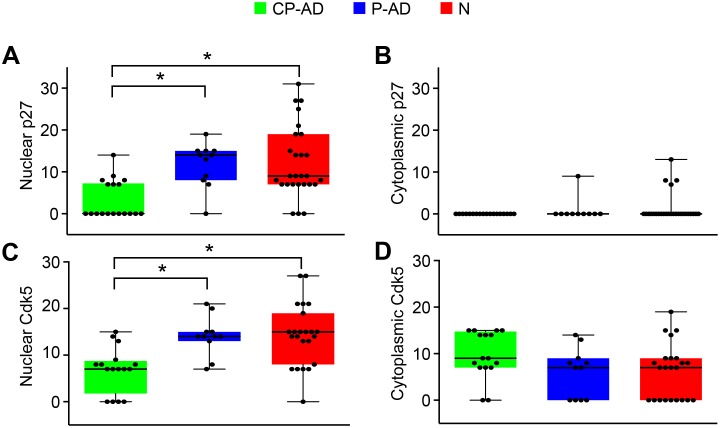
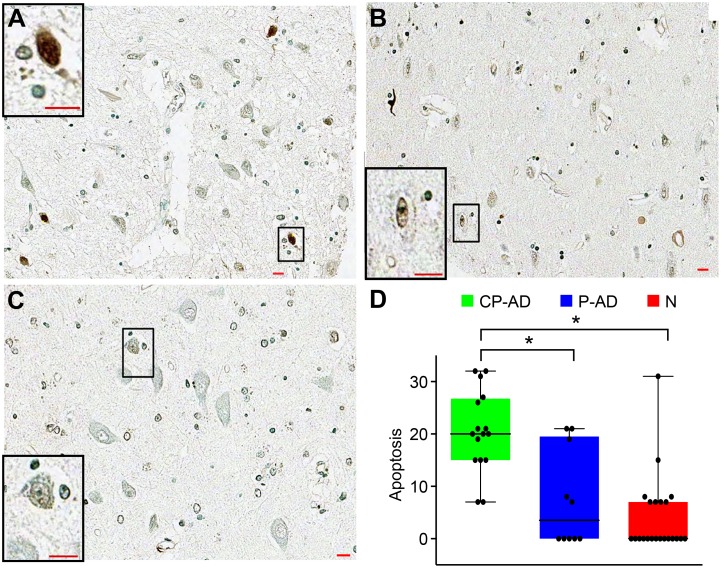
Alzheimer's disease (AD) is characterized by progressive cognitive decline associated with a featured neuropathology (neuritic plaques and neurofibrillary tangles). Several studies have implicated oxidative damage to DNA, DNA repair, and altered cell-cycle regulation in addition to cell death in AD post-mitotic neurons. However, there is a lack of studies that systematically assess those biological processes in patients with AD neuropathology but with no evidence of cognitive impairment. We evaluated markers of oxidative DNA damage (8-OHdG, H2AX), DNA repair (p53, BRCA1, PTEN), and cell-cycle (Cdk1, Cdk4, Cdk5, Cyclin B1, Cyclin D1, p27Kip1, phospho-Rb and E2F1) through immunohistochemistry and cell death through TUNEL in autopsy hippocampal tissue samples arrayed in a tissue microarray (TMA) composed of three groups: I) "clinical-pathological AD" (CP-AD)--subjects with neuropathological AD (Braak ≥ IV and CERAD = B or C) and clinical dementia (CDR ≥ 2, IQCODE>3.8); II) "pathological AD" (P-AD)--subjects with neuropathological AD (Braak ≥ IV and CERAD = B or C) and without cognitive impairment (CDR 0, IQCODE<3.2); and III) "normal aging" (N)--subjects without neuropathological AD (Braak ≤ II and CERAD 0 or A) and with normal cognitive function (CDR 0, IQCODE<3.2). Our results show that high levels of oxidative DNA damage are present in all groups. However, significant reductions in DNA repair and cell-cycle inhibition markers and increases in cell-cycle progression and cell death markers in subjects with CP-AD were detected when compared to both P-AD and N groups, whereas there were no significant differences in the studied markers between P-AD individuals and N subjects. This study indicates that, even in the setting of pathological AD, healthy cognition may be associated with a preserved repair to DNA damage, cell-cycle regulation, and cell death in post-mitotic neurons.
阿尔茨海默病(AD)的特征是进行性认知衰退,并伴有典型的神经病理学改变(神经炎性斑块和神经原纤维缠结)。多项研究表明,除了有丝分裂后神经元的细胞死亡外,AD还涉及DNA的氧化损伤、DNA修复以及细胞周期调控的改变。然而,缺乏系统评估那些具有AD神经病理学特征但无认知障碍证据患者的这些生物学过程的研究。我们通过免疫组织化学评估了氧化DNA损伤标志物(8-羟基脱氧鸟苷、H2AX)、DNA修复标志物(p53、BRCA1、PTEN)和细胞周期标志物(细胞周期蛋白依赖性激酶1、细胞周期蛋白依赖性激酶4、细胞周期蛋白依赖性激酶5、细胞周期蛋白B1、细胞周期蛋白D1、p27Kip1、磷酸化视网膜母细胞瘤蛋白和E2F1),并通过TUNEL法评估了尸检海马组织样本中的细胞死亡情况,这些样本排列在一个组织微阵列(TMA)中,该组织微阵列由三组组成:I)“临床病理AD”(CP-AD)——具有神经病理学AD特征(Braak分级≥IV且CERAD分级为B或C)且患有临床痴呆(临床痴呆评定量表≥2,智商变化率>3.8)的受试者;II)“病理AD”(P-AD)——具有神经病理学AD特征(Braak分级≥IV且CERAD分级为B或C)但无认知障碍(临床痴呆评定量表为0,智商变化率<3.2)的受试者;III)“正常衰老”(N)——无神经病理学AD特征(Braak分级≤II且CERAD分级为0或A)且认知功能正常(临床痴呆评定量表为0,智商变化率<3.2)的受试者。我们的结果表明,所有组中均存在高水平的氧化DNA损伤。然而,与P-AD组和N组相比,CP-AD组受试者的DNA修复和细胞周期抑制标志物显著减少,细胞周期进程和细胞死亡标志物增加,而P-AD个体与N组受试者在研究的标志物方面无显著差异。这项研究表明,即使在病理AD的情况下,健康的认知可能与有丝分裂后神经元中DNA损伤修复、细胞周期调控和细胞死亡的维持有关。