Sochor Marek, Basova Petra, Pesta Michal, Dusilkova Nina, Bartos Jiri, Burda Pavel, Pospisil Vit, Stopka Tomas
1st Faculty of Medicine, Institute of Pathological Physiology, Charles University in Prague, Prague, Czech Republic.
BMC Cancer. 2014 Jun 18;14:448. doi: 10.1186/1471-2407-14-448.
MicroRNAs (miRs) represent a distinct class of posttranscriptional modulators of gene expression with remarkable stability in sera. Several miRs are oncogenic (oncomiRs) and are deregulated in the pathogenesis of breast cancer and function to inhibit tumor suppressors. Routine blood monitoring of these circulating tumor-derived products could be of significant benefit to the diagnosis and relapse detection of early-stage breast cancer (EBC) patients.
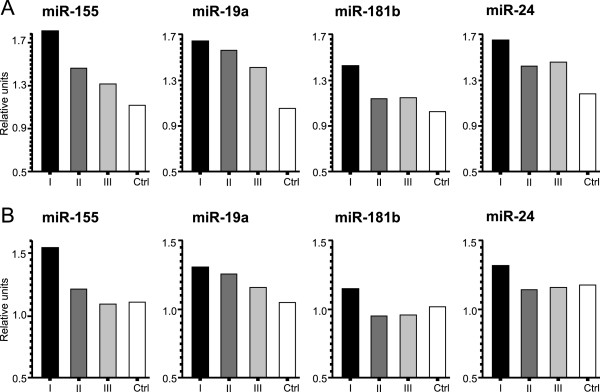
Aim of this project was to determine expression of miR-155, miR-19a, miR-181b, miR-24, relative to let-7a in sera of 63 patients with EBC and 21 healthy controls. Longitudinal multivariate data analysis was performed to stochastically model the serum levels of each of the oncomiRs during disease phases: from diagnosis, after surgery, and following chemo/radiotherapy. Moreover, this analysis was utilized to evaluate oncomiR levels in EBC patients subgrouped using current clinical prognostic factors including HER2, Ki-67, and grade III.
EBC patients significantly over-express the oncomiRs at the time of diagnosis. Following surgical resection the serum levels of miR-155, miR-181b, and miR-24 significantly decreased (p = 1.89e-05, 5.41e-06, and 0.00638, respectively) whereas the miR-19a decreased significantly after the therapy (p = 0.00869). Furthermore, in case of high-risk patients serum levels of miR-155, miR-19a, miR-181b, and miR-24 are significantly more abundant in comparison to low-risk group (p = 0.026, 0.02567, 0.0250, and 0.00990) and show a decreasing trend upon therapy.
OncomiRs are significantly more abundant in the sera of EBC patients compared to controls at diagnosis. Differences in oncomiR levels reflecting EBC risk were also observed. Testing the oncomiRs may be useful for diagnostic purpose and possibly also for relapse detection in follow-up studies of EBC.
微小RNA(miR)是一类独特的基因表达转录后调节因子,在血清中具有显著的稳定性。几种miR具有致癌性(致癌miR),在乳腺癌发病机制中失调,并发挥抑制肿瘤抑制因子的作用。对这些循环肿瘤衍生产物进行常规血液监测可能对早期乳腺癌(EBC)患者的诊断和复发检测具有显著益处。
本项目的目的是确定63例EBC患者和21名健康对照者血清中miR-155、miR-19a、miR-181b、miR-24相对于let-7a的表达。进行纵向多变量数据分析,以随机模拟疾病各阶段(从诊断、手术后以及化疗/放疗后)每种致癌miR的血清水平。此外,该分析用于评估根据HER2、Ki-67和III级等当前临床预后因素分组的EBC患者中的致癌miR水平。
EBC患者在诊断时显著过度表达致癌miR。手术切除后,miR-155、miR-181b和miR-24的血清水平显著下降(分别为p = 1.89e-05、5.41e-06和0.00638),而miR-19a在治疗后显著下降(p = 0.00869)。此外,在高危患者中,miR-155、miR-19a、miR-181b和miR-24的血清水平与低危组相比显著更高(p = 0.026、0.02567、0.0250和0.00990),并且在治疗后呈下降趋势。
与对照组相比,EBC患者血清中的致癌miR在诊断时显著更为丰富。还观察到反映EBC风险的致癌miR水平差异。检测致癌miR可能对诊断有用,并且在EBC的后续研究中可能对复发检测也有用。