Cui Hongying, Su Jianwei, Wei Jianing, Hu Yongjian, Ge Feng
1] State Key Laboratory of Integrated Management of Pest Insects and Rodents, Institute of Zoology, Chinese Academy of Sciences, Beijing 100101, PR of China [2] College of Life Science, Yangtze University, Hubei 434023, PR of China.
State Key Laboratory of Integrated Management of Pest Insects and Rodents, Institute of Zoology, Chinese Academy of Sciences, Beijing 100101, PR of China.
Sci Rep. 2014 Jun 18;4:5350. doi: 10.1038/srep05350.
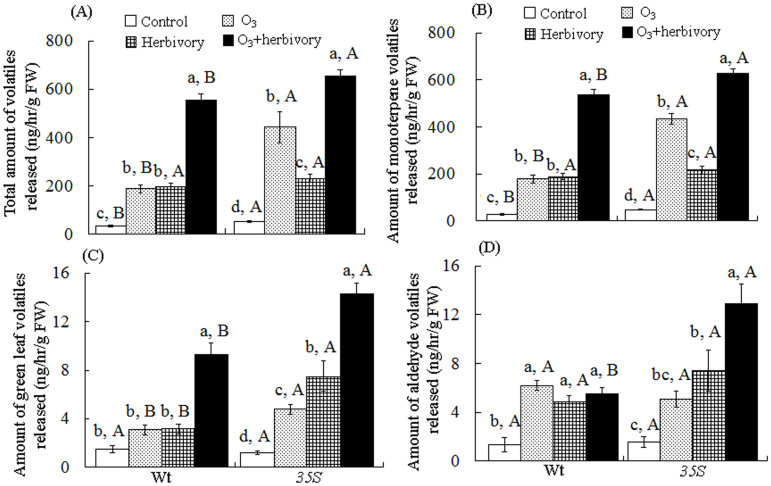
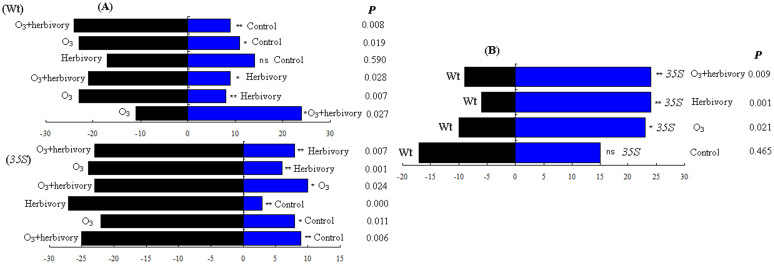
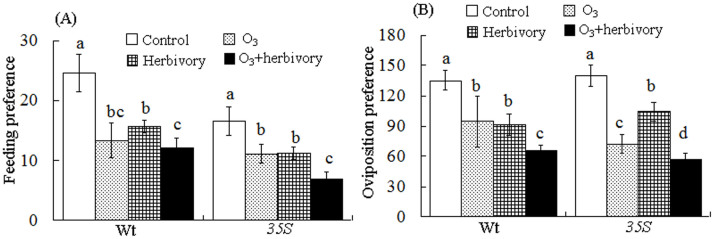
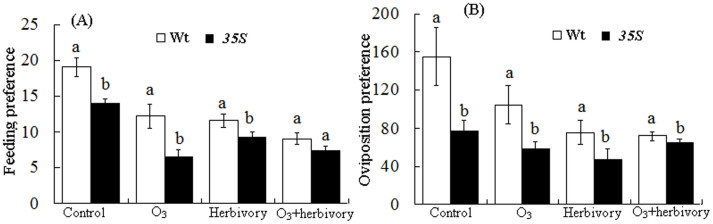
We experimentally examined the effects of elevated O₃ and whitefly herbivory on tomato volatiles, feeding and oviposition preferences of whiteflies and behavioural responses of Encarsia formosa to these emissions on two tomato genotypes, a wild-type (Wt) and a jasmonic acid (JA) defence-enhanced genotype (JA-OE, 35S). The O₃ level and whitefly herbivory significantly increased the total amount of volatile organic compounds (VOCs), monoterpenes, green leaf volatiles (GLVs), and aldehyde volatiles produced by tomato plants. The 35S plants released higher amount of total VOCs and monoterpene volatiles than Wt plants under O₃+herbivory treatments. The feeding and oviposition bioassays showed that control plants were preferred by adult whiteflies whereas the 35S plants were not preferred by whiteflies. In the Y-tube tests, O₃+herbivory treatment genotypes were preferred by adult E. Formosa. The 35S plants were preferred by adult E. formosa under O₃, herbivory and O₃+herbivory treatments. Our results demonstrated that elevated O₃ and whitefly herbivory significantly increased tomato volatiles, which attracted E. formosa and reduced whitefly feeding. The 35S plants had a higher resistance to B. tabaci than Wt plant. Such changes suggest that the direct and indirect defences of resistant genotypes, such as 35S, could strengthen as the atmospheric O₃ concentration increases.
我们通过实验研究了高浓度臭氧(O₃)和烟粉虱取食对番茄挥发性物质、烟粉虱的取食和产卵偏好以及丽蚜小蜂对这些挥发物的行为反应的影响,实验涉及两种番茄基因型,即野生型(Wt)和茉莉酸(JA)防御增强型基因型(JA - OE,35S)。臭氧水平和烟粉虱取食显著增加了番茄植株产生的挥发性有机化合物(VOCs)、单萜类、绿叶挥发物(GLVs)和醛类挥发物的总量。在臭氧 + 取食处理下,35S植株释放的总VOCs和单萜类挥发物比Wt植株更多。取食和产卵生物测定表明,成虫烟粉虱更喜欢对照植株,而不喜欢35S植株。在Y型管试验中,臭氧 + 取食处理的基因型更受丽蚜小蜂成虫青睐。在臭氧、取食以及臭氧 + 取食处理下,35S植株更受丽蚜小蜂成虫青睐。我们的结果表明,高浓度臭氧和烟粉虱取食显著增加了番茄挥发性物质,吸引了丽蚜小蜂并减少了烟粉虱的取食。35S植株对烟粉虱的抗性比Wt植株更高。这些变化表明,随着大气臭氧浓度的增加,抗性基因型(如35S)的直接和间接防御可能会增强。